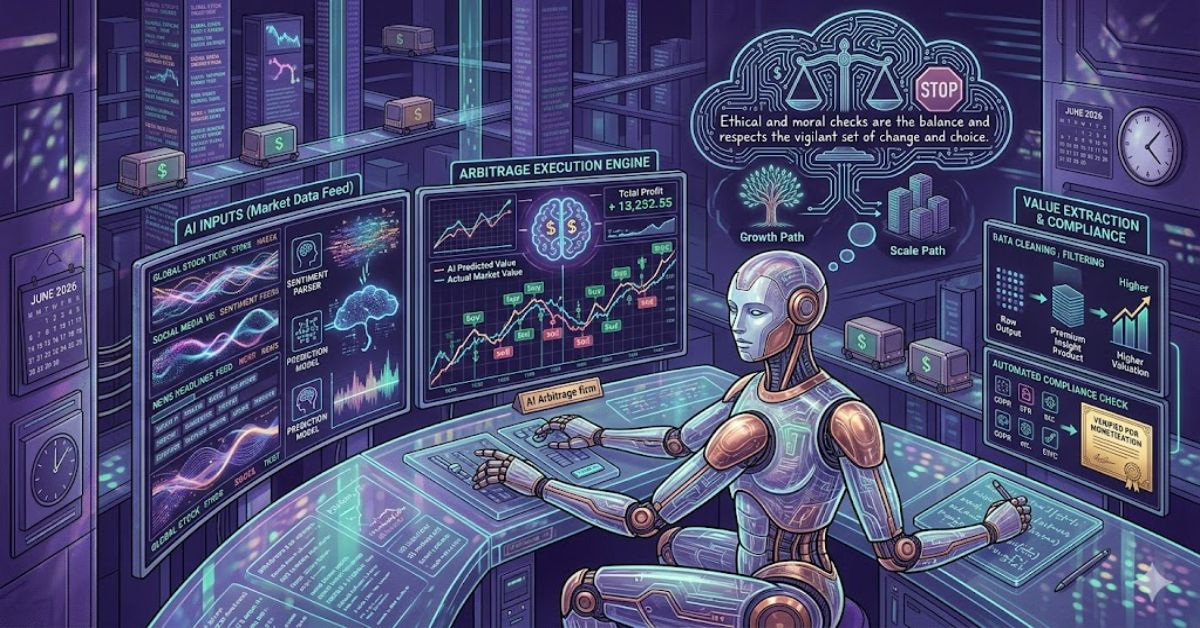
AI arbitrage has become one of the most discussed business opportunities of the past two years. At its core, the concept is simple: use artificial intelligence to dramatically reduce the time and cost required to complete a task while continuing to charge clients based on traditional market pricing. In other words, businesses “buy low” through AI efficiency and “sell high” by capturing the difference as profit.
The model has attracted freelancers, agencies, consultants, and start-ups looking to scale revenue without proportionally increasing labour costs. A content writer who once spent eight hours creating an article may now complete a draft in one hour using AI-assisted workflows. A marketing agency can produce campaign concepts faster. A developer can automate portions of coding and debugging. The economic advantage comes from retaining market pricing while reducing operational expenses.
Yet the conversation around AI-driven service arbitrage often focuses only on profit. The reality is more complex. Questions about quality, intellectual property, client expectations, and long-term sustainability are becoming increasingly important.
This article examines how the model works, where it creates genuine value, where it creates risk, and how it may evolve by 2027.
What Is AI Arbitrage?
AI arbitrage is the practice of leveraging artificial intelligence tools to perform work more efficiently than traditional methods while charging customers based on established market rates rather than the reduced production cost.
Traditional arbitrage involves exploiting price differences between markets. AI arbitrage applies the same principle to labour and productivity.
Basic Example
Consider a freelance copywriter:
| Traditional Workflow | AI-Assisted Workflow |
| 8 hours of research and writing | 2 hours using AI research and drafting tools |
| £400 project fee | £400 project fee |
| Higher labour cost | Lower labour cost |
| Smaller margin | Larger margin |
The client still receives the deliverable they requested. The difference lies in how efficiently it was produced.
Why AI Arbitrage Has Exploded Since 2023
Several developments accelerated adoption.
Generative AI Accessibility
The release of advanced language models and image-generation systems made sophisticated AI tools available to small businesses and individuals.
Rising Demand for Digital Services
Businesses increasingly require:
- Blog content
- Social media management
- SEO services
- Customer support
- Data analysis
- Software development
Many organisations care more about outcomes than production methods.
Lower Entry Barriers
Historically, building a service agency required hiring staff. Today, a single operator can use multiple AI tools to replicate portions of a larger team’s output.
How the AI Arbitrage Model Works
The process typically follows four stages.
Stage 1: Client Acquisition
A freelancer or agency secures a client at standard market pricing.
Stage 2: AI-Assisted Production
AI tools perform portions of the work:
- Drafting content
- Generating code
- Analysing data
- Creating graphics
- Producing marketing assets
Stage 3: Human Enhancement
The operator reviews, edits, verifies, and improves outputs.
Stage 4: Delivery
The final product is delivered at a market rate despite lower production costs.
This distinction is critical. Successful operators do not merely copy AI outputs. They add expertise, editing, strategy, and accountability.
Common AI Arbitrage Business Models
Content Marketing Agencies
Agencies use AI for:
- Research
- Content outlines
- Draft generation
- SEO optimisation
Human editors then refine the material.
Social Media Services
AI assists with:
- Caption generation
- Content calendars
- Audience research
- Trend monitoring
Web Development
Developers use AI coding assistants to accelerate:
- Front-end development
- Bug fixing
- Documentation
- Testing
Customer Support
AI-powered chatbots reduce staffing costs while maintaining service availability.
Consulting
Consultants increasingly use AI to accelerate analysis and report generation while providing strategic recommendations themselves.
Comparison of Traditional Services vs AI-Enhanced Services
| Factor | Traditional Model | AI Arbitrage Model |
| Labour Requirement | High | Lower |
| Delivery Speed | Moderate | Fast |
| Scalability | Limited by staff | Enhanced by automation |
| Profit Margin | Moderate | Potentially higher |
| Quality Control Need | Medium | Very high |
| Barrier to Entry | Higher | Lower |
| Competitive Pressure | Moderate | Increasing |
The Strategic Advantages
Increased Profit Margins
The most obvious benefit is improved margin.
If a task previously required ten billable hours and now requires three, businesses retain more profit without raising prices.
Faster Delivery
Speed often becomes a competitive advantage.
Many clients value turnaround time as much as price.
Greater Scalability
A freelancer managing five clients may be able to support fifteen clients using automation-assisted workflows.
Expanded Service Offerings
Businesses can offer services previously outside their expertise by leveraging specialised AI tools.
Three Overlooked Risks of AI Arbitrage
Most articles focus on earnings potential. The larger story lies in the risks.
1. Commoditisation Risk
As AI becomes widely available, efficiency advantages shrink.
A service that generates exceptional profits today may become highly competitive tomorrow.
The true competitive advantage shifts from AI access to business expertise.
2. Quality Degradation
Many operators assume AI automatically produces professional work.
In reality:
- Hallucinations occur
- Data may be outdated
- Sources may be inaccurate
- Context can be misunderstood
Without human oversight, quality can deteriorate quickly.
3. Client Trust Issues
Some clients expect transparency regarding AI usage.
Failure to disclose extensive automation may create reputational challenges if discovered.
A Practical Observation From Agency Workflows
One consistent trend across marketing and consulting sectors is that AI dramatically improves first drafts but rarely replaces final review.
Agencies that achieve the strongest margins typically use AI for repetitive production while retaining human control over:
- Strategy
- Brand voice
- Compliance checks
- Client communication
The businesses struggling with client retention often rely too heavily on raw AI output.
This distinction represents one of the most important lessons emerging from the market.
The Ethics of AI Arbitrage
The ethical debate centres on a simple question:
Should clients know AI was used?
Opinions vary.
Argument for Disclosure
Some clients believe production methods influence value.
Transparency helps maintain trust.
Argument Against Mandatory Disclosure
Others argue that clients purchase outcomes, not workflows.
A company does not typically disclose every software tool used during production.
The answer often depends on:
- Industry standards
- Contract requirements
- Client expectations
- Regulatory obligations
Real-World Impact on Labour Markets
AI arbitrage is already affecting employment patterns.
Positive Effects
- Lower business costs
- Increased entrepreneurship
- Greater productivity
- Faster innovation
Negative Effects
- Reduced demand for entry-level roles
- Pressure on freelance pricing
- Market saturation
- Increased competition
The impact resembles previous technology shifts where automation changed job structures rather than eliminating work entirely.
Structured Market Insight Table
| Sector | AI Adoption Level | Arbitrage Opportunity | Long-Term Sustainability |
| Content Marketing | High | High | Moderate |
| Graphic Design | High | Moderate | Moderate |
| Software Development | Moderate | High | High |
| Customer Support | Very High | High | High |
| Consulting | Moderate | Moderate | High |
| SEO Services | High | High | Moderate |
Compliance and Regulatory Considerations
Businesses operating in the UK and Europe should monitor several developments.
Data Protection
AI systems handling customer information must comply with:
- UK GDPR
- Data Protection Act 2018
Intellectual Property
Questions remain regarding:
- Training data usage
- Copyright ownership
- AI-generated content rights
Emerging AI Regulation
The European Union’s AI Act represents one of the most significant regulatory developments affecting AI deployment and transparency requirements.
Businesses relying heavily on automated workflows may face additional compliance obligations over time.
The Future of AI Arbitrage in 2027
By 2027, AI arbitrage is unlikely to disappear. However, it may look very different.
Several trends are emerging.
Margin Compression
As AI tools become standard, simple efficiency gains will no longer provide a competitive advantage.
Expertise Premium
Clients will increasingly pay for:
- Strategic thinking
- Industry knowledge
- Human judgement
- Risk management
rather than content production alone.
Regulation Growth
Governments are introducing frameworks focused on transparency, accountability, and data governance.
Hybrid Human-AI Firms
The most successful organisations will likely combine:
- AI automation
- Human expertise
- Strong quality assurance
- Domain-specific knowledge
Rather than replacing professionals, AI may become an invisible productivity layer behind premium services.
Key Takeaways
- AI arbitrage converts efficiency gains into profit by reducing labour costs.
- The model works best when AI supports human expertise rather than replacing it.
- Content creation, development, consulting, and support services are leading adoption sectors.
- Quality control remains the biggest operational challenge.
- Market competition is likely to compress margins over time.
- Transparency and trust will become increasingly important differentiators.
- Long-term winners will combine automation with specialised expertise.
Conclusion
AI arbitrage represents one of the most significant business opportunities created by modern artificial intelligence. The model is straightforward: use technology to perform work more efficiently while maintaining pricing aligned with traditional market expectations. For entrepreneurs, freelancers, and agencies, this can create substantial profit advantages.
However, efficiency alone is not a sustainable strategy. As AI adoption becomes widespread, the competitive edge shifts away from access to tools and towards expertise, judgement, and execution quality. Businesses that simply automate outputs risk becoming interchangeable. Those that use automation to strengthen professional services can create lasting value.
The next phase of this market will be defined less by technology and more by trust. Clients increasingly want reliable outcomes, expert guidance, and accountability. AI can accelerate production, but it cannot replace credibility.
The businesses most likely to thrive by 2027 will not be those using the most AI. They will be those using it most intelligently.
FAQ
What is AI arbitrage in simple terms?
AI arbitrage is the practice of using artificial intelligence to complete work faster and cheaper while charging clients standard market rates, allowing businesses to increase profit margins.
Is AI arbitrage legal?
Yes, using AI tools is generally legal. However, businesses must comply with data protection laws, intellectual property regulations, and industry-specific requirements.
Which industries benefit most from AI-assisted service delivery?
Content marketing, software development, customer support, consulting, SEO, and digital design currently offer some of the strongest opportunities.
Do clients know when AI is used?
Sometimes. Some providers disclose AI usage, while others focus on delivering results regardless of production methods. Expectations vary by industry and contract.
Can beginners start an AI-based service business?
Yes, but success requires more than access to AI tools. Domain knowledge, quality control, sales skills, and client management remain critical.
Will AI arbitrage still work in 2027?
Probably, although margins may decline as AI adoption becomes widespread. Expertise and strategic value will likely become more important than automation itself.
Methodology
This analysis was developed using publicly available information from regulatory bodies, AI industry research, business case studies, and market observations published between 2023 and 2025. The article focuses on business applications rather than promotional claims.
Sources were selected based on relevance to artificial intelligence adoption, productivity economics, labour market impacts, and regulatory developments. Where future projections are discussed, they are based on documented industry trends rather than guarantees.
Limitations include the rapidly changing nature of AI technology and varying business practices across industries. Readers should independently verify regulatory and legal requirements applicable to their jurisdiction.
Editorial Disclosure: This article was drafted with AI assistance and reviewed and verified by the editorial team at RubbleMagazine.co.uk. All data, citations, and claims should be independently confirmed before publication.
References
European Parliament. (2024). Artificial Intelligence Act. European Union.
International Monetary Fund. (2024). Gen-AI: Artificial Intelligence and the Future of Work. IMF.
McKinsey & Company. (2024). The State of AI in Early 2024.
Organisation for Economic Co-operation and Development (OECD). (2024). Artificial Intelligence, Productivity and Labour Markets.
UK Information Commissioner’s Office. (2024). Guidance on AI and Data Protection. ICO.
World Economic Forum. (2025). Future of Jobs Report 2025. World Economic Forum.