How do the characteristics of mother and father pass down to a child? The answer involves both genetics and the environment in which a child grows. A child receives genetic material from each biological parent, and this inherited information influences many physical features and aspects of biological development. However, a child’s personality, behaviour, abilities and health are not determined by genes alone.
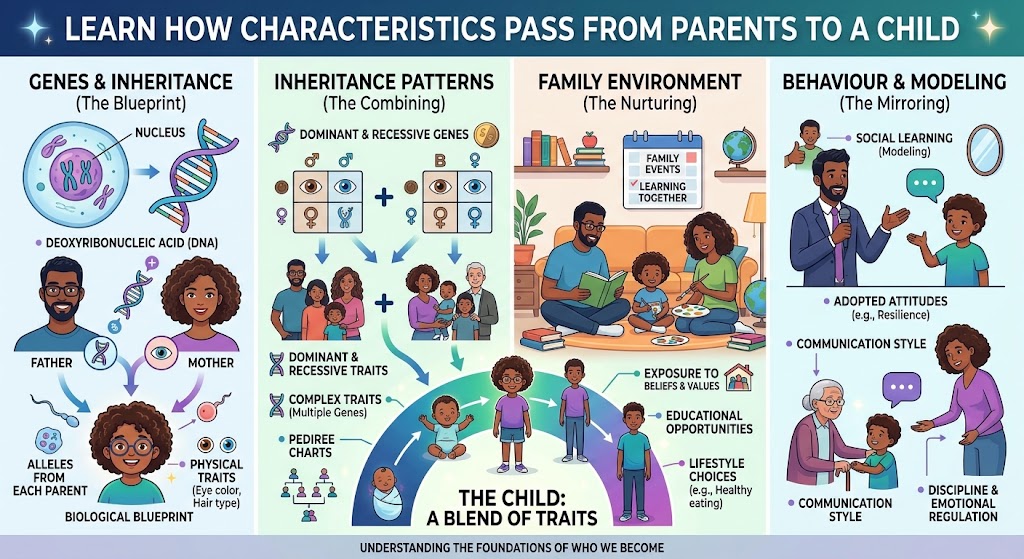
Genes are sections of DNA that carry instructions used by the body. A child typically inherits one copy of each chromosome in a pair from the mother and the other from the father. These genetic combinations help explain why children may resemble both parents, look more like one parent in certain ways or display traits that are not immediately obvious in either.
The family environment also matters. Children learn language, social habits, emotional responses and everyday routines through their relationships and experiences. Parents can influence these areas through communication, support, boundaries and the examples they set. Wider influences, including education, friendships, culture and living conditions, also contribute to development.
Understanding this distinction helps explain why siblings raised in the same home can still differ in appearance, temperament and interests. They inherit different combinations of genetic variants and may experience family life in different ways.
There is no single rule that assigns all physical traits to the mother and all others to the father, or vice versa. Most characteristics arise from several interacting factors. Examining genetic inheritance alongside parenting and environmental influences offers a clearer picture of how children develop.
How Genetic Inheritance Works
A child receives approximately half of their nuclear DNA from each biological parent. This does not mean that a child will look exactly 50% like the mother and 50% like the father. Inheritance involves many genes, and their effects differ depending on the trait.
Genes contain instructions that help cells produce proteins and regulate biological processes. Different versions of a gene, known as alleles, can contribute to differences in physical features and health. Some traits follow relatively simple inheritance patterns, while others involve many genes working together.
For example, certain inherited conditions are linked to changes in a single gene. Other characteristics, such as height and skin pigmentation, involve multiple genetic variants and environmental factors. This complexity explains why predicting a child’s exact appearance from the parents alone is difficult (MedlinePlus Genetics, n.d.).
Dominant and Recessive Inheritance
Dominant and recessive inheritance describes how some genetic variants influence particular traits or conditions.
- Dominant inheritance: One copy of a particular gene variant may be sufficient to produce a specific effect.
- Recessive inheritance: A condition may occur when a child inherits relevant variants in both copies of a gene.
- Polygenic inheritance: Many genes contribute to a characteristic, each potentially having a small effect.
These patterns should not be treated as universal rules for every physical feature. Eye colour, for example, is influenced by several genes rather than a simple brown-dominant, blue-recessive formula.
A parent may carry a recessive variant without showing the associated condition. If both parents carry variants affecting the same gene, their child may inherit a combination that causes a genetic condition. The probability depends on the specific inheritance pattern and family circumstances.
Characteristics Children May Inherit from Their Parents
| Characteristic | Genetic influence | Environmental influence |
| Eye colour | Strong | Limited direct influence |
| Hair texture | Strong | Hair care and styling affect appearance |
| Height | Substantial, involving many genes | Nutrition, health and childhood conditions |
| Skin pigmentation | Multiple genes | Sun exposure can alter visible pigmentation |
| Blood group | Inherited gene variants | Generally little influence |
| Temperament | Multiple genetic influences | Relationships, experiences and surroundings |
| Learning abilities | Multiple genetic influences | Education, practice, nutrition and opportunities |
This table provides a general overview rather than a method for predicting an individual child. The balance between genetic and environmental influences varies by characteristic.
Physical Appearance
Children may inherit features associated with both parents, including hair texture, facial structure and aspects of skin pigmentation. However, siblings can receive different combinations of genetic variants, producing noticeable differences even within the same family.
Height is another example. Parental height can provide useful information about a child’s likely growth pattern, but it cannot determine the final result precisely. Nutrition, hormonal factors, illness and other conditions during development also matter.
Health and Genetic Conditions
Parents can pass on genetic variants associated with certain medical conditions. Family health history can therefore help healthcare professionals identify risks and decide whether genetic counselling or testing may be appropriate.
However, an inherited risk does not always mean a condition will develop. Some illnesses involve interactions between genes, lifestyle and environmental exposures. Understanding family history is useful, but it cannot replace professional medical assessment.
How Parents Influence Personality and Behaviour
Genetics is only part of the explanation for a child’s development. Children also learn through observation, relationships and repeated experiences. The way parents communicate, manage emotions and respond to difficulties can influence the behaviours children practise themselves.
A child who regularly sees adults resolve disagreements calmly may learn constructive ways to handle conflict. A supportive home can also help children develop confidence, emotional awareness and social skills. The US Centers for Disease Control and Prevention identifies warmth, predictable responses, routines and appropriate discipline as practices that support healthy development (CDC, 2026).
Temperament has a genetic component, but it does not determine a child’s future personality. A naturally cautious child can develop confidence with support and experience, while an outgoing child can learn patience and emotional regulation.
Three important distinctions follow:
- Inherited tendency is not destiny: A genetic influence can affect the likelihood of a characteristic without making its development inevitable.
- Parenting is not the only environmental influence: Teachers, friends, culture and wider social conditions also shape development.
- Similar behaviour does not prove genetic inheritance: Children may resemble their parents because they share both genes and a household environment.
The Future of Understanding Parental Traits in 2027
By 2027, genetic research is likely to continue improving knowledge of inherited conditions and complex human traits. Genetic testing may help some families understand specific medical risks, although results require careful interpretation.
Research into gene–environment interactions will also remain important. Scientists are investigating how biological differences interact with experiences during childhood, but complex characteristics cannot be reduced to a single gene or parenting practice.
Genetic testing cannot reliably predict every aspect of a child’s personality, intelligence or future achievements. Families should be cautious about services promising precise predictions from limited DNA information.
The most useful approach combines evidence-based healthcare with supportive caregiving. Genetic information can explain certain inherited risks, while attention to nutrition, education, safety and emotional wellbeing helps support healthy development.
Key Takeaways
- Children inherit genetic material from both biological parents.
- Most complex physical and behavioural characteristics involve multiple influences.
- Siblings can differ because they inherit different genetic combinations.
- Family environment affects learning, emotional development and behaviour.
- Genetic risk does not always mean a health condition will develop.
- Supportive parenting can encourage healthy development without guaranteeing a particular outcome.
Conclusion
Understanding how the characteristics of mother and father pass to a child requires looking at genetics and environmental influences together. Inherited DNA contributes to physical appearance, biological development and susceptibility to certain health conditions. At the same time, parenting, education, relationships and life experiences influence how children learn, behave and develop.
No single parent determines every characteristic. A child may resemble one parent physically while sharing the temperament or habits of the other. Even siblings can develop very differently because they inherit different combinations of genetic variants and experience life in individual ways.
The distinction between inheritance and influence is important for families. Genes provide part of the biological foundation, but they do not define a child’s entire future. A safe environment, consistent care, appropriate healthcare and opportunities to learn can support development across childhood. Recognising both sides of the process encourages realistic expectations and helps parents focus on what they can influence while respecting the individual differences every child brings.
Frequently Asked Questions
How do the characteristics of mother and father pass to a child?
A child inherits nuclear DNA from both biological parents. This genetic material influences physical traits and aspects of health, while environmental and behavioural influences contribute to development.
Does a child inherit more characteristics from the mother or father?
Neither parent universally contributes more inherited characteristics. A child typically receives half of their nuclear DNA from each biological parent, although individual traits follow different inheritance patterns.
Can a child inherit personality traits from both parents?
Yes. Temperament has genetic influences, but personality and behaviour also develop through relationships, experiences, education and the surrounding environment.
Why do siblings look different despite having the same parents?
Siblings generally inherit different combinations of genetic variants. Environmental experiences can also differ, contributing to differences in appearance, interests and behaviour.
Can parents influence a child’s intelligence?
Parents can support learning through communication, education, encouragement, nutrition and access to learning opportunities. Intelligence also has genetic influences and cannot be predicted from parenting alone.
Are all inherited characteristics visible at birth?
No. Some inherited characteristics become apparent as a child grows, while others influence health risks or biological processes without producing an obvious visible feature.
References
- Centers for Disease Control and Prevention. (2026, 29 January). Healthy Habits: Child Development.
- MedlinePlus Genetics. (n.d.). Genetics and Human Traits.
- MedlinePlus Genetics. (n.d.). What are the different ways a genetic condition can be inherited?
- MedlinePlus Genetics. (n.d.). Is temperament determined by genetics?
Methodology
This article characteristics of mother and father draws on educational genetics resources from MedlinePlus and child-development guidance from the CDC. It distinguishes established inheritance principles from broader explanations of behaviour and personality. No original genetic testing, clinical assessment or firsthand research was conducted. Genetic outcomes vary by individual and family history, so readers concerned about inherited medical conditions should consult a qualified healthcare professional or genetic counsellor.