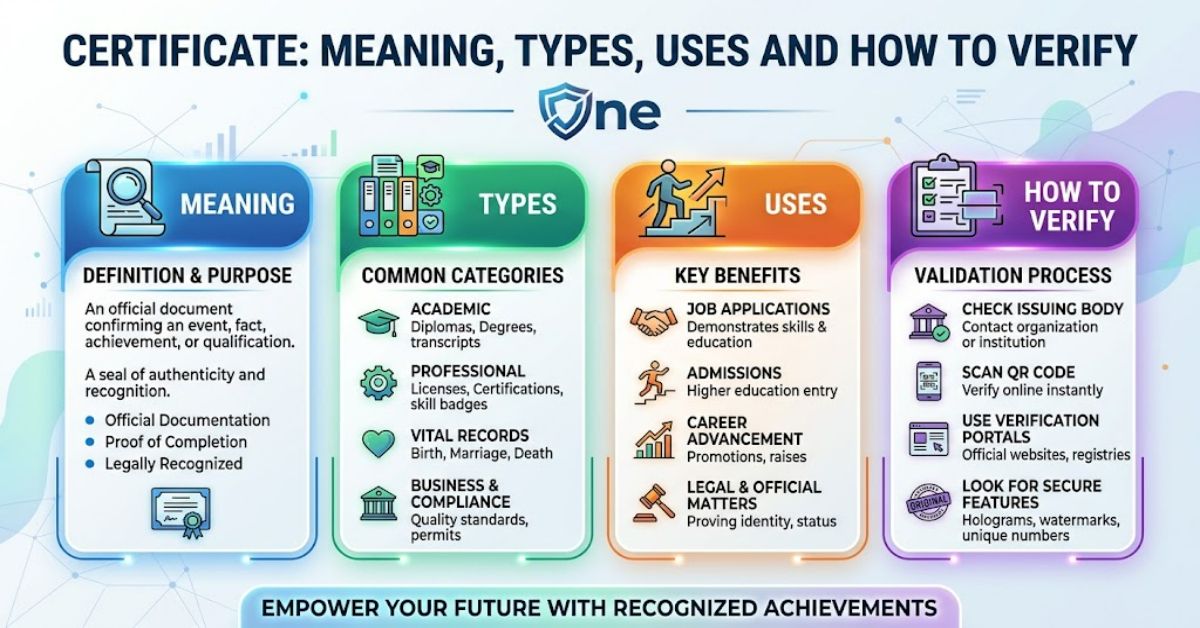
A certificate is a written or printed document that provides evidence of a fact, status, qualification, ownership or completed course. It can confirm that someone has passed an examination, completed professional training, registered a birth or met a specific requirement. Certificates are used across education, employment, government administration and commercial transactions.
Although the term sounds straightforward, not every certificate serves the same purpose. An educational certificate may demonstrate academic achievement, while a birth certificate records a legally recognised event. A professional certificate may indicate completion of training without granting a regulated licence to practise a particular occupation.
Understanding these differences matters because certificates are frequently used to make decisions. Employers assess qualifications, universities evaluate applications, government departments process records, and businesses rely on documents to establish compliance or ownership.
The document’s appearance alone does not establish its authenticity. A professionally designed certificate can still contain inaccurate information or come from an unrecognised organisation. Equally, a legitimate digital certificate may have no traditional paper counterpart.
The most useful approach is to examine three things: what the document proves, who issued it and how its claims can be verified. These checks help establish whether a credential meets the requirements of the person or organisation receiving it.
This guide explains the main types of certificates, their practical uses, the differences between paper and digital records, common risks and the verification steps readers should understand before relying on one.
Main Types of Certificates and Their Uses
Certificates vary according to the claim they establish. Identifying the document’s purpose is the first step towards understanding its legal, professional or practical value.
| Type | What it establishes | Common use |
| Educational | Completion of a course or qualification | Employment and further study |
| Professional | Training, competence or professional achievement | Career development |
| Civil | A registered life event or civil status | Administrative and legal procedures |
| Ownership | Evidence relating to an asset or registered interest | Property and business transactions |
| Digital | Identity or cryptographic information | Secure online communications |
| Compliance | Completion of a required inspection or standard | Business and regulatory processes |
A crucial distinction is that a certificate does not automatically grant permission to practise a profession, own an asset or perform regulated work. Its effect depends on the issuing body’s authority and the applicable rules.
How Certificates Work in Education and Employment
Educational credentials help institutions and employers assess a person’s learning. They may record the qualification awarded, the institution, the date of completion and, where relevant, grades or the level achieved.
Professional certificates serve a related but different purpose. They can demonstrate completion of specialised training, such as project management, workplace safety or information security. However, employers may distinguish between a short-course certificate, an accredited qualification and a licence required by law.
International applicants face an additional challenge: qualifications do not always map neatly between education systems. UK ENIC evaluates eligible overseas qualifications and provides Statements of Comparability to explain how they compare with UK education systems. Its guidance makes clear that these statements are not legal documents and that employers or educational institutions make the final decisions about acceptance.
UK ENIC
+1
This creates an important practical lesson. Before paying for a course or requesting document authentication, check the exact credential the receiving organisation requires. A certificate that is genuine may still be unsuitable for a particular application.
Paper Certificates Compared with Digital Credentials
Paper documents remain useful where original records, physical signatures or official stamps are required. Digital credentials, meanwhile, can simplify sharing and verification, particularly when organisations use secure issuing systems.
| Consideration | Paper document | Digital credential |
| Accessibility | Physical possession or certified copy may be needed | Can often be shared remotely |
| Verification | May require contacting the issuer | May support online or cryptographic checks |
| Main risk | Loss, damage or physical alteration | Account compromise or misleading digital copies |
| Storage | Requires secure physical storage | Requires secure electronic storage |
| Acceptance | Depends on recipient requirements | Depends on recipient requirements and format |
Digital certificates also have a specific meaning in cybersecurity. A public-key certificate binds an identity to a public key and is digitally signed by a trusted certification authority. Such certificates help systems authenticate identities and establish secure communications. They are different from ordinary training or achievement documents.
CSRC
+1
The format alone does not determine reliability. A PDF displaying a logo is not necessarily an authenticated credential, while a properly signed digital document may provide stronger verification than an unverified paper copy.
How to Verify a Certificate
Verification should establish both authenticity and relevance. A sensible process involves several checks.
- Identify the issuer. Confirm the organisation’s full name and whether it has authority to issue the credential.
- Check the details. Review the holder’s name, qualification, issue date, reference number and any stated expiry date.
- Contact the issuing organisation. Use independently obtained contact details rather than relying exclusively on information printed on a suspicious document.
- Use official verification systems. Where available, check the issuer’s register, verification portal or digital signature.
- Confirm acceptance requirements. Ask the employer, university, regulator or government department whether the document meets its specific rules.
A further risk concerns the difference between authenticity and recognition. An organisation might genuinely issue a certificate without its qualification being accredited or accepted by a particular employer. Both questions must be answered before relying on the document.
For international use, additional authentication may be necessary. UK government guidance explains that certain documents can be legalised through an apostille, which confirms that relevant signatures, stamps or seals match official records. Legalisation does not itself guarantee that the destination organisation will accept the document’s contents.
GOV.UK
The Future of Certificates in 2027
By 2027, digital credential systems are likely to remain important as organisations seek faster recruitment, remote education and more reliable identity checks. However, the pace of adoption will vary across countries, institutions and industries.
Cryptographic verification can help establish whether a digital credential has been altered and whether it was signed by the expected issuer. It cannot independently prove that the underlying qualification is recognised for every purpose. Trust still depends on sound issuing procedures, secure systems and clear acceptance standards.
Paper records will also remain relevant where local procedures require originals or where digital infrastructure is limited. The practical direction is therefore likely to be coexistence rather than an immediate, universal shift to electronic-only documents.
Key Takeaways
- Purpose matters: Understand exactly what the document confirms before relying on it.
- Issuer credibility is essential: A certificate’s value depends partly on the authority and recognition of its issuer.
- Verification prevents avoidable problems: Check details through independent, official channels.
- Format is not proof: Neither paper nor digital presentation guarantees authenticity.
- Acceptance is separate: A genuine credential may not satisfy every employer, regulator or institution.
- International use requires planning: Translation, comparability or legalisation may be necessary.
Frequently Asked Questions
What is a certificate used for?
It provides evidence of a qualification, achievement, status, ownership or other stated fact. Its precise purpose depends on the document and the authority that issued it.
How can I check whether a certificate is genuine?
Contact the issuing organisation using independently verified details. Check any official register, reference number or digital signature available, and confirm the credential’s acceptance with the receiving organisation.
Does a certificate expire?
Some remain valid indefinitely, while others have an expiry date or require renewal. The rules depend on the type of credential, issuer and intended use.
Is a certificate the same as a diploma?
Not necessarily. A diploma usually refers to a particular educational award, while a certificate can cover many different kinds of records and achievements. Terminology varies between countries and institutions.
Can a digital certificate be accepted as an official document?
Yes, where the relevant institution or authority accepts its format and verification method. Requirements should be checked before submission.
Do international qualifications need certification in the UK?
Some applications require qualification comparisons, certified translations or legalisation. The exact requirements depend on the document, its origin and the organisation requesting it.
Conclusion
Certificates help people and organisations establish facts, demonstrate achievements and meet administrative requirements. Their usefulness extends from education and employment to legal records, ownership documentation and cybersecurity. Yet a document’s appearance is only one part of its credibility.
The more important questions concern who issued it, what it actually proves and whether the intended recipient recognises it. These distinctions can prevent wasted fees, unsuccessful applications and reliance on misleading credentials.
Digital systems offer opportunities for faster verification, but they do not remove the need for trusted issuers and clear standards. Paper documents also retain a place in processes that require originals or formal authentication.
Ultimately, a reliable approach combines careful document handling with independent verification. Understanding the limits of a credential is just as important as understanding its benefits. When authenticity, recognition and purpose are assessed together, certificates become more useful evidence for informed decisions.
Methodology
This article draws on official guidance from UK ENIC, the UK government and the US National Institute of Standards and Technology. These sources support the discussion of qualification comparability, legalisation and cryptographic certificates. No firsthand testing or interviews were conducted. Requirements differ by jurisdiction and receiving organisation, so readers should confirm current rules before submitting documents.
References
- National Institute of Standards and Technology. (n.d.). Public key certificate and public-key infrastructure glossary entries.
- UK Government. (2024). Documents for British people abroad.
- UK ENIC. (n.d.). Statement of Comparability.
- UK ENIC. (n.d.). How we check your qualifications.