The search phrase “Shiv and” is incomplete, but one of its most significant interpretations is Shiv and Shakti. The expression refers to the relationship between Shiva, often understood as pure consciousness or the principle of stillness, and Shakti, the dynamic power through which creation, transformation and activity become possible.
In many Hindu traditions, Shiv and Shakti are not best understood as two completely separate beings. Their relationship can instead represent complementary dimensions of reality. Shiva without Shakti is associated with stillness and potential, while Shakti represents movement, manifestation and energy.
This distinction explains why the phrase appears across religious philosophy, devotional practice and Indian art. It is not simply a story about a divine couple. It is also a symbolic framework for understanding how apparently opposite qualities can exist together.
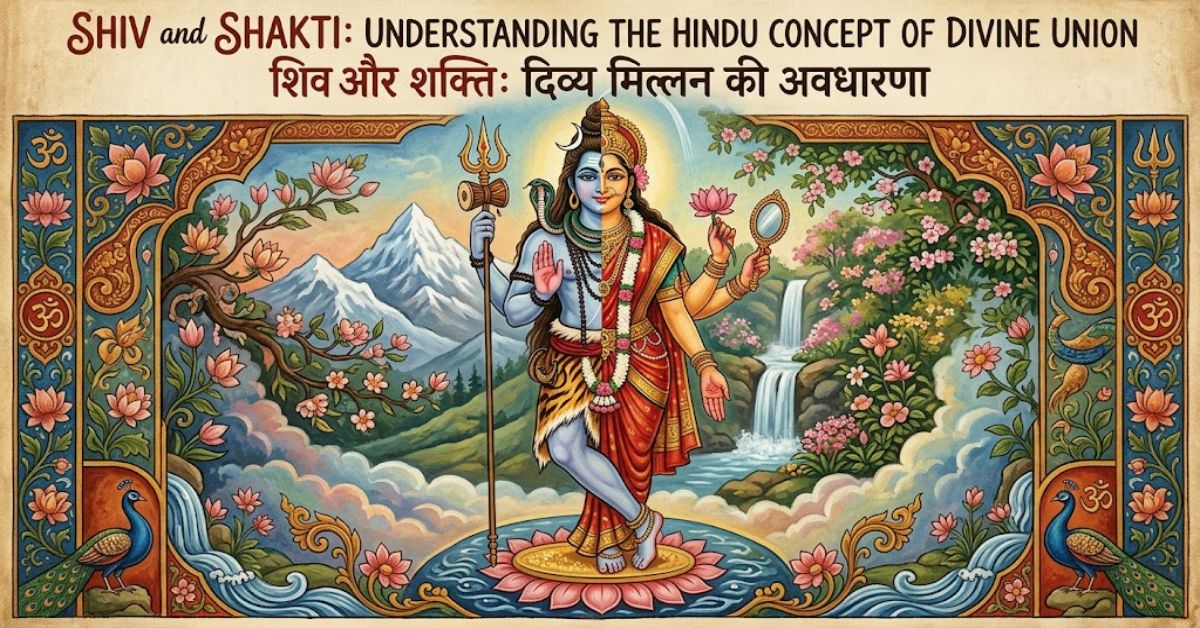
The idea is expressed especially powerfully through Ardhanarishvara, a form in which Shiva and the feminine divine are represented within a single body. The image challenges a simple division between masculine and feminine and instead presents them as interdependent.
Shiv and Shakti: Consciousness and Energy
A useful way to understand the concept is through the contrast between stillness and activity.
| Principle | Symbolic association | Broader meaning |
| Shiv | Consciousness, stillness | Awareness and potential |
| Shakti | Energy, movement | Creation and transformation |
| Union | Interdependence | Complete or manifested reality |
| Ardhanarishvara | Integrated masculine and feminine | Unity within apparent duality |
These descriptions should not be treated as rigid definitions. Hindu traditions contain numerous philosophical schools, and interpretations of Shiva and Shakti differ considerably.
In Shaktism, Shakti is central to religious understanding and is worshipped as the supreme divine power in forms such as Devi, Durga, Kali and Lalita. In Shaiva traditions, Shiva occupies the central position. Other traditions emphasise their inseparability.
That diversity is important. There is no single interpretation that can represent every Hindu community.
The deeper insight is that the two principles are frequently discussed together because creation requires both potential and activity. Symbolically, Shiv provides the still centre while Shakti represents the power that makes transformation possible.
Shiv and Parvati: The Mythological Relationship
Another common completion of “Shiv and” is Shiv and Parvati.
Parvati is one of the principal manifestations of the Goddess and is traditionally associated with Shiva as his consort. Their mythology appears across the Puranic tradition and has influenced religious storytelling, sculpture, painting and temple culture.
Their relationship includes themes of devotion, austerity, marriage, family and cosmic balance. It also differs from a conventional romantic narrative because their union has a wider theological significance.
Parvati’s devotion to Shiva is frequently portrayed alongside her own strength and spiritual agency. She is not merely presented as an accessory to Shiva. In different traditions, Parvati and her other manifestations can embody divine power in their own right.
Their family mythology also connects them with Ganesha and Kartikeya, making Shiva and Parvati central figures in the broader visual and devotional imagination of Hinduism.
Ardhanarishvara and the Idea of Wholeness
One of the most sophisticated representations of Shiv and Shakti is Ardhanarishvara.
The name is generally translated as “the Lord who is half woman”. The figure combines Shiva and the Goddess into a single form, usually dividing the body vertically into masculine and feminine aspects.
The symbolism can be interpreted at several levels.
At the simplest level, it represents unity. At a philosophical level, it questions whether apparently opposite categories can really exist independently. At a social and artistic level, it provides an extraordinary visual statement about complementarity.
Importantly, Ardhanarishvara should not be reduced to a modern claim that Hinduism simply teaches “gender equality”. The historical religious meanings are more complex. The image belongs to particular theological and artistic traditions, and its interpretation has changed across time and regions.
Its enduring power comes partly from that complexity.
Shiv and Shakti in Indian Art and Culture
The relationship has had a major influence on Indian visual culture.
Temple sculptures frequently portray Shiva with Parvati, while representations of Ardhanarishvara provide a more abstract expression of their relationship. Artists have used posture, jewellery, clothing, bodily proportions and attributes to distinguish the two sides of composite figures.
| Cultural form | Representation | Main significance |
| Temple sculpture | Shiva and Parvati | Divine partnership |
| Ardhanarishvara | Unified male-female form | Complementarity |
| Devotional art | Shiv and Shakti | Divine love and power |
| Dance traditions | Shiva-Shakti symbolism | Movement and cosmic rhythm |
| Festivals | Shiva and Parvati traditions | Devotion, marriage and spiritual renewal |
This symbolism remains visible beyond traditional temple settings. Contemporary paintings, digital art, dance performances and popular devotional media continue to reinterpret the pair.
That continuity demonstrates an important cultural point: religious symbols survive not because their meaning remains frozen, but because different generations find new ways to interpret them.
Why the Phrase “Shiv and” Can Be Confusing
The keyword itself presents an SEO and cultural challenge because “Shiv and” does not identify one subject.
Searchers may mean:
- Shiv and Shakti
- Shiv and Parvati
- Shiv and Sati
- Shiv and Ganesha
- Shiv and Kartikeya
- Shiv and Vishnu
- Shiv and Shankar in linguistic or devotional usage
This ambiguity is significant. Treating every search for “Shiv and” as a request for one specific relationship could produce an inaccurate answer.
For search intent, the strongest approach is to explain the principal interpretations while establishing Shiv and Shakti as the broader philosophical framework. Shiv and Parvati can then be understood as one of its most familiar mythological expressions.
The Future of Shiv and Shakti in 2027
By 2027, interest in Shiv and Shakti is likely to continue through a mixture of traditional worship, contemporary visual culture and digital communities.
The most interesting development is not simply the volume of devotional content online. It is the growing interaction between traditional iconography and contemporary design. Digital artists increasingly reinterpret familiar forms, while younger audiences encounter Hindu philosophical concepts through short videos, illustrations, music and educational content.
This creates both opportunity and risk. Digital distribution can make complex traditions accessible to people who have never encountered them before. It can also strip symbols from their historical context or reduce sophisticated theology to motivational slogans.
The strongest future interpretations will therefore balance accessibility with cultural accuracy.
Key Insights
- “Shiv and” is a broad search phrase rather than a complete religious concept.
- Shiv and Shakti provide a useful framework for understanding consciousness and dynamic energy.
- Shiv and Parvati represent the mythological and devotional dimension of the same wider religious universe.
- Ardhanarishvara demonstrates how Hindu art can express philosophical ideas through visual form.
- Different Hindu traditions interpret Shiva and Shakti differently, so no single explanation should be treated as universal.
- Contemporary digital culture is expanding access to these symbols while creating new questions about context and interpretation.
Conclusion
The phrase “Shiv and” opens into a much larger cultural and philosophical world. Most commonly, it can lead towards Shiv and Shakti or Shiv and Parvati, but these expressions represent different aspects of a complex religious tradition.
Shiv and Shakti are particularly important because their relationship goes beyond mythology. It provides a symbolic language for discussing consciousness, energy, stillness, activity and the relationship between apparently opposing principles. Shiv and Parvati make those ideas more personal through stories of devotion, marriage, family and transformation.
The enduring significance of these figures can also be seen in Ardhanarishvara, temple sculpture, devotional art and contemporary cultural expression. Their meanings vary between traditions, regions and historical periods, but the central theme of interdependence remains powerful.
Understanding Shiv and therefore requires more than identifying a divine pair. It means recognising the philosophical, mythological and artistic traditions that have allowed these symbols to remain relevant across centuries.
FAQ
What does Shiv and Shakti mean?
Shiv and Shakti commonly represent complementary principles of consciousness and dynamic energy. Their union is often used to express the relationship between stillness and creative activity.
Are Shiv and Parvati the same as Shiv and Shakti?
They are closely related but are not identical expressions. Parvati is a major manifestation of Shakti and is traditionally Shiva’s consort. Shiv and Shakti can therefore have a broader philosophical meaning.
What is Ardhanarishvara?
Ardhanarishvara is a composite form representing Shiva and the Goddess within one body. It symbolises the inseparability or complementarity of masculine and feminine divine principles.
Who is Shakti?
Shakti is a Sanskrit term associated with divine power or energy. In different Hindu traditions, Shakti may be understood as the Goddess herself or as the active power of a deity.
Why are Shiva and Parvati important in Hinduism?
Their mythology explores devotion, marriage, family, asceticism and divine power. They are also central to a large body of Indian religious art and storytelling.
Is Shiv and Shakti a philosophical concept?
Yes. Beyond devotional worship, the relationship can be interpreted philosophically as a union between consciousness and dynamic power, although interpretations vary between Hindu schools.
Methodology
This article treats the supplied keyword, “shiv and”, as an incomplete search phrase and uses the supplied keyword detail as the basis for interpreting its likely cultural intent. Because the keyword detail does not specify one particular duo, the article focuses on the two strongest interpretations: Shiv and Shakti, and Shiv and Parvati.
General cultural and religious claims were checked against established reference material concerning Hindu traditions, Shiva, Shakti, Parvati and Ardhanarishvara. The analysis does not claim firsthand field reporting, personal religious experience or original archaeological research. Interpretations can differ substantially between Hindu denominations, texts and regional traditions, which is an important limitation.
Editorial disclosure: This article was drafted with AI assistance and should be reviewed by a human editor for factual, cultural and theological accuracy before publication.
References
Flood, G. (1996). An Introduction to Hinduism. Cambridge University Press.
Kinsley, D. (1986). Hindu Goddesses: Visions of the Divine Feminine in the Hindu Religious Tradition. University of California Press.
Kinsley, D. (1988). Hinduism: A Cultural Perspective. Prentice-Hall.
Lorenzen, D. N. (Ed.). (2002). Religious Movements in South Asia 600–1800. Oxford University Press.
Pintchman, T. (2001). Seeking Mahadevi: Constructing the Identities of the Hindu Great Goddess. State University of New York Press.
Shulman, D. D. (1980). Tamil Temple Myths: Sacrifice and Divine Marriage in the South Indian Saiva Tradition. Princeton University Press.