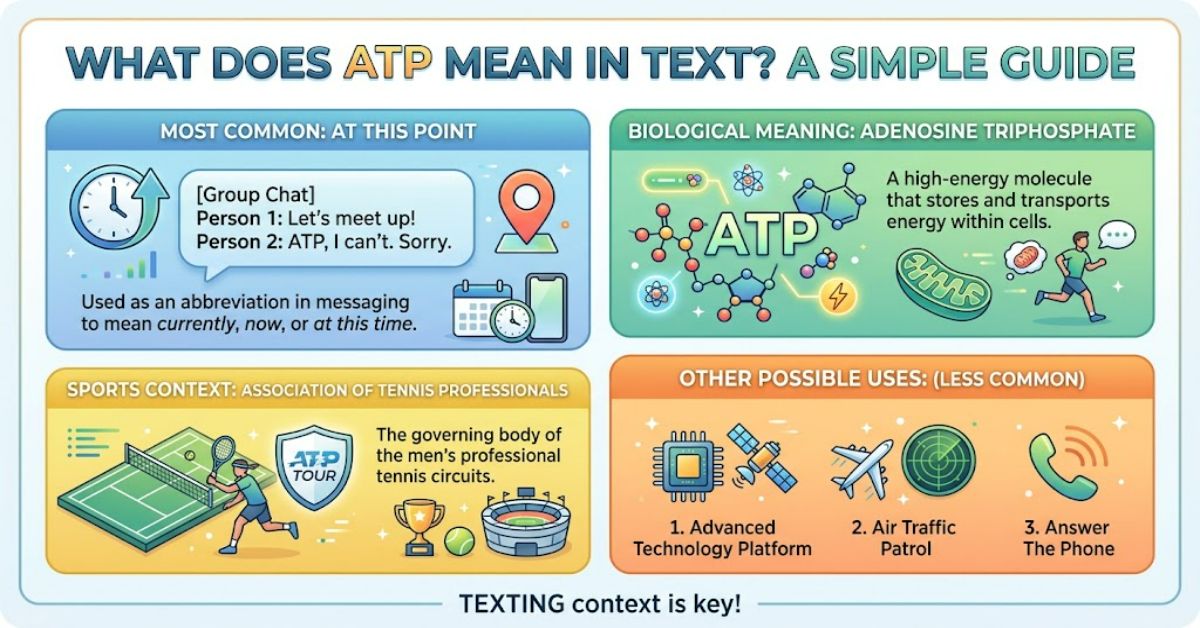
If you see someone write “ATP” in a text message, they most commonly mean “at this point.” The abbreviation is widely used in informal digital communication because it allows people to express a longer phrase quickly.
For example, someone might write, “ATP I just want to go home.” Here, ATP means “at this point”, suggesting that the person’s feelings or situation have reached a particular stage.
The abbreviation is especially suited to conversational writing. Texting, direct messages, comments and social media posts often favour short expressions that can be understood without formal sentences. Knowing what does ATP mean in text therefore comes down mainly to recognising the conversational context.
Unlike a formal abbreviation, ATP does not usually need capitalisation rules or punctuation in casual messages. People may write “ATP”, “atp” or use it alongside other texting abbreviations.
How ATP Is Used in Messages
ATP usually introduces a thought about someone’s current situation, attitude or decision. It can indicate that circumstances have changed or that the speaker has reached a particular point.
Consider these examples:
| Example | Meaning |
| “ATP I don’t even care.” | At this point, I don’t care. |
| “ATP we should just leave.” | At this point, leaving seems appropriate. |
| “I’m tired ATP.” | I’m tired at this point. |
| “ATP there’s nothing we can do.” | At this point, nothing can be done. |
The abbreviation can communicate frustration, acceptance, exhaustion, humour or determination. The emotional meaning comes from the rest of the message rather than from ATP itself.
This makes context particularly important. “ATP I’m going to bed” sounds different from “ATP I’m not answering him again”, even though the abbreviation has the same basic meaning.
Why People Use ATP
Digital communication encourages brevity. Typing “at this point” takes considerably more effort than typing three letters, particularly during fast conversations.
ATP also fits naturally into the informal style of social media. Users frequently combine abbreviations with shortened words, emojis and conversational punctuation. The result is writing that resembles spoken language more closely than traditional written English.
There is also a practical advantage. Because ATP is short, it can be inserted into a sentence without disrupting the rhythm of a message. A phrase such as “ATP I don’t know what to do” can feel more immediate than its fully written equivalent.
| Feature | ATP in casual texting |
| Full phrase | At this point |
| Typical setting | Texts, chats and social media |
| Register | Informal |
| Main function | Refers to the current stage or situation |
| Capitalisation | Usually ATP or atp |
| Meaning depends on context | Yes |
ATP Does Not Always Mean “At This Point”
Although “at this point” is the common texting meaning, ATP is not exclusive to internet slang.
In science, ATP is the abbreviation for adenosine triphosphate, a molecule involved in cellular energy transfer. In that context, a sentence such as “ATP provides energy for cellular processes” has nothing to do with texting language.
ATP can also appear as an abbreviation for organisations, programmes, technical terms and names. The surrounding subject therefore matters.
A useful rule is simple: if ATP appears in a casual conversation about feelings, plans or everyday events, “at this point” is usually the intended meaning. If it appears in a biology lesson, scientific article or technical document, another definition is likely.
Three Context Clues That Help
When interpreting ATP, readers can use three straightforward clues.
1. Look at the subject.
A conversation about relationships, work, plans or everyday problems is much more likely to use ATP as “at this point”.
2. Read the whole sentence.
The words immediately surrounding ATP usually reveal whether it describes a current situation.
3. Consider the platform.
Messaging apps, social networks and informal online communities commonly use abbreviations. Formal documents are less likely to use ATP in this sense.
These clues are more reliable than assuming every occurrence has the same definition.
Common Misunderstandings
One frequent mistake is assuming that ATP always refers to biology. The scientific abbreviation is well established, but online communication has its own vocabulary.
Another misunderstanding occurs when readers interpret ATP as a separate slang word rather than an abbreviation. In most casual examples, it simply replaces “at this point”.
For instance, “ATP I’m done explaining” is not describing a special action called “ATP”. It means that, given the current circumstances, the speaker has decided they are finished explaining.
The tone can also be misunderstood. ATP itself is neutral. The sentence around it determines whether the message sounds annoyed, humorous, resigned or matter-of-fact.
The Future of ATP in 2027
Informal abbreviations are likely to remain part of digital communication in 2027 because messaging continues to favour speed and conversational language. However, slang changes quickly. New abbreviations can gain popularity while older expressions become less common.
ATP has an advantage because “at this point” is a useful phrase in everyday conversation. Its meaning is intuitive once encountered in context, which can support continued use.
At the same time, language differs between communities and platforms. An abbreviation that is familiar to one age group or online community may be unfamiliar to another. Context will therefore remain important even when the abbreviation itself is widely recognised.
Key Insights
- ATP usually functions as a compact substitute for “at this point”.
- Its meaning is strongly connected to the sentence around it.
- ATP is particularly common in informal digital communication.
- The abbreviation does not automatically indicate a particular emotion.
- Scientific writing may use ATP to mean adenosine triphosphate instead.
- Platform, subject and surrounding vocabulary provide useful clues.
- Digital slang can change, so meanings should be interpreted in context.
Conclusion
Understanding what does ATP mean in text is straightforward in most casual conversations: ATP usually means “at this point”. People use it in messages and social media to describe their current situation, opinion, feeling or decision without typing the complete phrase.
Its simplicity is part of its usefulness. A short abbreviation can make a message faster while retaining the meaning of ordinary speech. However, ATP is not limited to internet slang. In biology and other technical settings, it can have completely different meanings.
The safest approach is therefore to consider the context before interpreting the abbreviation. In a casual message, “at this point” will usually make sense. In a specialist setting, the surrounding subject should determine the definition.
FAQ
What does ATP mean in text messages?
ATP most commonly means “at this point” in informal text messages. It is used to refer to a current situation, feeling, decision or stage of events.
What does ATP mean on social media?
On social media, ATP usually has the same meaning: “at this point”. Users often place it before a statement about how they currently feel or what they plan to do.
Is ATP slang?
ATP can be considered an informal abbreviation when it means “at this point”. It is common in digital communication but is not necessarily slang in every context.
Can ATP have another meaning?
Yes. In biology, ATP means adenosine triphosphate, a molecule involved in cellular energy transfer. Context determines which meaning applies.
Is ATP the same as “at this point”?
In casual texting, yes. ATP is generally used as a shortened form of “at this point”.
Should ATP be written in capital letters?
Both “ATP” and “atp” may appear in informal messages. Capitalisation usually does not change the intended texting meaning.
Methodology
This article treats the supplied keyword detail as the primary basis for the definition and explains its use through common conversational examples. The distinction between the texting meaning and specialist meanings is based on established terminology. No fabricated firsthand testing or personal experience is presented. Because informal language changes across communities, examples should be understood as illustrative rather than universal.
References
AmazingTalker. (n.d.). What does ATP mean in text? Language-learning and vocabulary resource.
National Human Genome Research Institute. (n.d.). Talking glossary of genetic terms. National Institutes of Health.
National Center for Biotechnology Information. (n.d.). Adenosine triphosphate. PubChem, U.S. National Library of Medicine.