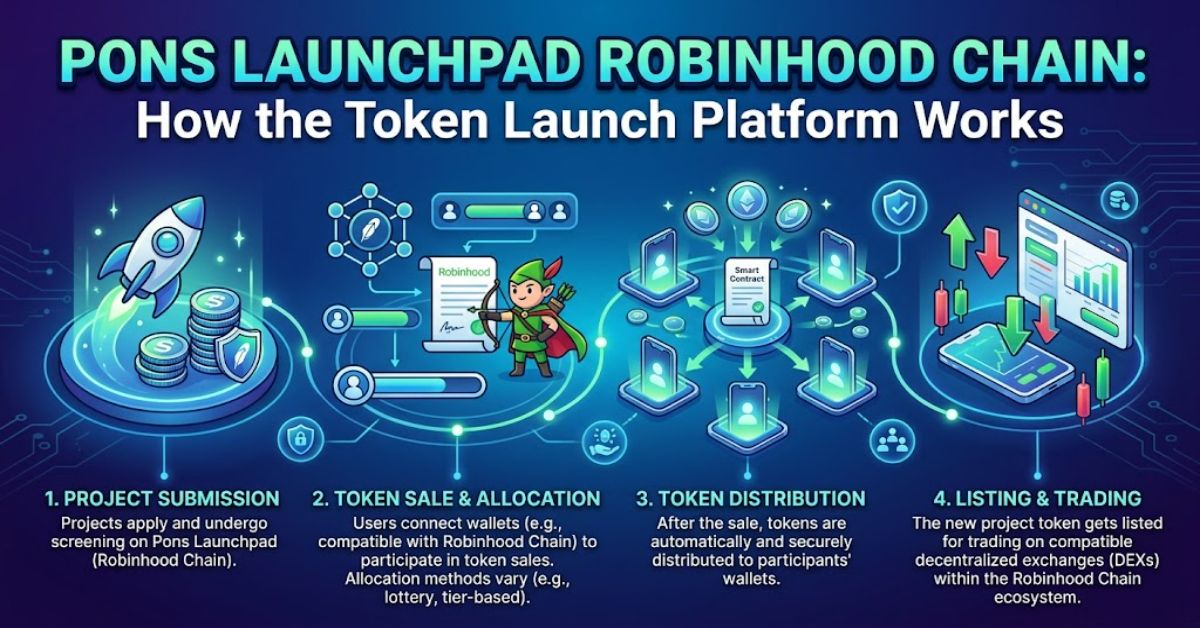
Pons launchpad Robinhood Chain refers to a token-launch platform designed specifically for Robinhood Chain. The supplied brief describes Pons as a leading non-custodial token launchpad built on the network, while current Pons documentation describes the platform as a place to launch and trade tokens directly from a wallet.
The important distinction is between a launchpad and a conventional centralised exchange. Pons does not require users to deposit assets into an internal account. Instead, transactions are submitted through a connected wallet, meaning the user approves each transaction and remains responsible for the assets held in that wallet.
That model makes Pons part of the broader decentralised-finance infrastructure developing around Robinhood Chain. Robinhood announced its public testnet in February 2026, describing Robinhood Chain as an Ethereum Layer 2 built on Arbitrum and intended to support on-chain financial applications and tokenised assets.
For readers researching the platform, however, the most useful question is not simply what Pons is. It is how the launch mechanism actually works and where its risks remain.
How the Pons Launch Model Works
The launchpad uses a bonding curve to establish pricing during the initial stage of a token launch. Instead of relying on a traditional order book, the price changes according to a programmed formula as buying and selling activity changes.
This creates a transparent mechanism for early trading, but transparency should not be confused with stability. A token launched through a bonding curve can experience significant price movement, particularly when liquidity is limited or a small number of wallets control substantial positions.
Current Pons documentation describes launches as fixed-supply token deployments on Robinhood Chain. It also states that the user’s wallet submits transactions and that Pons does not custody funds.
| Feature | Pons launch model | Practical implication |
| Custody | Non-custodial | Users retain wallet control |
| Network | Robinhood Chain | Transactions settle on the same network |
| Pricing | Bonding curve | Price changes with launch activity |
| Token supply | Fixed-supply model | Supply rules are established at creation |
| Graduation | DEX liquidity stage | Successful launches can progress beyond the initial curve |
| Transaction approval | User wallet | Transactions require wallet confirmation |
One useful insight is that the launchpad’s simplicity creates responsibility rather than eliminating it. A centralised platform may provide account recovery or transaction intervention; a non-custodial system generally cannot reverse a transaction simply because a user made an error.
Bonding Curves and Token Graduation
A bonding curve is central to understanding how Pons differs from a conventional token listing.
At the beginning of a launch, buyers interact with the curve rather than an established open-market liquidity pool. As demand changes, the curve adjusts the token’s price. This provides an automated market mechanism and removes the need for a human operator to manually set every transaction price.
Graduation represents a separate stage. Pons documentation describes a model in which tokens that meet the relevant threshold can transition into decentralised exchange liquidity. Current documentation also distinguishes between different generations of the Pons contracts, meaning readers should check which launch mechanism applies to a specific token rather than assuming every historical launch follows identical rules.
That distinction matters. Public documentation describes both V1 and V2 systems, with differences in liquidity architecture and launch mechanics. A reader analysing a token should therefore inspect its contract and launch details rather than relying only on the general Pons brand description.
What Makes the Model Different?
Three characteristics define the platform’s operating model.
Non-custodial control: Pons states that it does not hold user funds or private keys. Transactions are approved through the user’s wallet. This reduces one category of custodial exposure but places greater responsibility on the wallet owner.
On-chain transparency: Launches, transactions and contract activity can be examined through blockchain infrastructure. This can make important events independently verifiable rather than dependent entirely on a platform’s internal database.
Automated launch progression: Bonding curves and programmed graduation rules reduce the need for manual intervention. The trade-off is that users must understand the smart-contract rules that determine how the process works.
| Risk area | What users should examine |
| Smart contracts | Contract verification, permissions and upgrade mechanisms |
| Liquidity | Amount available and how it is controlled |
| Token concentration | Large holders and creator allocations |
| Price volatility | Curve behaviour and trading depth |
| Identity | Contract address rather than token name or ticker |
| Network | Correct Robinhood Chain configuration |
| Transaction safety | Wallet confirmation and destination addresses |
Risks and Trade-Offs
Pons documentation explicitly warns about price risk, dilution, oracle risk, governance risk and launch risk. It also states that the code is unaudited in the reviewed documentation.
The first major risk is volatility. A fixed supply does not create a fixed value. Demand can disappear, liquidity can become thin and a token can lose most or all of its market value.
The second is concentration. A bonding curve does not automatically prevent a well-funded participant from acquiring a large position. Pons documentation identifies this as a launch risk.
The third is operational risk. Users must verify contract addresses, network settings and transaction details themselves. Current Pons documentation warns that names and symbols can be copied, making the contract address more important than branding when identifying a token.
A fourth consideration is the difference between liquidity protection and price protection. A liquidity lock may reduce the risk of straightforward liquidity withdrawal, but it cannot guarantee continuing demand or prevent a token’s price from falling.
The Future of Pons Launchpad Robinhood Chain in 2027
The outlook for Pons in 2027 will depend heavily on the development of Robinhood Chain itself, the number of applications deployed on the network and whether users continue to demand permissionless token-launch infrastructure.
Robinhood’s 2026 announcement positioned the chain as an Ethereum Layer 2 for on-chain financial applications, including tokenised assets. That creates a wider infrastructure context for projects such as Pons.
However, future growth should not be treated as guaranteed. Launchpad activity can increase without every token becoming successful, while regulatory expectations, smart-contract security and liquidity conditions can change. The most meaningful development indicators will therefore be actual on-chain usage, liquidity quality, contract security and sustained ecosystem activity.
Key Takeaways
- Pons provides a wallet-based token-launch environment on Robinhood Chain.
- Its non-custodial structure means users retain control of their wallets.
- Bonding curves automate initial token pricing.
- Graduation can move successful launches into decentralised exchange liquidity.
- Fixed supply does not eliminate volatility or liquidity risk.
- Different Pons contract generations can have different mechanics.
- Contract addresses and on-chain activity are more reliable identifiers than names or symbols.
Conclusion
Pons represents a specific approach to token issuance: put the launch process on-chain, allow users to transact through their own wallets and automate pricing and liquidity progression through smart contracts. The model fits the broader direction of decentralised applications developing around Robinhood Chain.
Its non-custodial design is significant, but it should be understood as a change in responsibility rather than a removal of risk. Users remain exposed to volatility, liquidity conditions, smart-contract vulnerabilities, transaction errors and the behaviour of other market participants.
For anyone examining the Pons launchpad Robinhood Chain ecosystem, the practical starting point is contract-level verification. Understanding the launch version, bonding-curve rules, graduation conditions, liquidity arrangements and holder distribution provides a more useful picture than relying on branding or headline market figures.
Methodology
This article was prepared from the supplied keyword brief and current public documentation relating to Pons and Robinhood Chain. Pons documentation was used to examine launch mechanics, non-custodial transactions, bonding curves and stated risks. Robinhood’s February 2026 announcement was used for network context.
A limitation is that Pons documentation covers multiple contract generations, so mechanics can vary between launches. Interface statistics can also change as blockchain activity develops. Readers should verify contract addresses and current launch conditions directly on-chain before relying on them.
FAQ
What is Pons launchpad Robinhood Chain?
Pons is a non-custodial token launch and trading platform built on Robinhood Chain. It allows users to create and trade tokens through wallet-approved blockchain transactions.
Is Pons custodial?
No. Current Pons documentation states that the platform does not custody users’ funds or private keys. Transactions are submitted and approved through connected wallets.
What is a bonding curve on Pons?
A bonding curve is a programmed pricing mechanism that adjusts the token price according to buying and selling activity during the launch stage.
What does token graduation mean?
Graduation is the transition from the initial launch mechanism into decentralised exchange liquidity after a token reaches the applicable launch threshold.
Are Pons tokens safe?
There is no blanket safety guarantee. Pons documentation identifies volatility, smart-contract, governance, oracle and launch risks. Individual tokens require separate evaluation.
Does fixed supply mean a token cannot lose value?
No. Fixed supply limits the token’s programmed supply but does not determine demand, liquidity or market price.
References
Pons. (2026). Pons launchpad and protocol documentation. Public project documentation.
Pons Family. (2026). Pons launchpad documentation and FAQ. Public project documentation.
Robinhood. (2026, 10 February). Robinhood Chain launches public testnet. Robinhood Newsroom.
Pons Labs. (2026). Pons Launchpad Contracts — V1 & V2. Public GitHub repository.
KTX. (2026, 7 September). What Is Pons? Understanding the Robinhood Chain Token Launchpad.