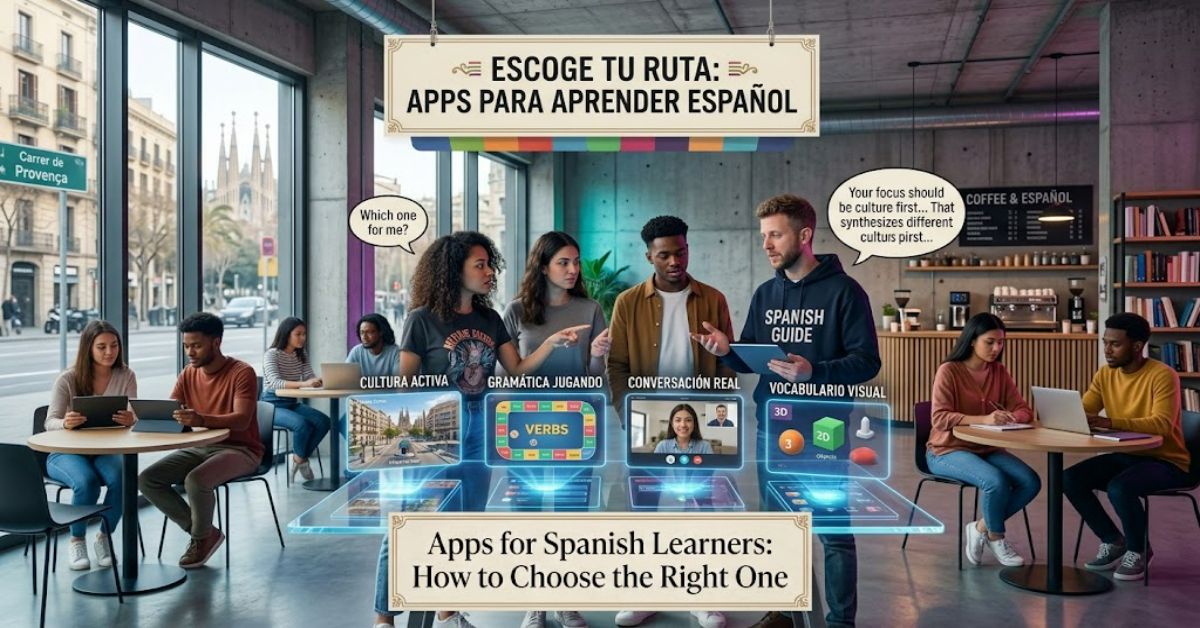
The best apps for Spanish learners are not necessarily the ones with the most features. The useful choice depends on what you want Spanish to do for you. A beginner preparing for a holiday may need short, practical lessons, while someone working towards conversational fluency needs structured grammar, listening practice and opportunities to speak.
The market now includes several distinct learning models. Duolingo emphasises gamification and daily habit-building, Babbel uses structured lessons and real-world dialogues, Busuu combines CEFR-aligned learning with community feedback and AI conversation practice, while Pimsleur focuses heavily on listening and speaking. Other services use television, authentic video or vocabulary-based exercises to fill particular gaps.
That means comparing apps purely by price or download popularity can be misleading. The more useful questions concern curriculum structure, speech practice, regional Spanish, review systems, feedback and the amount of active language production required.
Current platform information also shows a growing role for artificial intelligence. Busuu, for example, introduced AI-powered Conversations that place learners into realistic speaking scenarios aligned with CEFR levels.
For a learner choosing between apps for Spanish learners, the practical objective should therefore be simple: match the learning system to the skill you actually need to develop.
What Should You Look For in a Spanish Learning App?
| Learning need | Useful app feature | Why it matters |
| Vocabulary | Spaced repetition and review | Improves long-term recall |
| Grammar | Structured explanations and exercises | Builds sentence accuracy |
| Speaking | Voice recognition or conversation | Requires active language production |
| Listening | Native-speaker audio | Develops comprehension |
| Writing | Corrections and prompts | Builds accurate written Spanish |
| Progress | CEFR levels or assessments | Gives learning a measurable structure |
| Regional Spanish | Spain or Latin American options | Helps match your target environment |
One important issue is regional variety. European Spanish and Latin American Spanish are mutually intelligible, but vocabulary, pronunciation and some grammatical conventions differ. Babbel currently offers separate Spanish courses focused on Spain and Mexico, allowing learners to choose according to their goals.
Comparing Popular Apps for Spanish Learners
| App | Main approach | Particularly useful for | Important limitation |
| Duolingo | Gamified lessons | Daily habits and beginners | Less comprehensive speaking practice |
| Babbel | Structured lessons | Practical conversation and grammar | Subscription-based |
| Busuu | CEFR courses and community | Balanced skills and feedback | Some advanced features require Premium |
| Pimsleur | Audio-based learning | Speaking and listening | Less visual and grammar-focused |
| Rosetta Stone | Immersive visual learning | Pronunciation and contextual learning | Can feel less explicit for grammar |
| Lingopie | TV and video immersion | Intermediate listening | Better suited to learners beyond absolute beginner level |
These platforms should not be treated as interchangeable. Their instructional models are different.
Busuu describes its courses as covering reading, writing, listening and speaking, with CEFR alignment and corrections from its community of native speakers. Its newer Conversations feature adds generative-AI speaking scenarios.
Babbel takes a more explicitly structured approach. Its Spanish offering includes both Spain and Mexico varieties, and its current Spanish curriculum spans CEFR levels from A1 through C1 in its European Spanish course.
Duolingo occupies a different position. Its greatest practical strength is reducing the friction of starting a daily study session. That can be valuable for beginners who struggle with consistency, although a habit-building system should not be confused with complete language instruction.
Match the App to Your Learning Goal
The most useful way to select among apps for Spanish learners is to start with the skill rather than the brand.
For beginners: Look for a structured sequence that introduces basic vocabulary, grammar and everyday expressions without overwhelming you.
For speaking: Prioritise systems that require you to produce Spanish aloud. AI conversations can provide low-pressure practice, while human correction adds another layer of feedback.
For travel: Focus on functional language such as directions, restaurants, accommodation, transport and introductions. A specialised travel course can be more efficient than working through unrelated vocabulary.
For listening: Native-speaker audio and authentic video become increasingly valuable once basic comprehension is established.
For advanced learners: An app alone may provide insufficient exposure to spontaneous speech, complex writing and culturally specific language. At this stage, authentic media and human interaction become more important.
The Hidden Issue: Spanish Variety
One of the less obvious decisions is choosing which Spanish you actually want to hear.
A learner moving to Madrid has a different exposure environment from someone preparing to live in Mexico City, Bogotá or Buenos Aires. Pronunciation, vocabulary and everyday expressions can vary considerably.
This does not mean learners need to become anxious about choosing the “wrong” Spanish. The major varieties remain mutually intelligible. However, beginning with the variety most relevant to your circumstances can reduce unnecessary switching later.
Babbel explicitly separates its Spanish courses into European Spanish and Mexican Spanish. Its documentation also explains that both courses expose learners to speakers from multiple Spanish-speaking countries.
That is a useful model: choose a primary variety, then gradually broaden your listening exposure.
Why One App May Not Be Enough
A language-learning app can organise practice, but Spanish fluency requires several different forms of processing.
| Skill | App practice | Additional practice that helps |
| Vocabulary | Flashcards and review | Reading and conversation |
| Grammar | Exercises | Writing and correction |
| Listening | Recorded lessons | Films, podcasts and real conversations |
| Speaking | AI or voice exercises | Human interaction |
| Pronunciation | Speech recognition | Native-speaker comparison |
| Cultural competence | Dialogue examples | Authentic media and social context |
This creates an important distinction between learning content and using a language. Completing hundreds of exercises can improve recognition without necessarily creating spontaneous speaking ability.
A sensible study system therefore uses an app as the organised core of learning, then adds authentic input and real communication as proficiency develops.
The Future of Apps for Spanish Learners in 2027
AI conversation systems are likely to become increasingly important in language-learning apps during 2027. The direction is already visible in products such as Busuu Conversations, which uses generative AI to place learners into realistic speaking scenarios connected to CEFR levels.
The likely benefit is availability. A learner can practise speaking without arranging a lesson or finding a conversation partner.
The limitation is equally important. Simulated conversation does not completely reproduce the unpredictability of human interaction, regional accents, social context or genuine interpersonal communication.
CEFR alignment should also remain useful because it gives learners a shared framework for describing progress. Busuu currently offers Spanish certificates from A1 through C1 for eligible Premium learners.
The strongest future systems are therefore likely to combine structured progression, adaptive technology and authentic human language use rather than relying on AI alone.
Key Takeaways
- Choose an app according to the Spanish skill you most need to develop.
- CEFR-aligned courses provide more structure than isolated vocabulary practice.
- Regional Spanish should be considered before committing to a long-term course.
- Speaking requires active production, not simply recognising correct answers.
- AI can provide convenient conversation practice but does not fully replace human interaction.
- Authentic Spanish media becomes increasingly valuable beyond beginner level.
- Combining structured app lessons with real-world practice creates a broader learning system.
Frequently Asked Questions
What are the best apps for Spanish learners?
There is no single app that suits every learner. Babbel, Busuu, Duolingo, Pimsleur and Rosetta Stone use different approaches, so the appropriate choice depends on whether you prioritise structure, speaking, vocabulary, listening or habit-building.
Are apps for Spanish learners enough to become fluent?
An app can provide a strong foundation, but advanced fluency generally requires additional listening, reading, writing and real conversation. The broader your exposure, the more effectively you develop spontaneous language skills.
Which app is best for learning Spanish pronunciation?
Look for speech-recognition or speaking features that require you to produce Spanish aloud. These can provide useful feedback on individual sounds, although human listeners can identify aspects of rhythm, register and natural phrasing that automated systems may miss.
Should I learn European or Latin American Spanish?
Choose the variety most relevant to where you plan to live, work or travel. European and Latin American Spanish remain mutually intelligible, but pronunciation and vocabulary can differ.
Can AI help me practise Spanish conversation?
Yes. AI conversation tools can create realistic scenarios and allow repeated speaking practice without scheduling a lesson. They work best as one component of a broader learning routine.
How long should I study Spanish each day?
Consistency matters more than an arbitrary daily target. A manageable session that combines vocabulary review, listening and active speaking is generally more useful than occasional long sessions.
Conclusion
Apps for Spanish learners have developed from simple vocabulary tools into broader learning platforms covering grammar, listening, pronunciation, speaking and progress tracking. That expansion gives learners more choice, but it also makes selection more complicated.
The strongest starting point is to identify the skill that matters most. A traveller may need functional phrases, an adult beginner may prefer structured lessons, and an intermediate learner may benefit more from authentic video and conversation practice. Regional Spanish should also be considered, particularly for people planning to live in a specific Spanish-speaking country.
Technology can make language learning more accessible and consistent, especially through adaptive review and AI conversation. But an app remains a learning tool rather than a substitute for communication. The most durable progress comes from combining organised lessons with listening, reading, writing and real opportunities to use Spanish.
Methodology
This article was researched using current information from official platform documentation and current language-learning resources, with particular attention to Busuu and Babbel’s published course structures and features.
No firsthand app testing or fabricated user experience has been presented as original observation. Product capabilities have instead been attributed to the platforms’ current documentation. Because app features, pricing and subscription structures can change, readers should verify current commercial terms before purchasing.
The comparison focuses on instructional models rather than declaring one platform universally superior. A learner’s existing level, target country, preferred study method and need for human interaction can materially change which system is most appropriate.
Editorial disclosure: This article was drafted with AI assistance and should undergo human editorial verification before publication. Current pricing, feature availability and course specifications should be checked against the relevant providers at the time of publication.
References
Babbel. (2026). Available languages. Babbel Help Centre.
Babbel. (2026). Learn Spanish online. Babbel.
Babbel. (2026). Best language-learning apps 2026. Babbel.
Busuu. (2024). What is Busuu? Busuu Support.
Busuu. (2026). What are Busuu Conversations and how can they help me learn a language? Busuu Support.
Busuu. (2025). What are certificates and how can I get them? Busuu Support.