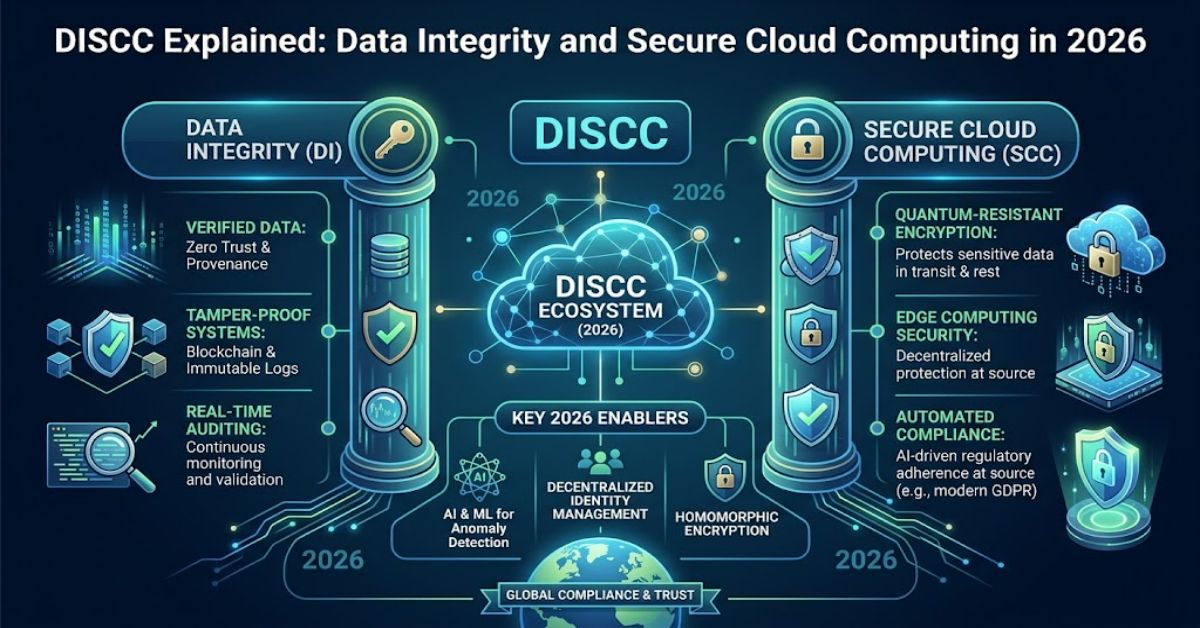
DISCC can mean different things depending on the context, but in current technology research it most notably refers to the Workshop on Data Integrity and Secure Cloud Computing. The fourth edition, DISCC 2026, was held alongside the 32nd International Symposium on High-Performance Computer Architecture (HPCA 2026) and focused on a problem becoming increasingly important as cloud computing and AI systems operate at enormous scale: how can organisations trust the results produced by complex computing infrastructure?
The workshop brings together two closely related concerns. The first is data integrity: ensuring that information and computations have not been silently corrupted by hardware or software faults. The second is data security: preventing unauthorised access, manipulation and disclosure.
The distinction matters. A system can be secure against an external attacker while still producing incorrect results because of an undetected hardware fault. Conversely, a system can calculate accurately while exposing sensitive information.
DISCC’s value lies in examining these problems together rather than treating reliability, security and privacy as completely separate engineering tasks. Its programme covers hardware, software, firmware, cryptography, cloud infrastructure and AI workloads.
What Does DISCC Stand For?
In the technology context, DISCC stands for Data Integrity and Secure Cloud Computing.
The 2026 edition took place on 1 February 2026 in Sydney, Australia, in conjunction with HPCA 2026. The organisers described the event as a unified forum for data integrity and security in hyperscale cloud computing environments.
| Term | Meaning in the DISCC context |
| Data integrity | Confidence that computing results and stored information remain correct |
| Secure cloud computing | Protecting cloud workloads, infrastructure and information |
| Silent data corruption | Incorrect computation results that may occur without an obvious system failure |
| FHE | Fully Homomorphic Encryption, allowing computation on encrypted information |
| AI resilience | Designing AI systems that can tolerate or detect faults and attacks |
This terminology shows why DISCC sits between computer architecture, cybersecurity, cloud engineering and AI research.
Why Data Integrity Has Become a Major Issue
Modern cloud data centres contain huge numbers of processors, memory components and interconnected systems. At that scale, even uncommon faults can become operationally significant.
One concern highlighted by DISCC is silent data corruption, where a system produces an incorrect result without necessarily crashing or generating an obvious warning. Such failures are particularly difficult because conventional monitoring may focus on availability rather than correctness.
The 2026 programme included a session examining silent data corruptions from silicon through cloud data centres and large AI systems. It also addressed robust power management and the relationship between system architecture and resilience.
This creates a practical engineering challenge: detecting every possible error can be expensive, while failing to detect important errors can undermine confidence in the computation itself.
DISCC and Secure Computation
Security is the second major pillar.
Cloud providers increasingly process information that organisations may not want exposed even while computation is taking place. One technology discussed within DISCC is Fully Homomorphic Encryption (FHE).
FHE allows certain computations to be performed on encrypted data without first exposing the underlying plaintext. It has significant potential for privacy-sensitive applications, although performance and implementation complexity remain important constraints.
DISCC 2026 included an invited tutorial on IBM HElayers and advanced FHE packing methods for machine learning. The programme also included research examining transient errors in homomorphic computing.
That combination is particularly important. Protecting data through encryption is not enough if the underlying computation can silently produce incorrect results.
What Problems Does DISCC Address?
DISCC’s scope extends across several layers of the computing stack.
| Area | Core problem | Potential approach |
| Hardware | Faulty or unreliable components | Detection and resilient architecture |
| Software | Undetected computational errors | Testing, diagnosis and verification |
| Cloud | Large-scale reliability and security | System-level monitoring and mitigation |
| AI | Fault-sensitive workloads | Resilient architectures and validation |
| Cryptography | Secure computation overhead | Hardware and software acceleration |
| Edge systems | Security and reliability constraints | Context-specific modelling |
The workshop explicitly invites approaches at algorithm, software, firmware and hardware levels. Its topics also include testing silent data errors, detecting malicious attacks, privacy-preserving computation and modelling cloud-edge solutions.
Three Important Insights About DISCC
Reliability and security overlap. A secure system that generates incorrect results is still problematic. DISCC’s combined approach reflects the fact that trustworthy computing requires both protection and correctness.
AI increases the scale of the problem. AI workloads can involve enormous computational pipelines, making resilience relevant not only to traditional cloud applications but also to modern machine-learning infrastructure.
Encryption introduces a second engineering challenge. FHE can strengthen privacy, but encrypted computation can require specialised optimisation. DISCC’s attention to hardware acceleration and error sensitivity demonstrates why cryptographic protection cannot be considered independently from system architecture.
DISCC Is Not Always the Same Thing
Searches for DISCC can produce unrelated results because the acronym is used by several initiatives.
For example, DISCC-AT is an Austrian climate research project examining the distributional effects of climate change, particularly flood and heat-related health risks. It is unrelated to the computing workshop.
Another initiative, Prevent-DisCC, is a Greece-Cyprus cooperation project focused on preventing natural disasters and addressing climate change through forecasting, early-warning systems, digital mapping and related technologies.
The acronym has also been associated with the Data & Information System Consultation Center in the US child-care technology context, as indicated by the supplied keyword brief.
The practical lesson is simple: the surrounding subject matter is essential when interpreting DISCC.
The Future of DISCC in 2027
DISCC’s technology focus is likely to remain relevant as AI systems become more computationally demanding and cloud infrastructure continues to expand.
The 2026 programme already connected data integrity with AI, cryptography, cloud computing and hardware resilience. IBM Research’s publication record similarly places DISCC alongside research areas including trustworthy AI, cloud security, cryptography and fully homomorphic encryption.
The major uncertainty is not whether these problems matter, but which mitigation techniques will become economical at scale. Stronger reliability mechanisms can consume additional processing capacity, energy or development resources.
By 2027, the practical direction is therefore likely to involve greater integration between security testing, hardware reliability, AI validation and privacy-preserving computation rather than treating each discipline in isolation.
Key Takeaways
- DISCC commonly refers to Data Integrity and Secure Cloud Computing in current computer-architecture research.
- DISCC 2026 took place alongside HPCA 2026.
- Silent data corruption is a central reliability concern.
- Fully Homomorphic Encryption connects privacy with computational architecture.
- AI systems create additional requirements for resilience and verification.
- The acronym has several unrelated meanings, so context matters.
- Future research is likely to focus on practical, cost-effective protection at scale.
Conclusion
DISCC provides a useful lens for understanding a difficult problem in modern computing: trustworthy systems must do more than remain available. They must protect sensitive information, resist malicious interference and produce reliable results.
The 2026 workshop demonstrated how closely these requirements are becoming connected. Silent data corruption raises questions about hardware and system reliability, while FHE raises questions about privacy, performance and secure computation. AI brings both challenges together at increasingly large computational scales.
At the same time, DISCC should not automatically be interpreted as a single organisation or project. The acronym is also used in climate, disaster-prevention and child-care information-system contexts.
For technology readers, however, its Data Integrity and Secure Cloud Computing meaning is particularly significant because it sits at the intersection of cloud security, computer architecture, cryptography and trustworthy AI.
FAQ
What does DISCC stand for in technology?
In current computing research, DISCC commonly stands for the Workshop on Data Integrity and Secure Cloud Computing.
What is DISCC 2026?
DISCC 2026 was the fourth Workshop on Data Integrity and Secure Cloud Computing, held alongside HPCA 2026 on 1 February 2026.
What is data integrity in cloud computing?
Data integrity means maintaining confidence that information and computational results have not been incorrectly altered or corrupted.
What is silent data corruption?
Silent data corruption occurs when a computing system produces incorrect results without necessarily generating an obvious failure signal.
How does DISCC relate to AI?
DISCC examines reliability and security challenges affecting AI systems, including silent errors, resilient architectures and privacy-preserving computation.
Does DISCC always refer to computing?
No. The acronym is also used by unrelated climate, disaster-prevention and child-care information-system initiatives.
Methodology
This article interprets DISCC primarily through current technology sources from the DISCC workshop, IBM Research and related research organisations. The workshop’s official programme and IBM’s publication record were used to validate its 2026 scope, dates, participating researchers and technical themes.
Other uses of the acronym were checked separately to avoid conflating unrelated projects. The article does not treat the different DISCC initiatives as connected organisations.
A limitation is that workshop material describes research directions and technical concerns rather than proving that a particular solution has become commercially dominant. Future statements are therefore framed as developments to watch rather than guaranteed outcomes.
References
Bose, P., Dworak, J., Mitra, S., Gizopoulos, D., Wilkerson, C., Chandramoorthy, N., Vega, A., & Drucker, N. (2026). 4th Workshop on Data Integrity and Secure Cloud Computing (DISCC). IBM Research / HPCA 2026.
DISCC Workshop. (2026). Workshop on Data Integrity and Secure Cloud Computing (DISCC 2026).
DARE-RISC-V. (2026). DISCC 2026 – 4th Workshop on Data Integrity and Secure Cloud Computing.
International Institute for Applied Systems Analysis. (2024). Assessing the distributional effects of climate change impacts and adaptation in Austria, for just, targeted and efficient adaptation (DISCC-AT).
Prevent-DisCC. (2026). Cross-Border Actions for Prevention of Disasters and Climate Change.
Editorial disclosure: This article was drafted with AI assistance and should be independently reviewed and verified by the editorial team before publication.