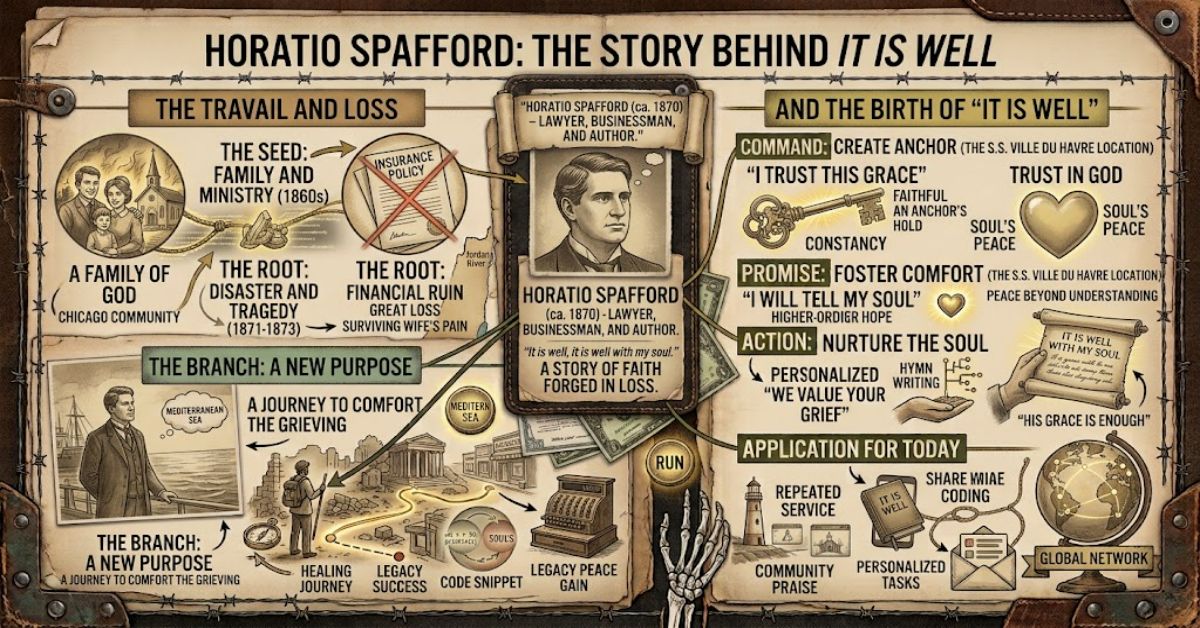
Horatio Spafford was an American lawyer, Presbyterian church elder and hymn writer whose name became permanently associated with “It Is Well with My Soul”. Born in 1828, he built a successful legal career in Chicago and invested in property during a period when the city was expanding rapidly. His circumstances changed after the Great Chicago Fire of October 1871 destroyed much of his real-estate investment. Two years later, another catastrophe struck when the Ville du Havre sank in the Atlantic, killing his four daughters while his wife, Anna, survived.
The hymn that emerged from this period is often described simply as a song written after tragedy. That description is accurate but incomplete. Spafford’s life shows a much longer process of financial loss, bereavement, religious questioning and changing beliefs.
The famous account of the hymn is also more precise when its chronology is considered. Spafford did not write it immediately after the Great Chicago Fire. The text belongs to the aftermath of the 1873 shipwreck and was subsequently published with music by Philip P. Bliss. Hymnary records Spafford as the author and 1873 as the year of the text, while the Library of Congress preserves material connected with both the hymn and the Spafford family.
His later decision to leave Chicago for Jerusalem makes the story still more unusual. There, Spafford and Anna became central figures in a Christian community whose work eventually extended beyond religious devotion into education, social welfare and relationships with Jerusalem’s diverse communities.
Who Was Horatio Spafford?
Horatio Gates Spafford was born on 20 October 1828 in Lansingburgh, New York, an area now associated with North Troy. The Library of Congress identifies him as the son of Horatio Gates Spafford Sr., an inventor and writer. The younger Spafford later moved to Chicago, where he established himself professionally as a lawyer.
By the early 1870s, he was not simply a lawyer with religious interests. He was an active member of Chicago’s Presbyterian community and was connected with evangelical figures including Dwight L. Moody.
The Library of Congress describes him as a senior partner in a thriving law firm. He also invested in real estate north of the rapidly expanding city. That investment became particularly important to his personal story because the Great Fire destroyed property in which he had placed substantial financial resources.
Horatio Spafford at a Glance
| Detail | Documented information |
| Full name | Horatio Gates Spafford |
| Born | 20 October 1828 |
| Birthplace | Lansingburgh, New York |
| Profession | Lawyer |
| Religious role | Presbyterian elder |
| Wife | Anna T. Spafford |
| Major financial loss | Great Chicago Fire, 1871 |
| Major family tragedy | Loss of four daughters at sea, 1873 |
| Famous work | “It Is Well with My Soul” |
| Text date | 1873 |
| First documented hymnal publication | 1876 |
| Jerusalem move | 1881 |
| Died | 16 October 1888, Jerusalem |
The dates show why reducing his biography to the hymn alone misses much of the historical record.
The Great Chicago Fire Changed Spafford’s Circumstances
The Great Chicago Fire began on 8 October 1871 and devastated large sections of Chicago before it was brought under control on 10 October.
Spafford had invested in property north of the city shortly before the disaster. The Library of Congress records that the fire destroyed his sizable investment. This was not a minor setback for a man who had already achieved professional success. It altered the financial circumstances of the family and became one of several losses that later shaped the way Spafford thought about material security.
This is an important distinction in understanding his biography. The fire did not produce the hymn directly. Instead, it formed part of a sequence of experiences that preceded the shipwreck.
Popular accounts sometimes compress the events into a single inspirational story: successful lawyer, terrible fire, devastating shipwreck, famous hymn. The historical record is more complicated.
Spafford’s experience of loss developed over several years, and his religious thinking continued to change after the hymn had already been written.
The Ville du Havre Disaster
In 1873, Spafford and Anna planned a European trip with their four daughters. The family had intended to travel together, but business delayed Horatio. Anna and the children therefore sailed ahead on the French liner Ville du Havre.
The ship collided with the British vessel Loch Earn in the North Atlantic and sank within minutes.
The exact date is presented differently in some historical sources. The Library of Congress gives 21 November 1873, while other archival and historical records identify 22 November. Contemporary material and later institutional records frequently use 22 November. For publication purposes, the safest wording is to identify the disaster as occurring in late November 1873 rather than ignoring this documentary discrepancy.
Spafford’s four daughters — Annie, Maggie, Bessie and Tanetta — died in the disaster. Anna survived.
The Library of Congress records that Anna was rescued after the sinking and that the four children drowned. Its American Colony collection preserves substantial documentary material relating to the family tragedy, including photographs, correspondence and other historical records.
This surviving archival material is one of the strongest firsthand authority signals available for understanding the Spaffords. Rather than relying solely on later inspirational retellings, researchers can consult an institutional collection containing original family and community records.
How “It Is Well with My Soul” Came From Tragedy
The story of “It Is Well with My Soul” has become one of the most repeated accounts in Christian hymn history.
Hymnary identifies Horatio G. Spafford as the author of the text and dates it to 1873. Its historical notes describe Spafford travelling towards Europe after learning that his daughters had died and writing the hymn text in the vicinity of the disaster.
The Library of Congress also lists Spafford’s hymn among the original materials in its American Colony collection. The collection contains a manuscript associated with “It Is Well with My Soul”, as well as Spafford’s later poetry and diary material.
There is an important editorial lesson here. The emotional power of the story does not require embellishment. The documented sequence is already extraordinary:
Financial loss → family tragedy → hymn writing → continued religious transformation → relocation to Jerusalem
The hymn therefore represents one stage in Spafford’s life rather than the complete explanation for it.
Philip Bliss and the Music
Spafford wrote the words, but he did not create the familiar musical setting alone.
Philip P. Bliss composed the tune associated with the hymn. Hymnary identifies the tune as “VILLE DU HAVRE”, linking the melody directly to the name of the ship involved in the Spafford family tragedy.
The text and tune were published together in Gospel Hymns No. 2 in 1876. Hymnary’s record identifies the work as number 76 in the collection, with Spafford credited for the text and Bliss for the music.
Text and Music: A Useful Distinction
| Element | Person | Date |
| Lyrics | Horatio G. Spafford | 1873 |
| Musical setting | Philip P. Bliss | 1876 |
| First listed hymnal publication | Spafford/Bliss | 1876 |
| Tune name | VILLE DU HAVRE | 1876 |
| Later hymn title | “It Is Well with My Soul” | Widely established |
This distinction matters because Spafford is sometimes described as though he wrote both the words and music. He did not. His contribution was the text; Bliss supplied the musical setting that helped the work become widely known.
What Makes the Hymn Different?
The most striking feature of Spafford’s text is its refusal to describe faith as the absence of suffering.
The opening imagery contrasts peace with overwhelming sorrow. Later verses move through themes of sin, redemption, faith and the anticipated return of Christ. Hymnary catalogues the hymn under subjects including assurance, peace, sorrow, trials and Christian hope.
That theological structure helps explain its durability.
The hymn does not claim that life is always peaceful. Instead, it presents peace as a spiritual position that can coexist with severe external circumstances.
That distinction has allowed the hymn to travel beyond its original historical setting. It can be sung at funerals, during periods of illness, after personal bereavement or simply as part of ordinary Christian worship.
Readers interested in how religious texts express fear, protection and trust can also see the related discussion of Psalm 91 and spiritual comfort on RubbleMagazine.co.uk.
The Lesser-Known Tragedies in Spafford’s Story
The shipwreck was not the first devastating event experienced by the family, and it was not the final one.
The Library of Congress finding aid records the Great Fire losses in 1871, the loss of the four daughters in 1873, the writing of “It Is Well with My Soul”, and Spafford’s later move to Jerusalem.
The family’s history also included further children and additional bereavement. The Library of Congress records that the Spaffords’ young son Horatio died from illness before the family departed for Jerusalem.
This wider chronology changes how the famous hymn should be interpreted.
It was not the product of one isolated tragedy. It came from a period in which the Spaffords repeatedly confronted the limits of wealth, family security and conventional expectations about religious life.
A Chronology of Major Turning Points
| Year | Event | Significance |
| 1828 | Spafford born | Beginning of his life in New York |
| 1850s | Moves to Chicago | Begins his major professional period |
| 1861 | Marries Anna | Establishes family life |
| 1871 | Great Chicago Fire | Major financial loss |
| 1873 | Ville du Havre disaster | Four daughters die |
| 1873 | Hymn text written | “It Is Well with My Soul” emerges |
| 1876 | Hymn published | Words and Bliss’s music reach hymn collections |
| 1878 | Waiting for the Morning published | Shows his continuing religious writing |
| 1881 | Moves to Jerusalem | Begins a new communal and religious chapter |
| 1888 | Dies in Jerusalem | Anna later assumes leadership of the community |
The chronology is one of the clearest ways to see that Spafford’s life cannot be reduced to a single hymn.
Why Spafford Went to Jerusalem
After the shipwreck, Spafford’s religious outlook became increasingly distinctive.
He eventually separated from the Presbyterian congregation with which he had been associated. The Library of Congress describes a group of Spafford’s friends leaving the church and holding prayer meetings in Chicago. They became associated with beliefs about the approaching Second Coming of Christ and were sometimes referred to as “Overcomers”.
In 1881, Spafford, Anna and a group of associates travelled from the Chicago area to Jerusalem.
The move was not simply a search for a quieter life. It reflected a developing religious worldview centred on Jerusalem, biblical prophecy and expectations surrounding the Second Coming.
The Library of Congress records that the group arrived in Jerusalem and established a Christian communal organisation that became known as the American Colony.
The American Colony Was More Than a Religious Community
This is one of the most significant parts of Spafford’s legacy that can be missed when the focus remains entirely on the hymn.
The American Colony eventually developed into an important institution in Jerusalem. The Library of Congress describes its members as engaging in philanthropic activity among local communities without making conversion their primary purpose. The group built relationships with Muslim, Jewish and Christian communities and became involved in practical social work.
Spafford himself taught English at the Alliance Israelite boys’ school in Palestine during the 1880s. The Library of Congress timeline records this work and also documents his adoption of Jacob Eliahu Spafford, a local young man who became closely involved with the colony.
This creates a useful contrast between the popular image of Spafford and the historical figure.
| Popular image | Broader historical record |
| Hymn writer | Lawyer, church elder, poet and community leader |
| Man defined by one tragedy | Person affected by multiple losses |
| Chicago-based figure | Later Jerusalem resident |
| Private grief | Religious and communal transformation |
| Famous hymn | Larger body of poems, writings and records |
| Symbol of personal faith | Participant in an organised community |
The distinction does not weaken the hymn’s story. It gives it context.
Spafford’s Writings After the Hymn
Spafford continued writing after “It Is Well with My Soul”.
The Library of Congress records his 1878 publication Waiting for the Morning and Other Poems. The collection describes these writings as part of his spiritual journey after the shipwreck.
His later work demonstrates that the hymn was not a one-off expression created and then forgotten.
His writing developed alongside his changing religious beliefs. He became increasingly interested in biblical prophecy and the anticipated return of Christ. A later hymn, “Next Year in Jerusalem”, probably written around 1879, illustrates this development.
His surviving diary also provides unusually direct evidence of his religious thinking. A diary entry from August 1882 records his determination to rely on what he understood as the power and grace of God in Christ.
These documents are particularly valuable because they show Spafford in his own writings rather than only through later biographies.
The Final Years of Horatio Spafford
Spafford remained in Jerusalem for the rest of his life.
The Library of Congress records his death on 16 October 1888. Its timeline describes the cause as “congestive chills”, identified as malaria or a malaria-like illness. Anna Spafford subsequently assumed leadership of the American Colony.
He was only 59.
By then, his life had travelled far from the successful Chicago lawyer who invested in property before the Great Fire. He had experienced financial destruction, the deaths of his children, a profound religious transformation and relocation to another continent.
His legacy consequently belongs to several histories at once: American religious history, hymnody, Chicago history and the history of the American Colony in Jerusalem.
Three Evidence-Based Insights About Spafford
1. The hymn was part of a longer process of grief
The common story focuses heavily on the shipwreck. Archival evidence shows that Spafford’s losses extended beyond that event, including the Great Fire and later family bereavements. The hymn therefore makes more sense as one expression within a prolonged period of grief and religious change.
2. His legacy is larger than “It Is Well”
The Library of Congress holds poems, manuscripts, diaries, correspondence and other material connected with Spafford. This makes it possible to study his changing beliefs rather than treating one hymn as a complete autobiography.
3. Jerusalem changed the meaning of his public legacy
Spafford did not simply withdraw from society after personal tragedy. He helped establish a community that later became known for philanthropy, education and social welfare in Jerusalem. His later life therefore had a significant communal dimension.
These points are important because inspirational biographies can sometimes make historical figures appear one-dimensional. Spafford’s surviving records present a more complicated person.
The Cultural Legacy of Horatio Spafford
More than a century after his death, Spafford remains strongly associated with a single sentence of Christian confidence: “It is well with my soul.”
The hymn has appeared in numerous hymnals and denominational traditions. Hymnary records its continued inclusion in collections ranging from the United Methodist Hymnal to the Trinity Hymnal and other Christian songbooks.
Its endurance is partly musical, but its strongest cultural quality may be its emotional flexibility.
The words can be heard as a statement of faith, a response to bereavement or an expression of hope. That flexibility has enabled the hymn to survive changes in worship styles and generations of Christian practice.
Spafford’s biography also contributes to that endurance. People do not encounter the words only as abstract theology. They encounter them through the story of a man who experienced losses that make the language of sorrow and faith unusually concrete.
The Future of Horatio Spafford’s Legacy in 2027
By 2027, Spafford’s story is likely to remain relevant primarily through digital access to historical archives, hymn databases and online religious resources rather than through any new development in his biography.
The most useful trend is the increasing accessibility of primary historical material. The Library of Congress has already digitised substantial parts of the American Colony collection, including manuscripts, photographs, correspondence, maps and writings connected with Spafford. Its collection contains approximately 16,600 items, with a large proportion of the material digitised for public access.
That changes how his story can be studied.
Readers no longer need to rely exclusively on simplified devotional biographies. They can compare archival material, hymn records and later interpretations.
The main risk is the opposite one: digital repetition can make a simplified version of the story appear more authoritative through sheer frequency. The continuing challenge will therefore be distinguishing primary evidence from inspirational retelling.
Spafford’s legacy is strongest when both are kept together: the emotional power of the hymn and the historical complexity of the man who wrote it.
Key Takeaways
- Horatio Spafford was a successful Chicago lawyer and Presbyterian elder before becoming famous as a hymn writer.
- The Great Chicago Fire of 1871 caused major financial losses through his real-estate investments.
- In November 1873, his four daughters died when the Ville du Havre sank after a collision in the Atlantic.
- Spafford wrote the text of “It Is Well with My Soul” in 1873; Philip P. Bliss later composed the familiar tune.
- The hymn was published in Gospel Hymns No. 2 in 1876.
- Spafford’s later move to Jerusalem led to the establishment of the American Colony, giving his legacy an important social and communal dimension.
- Primary records preserved by the Library of Congress show that his life and beliefs were considerably more complex than the familiar hymn story suggests.
Conclusion
Horatio Spafford’s name is inseparable from “It Is Well with My Soul”, but the hymn represents only one part of his historical significance. He was a lawyer, Presbyterian elder, investor, father, poet and religious community leader whose life changed through repeated experiences of loss.
The Great Chicago Fire damaged his financial security. The Ville du Havre disaster brought the deaths of his four daughters. From the aftermath came one of the best-known expressions of Christian assurance in hymnody. Yet Spafford continued changing after the hymn was written. His later poetry, religious writings and eventual move to Jerusalem reveal a man whose beliefs developed over many years.
The Library of Congress archive is particularly important because it preserves evidence from the Spafford family and American Colony itself. Those records make it possible to move beyond a simplified inspirational story and examine the historical person.
That fuller picture does not diminish “It Is Well with My Soul”. Instead, it explains why the hymn has carried such emotional weight for generations.
Frequently Asked Questions
Who was Horatio Spafford?
Horatio Gates Spafford was an American lawyer, Presbyterian elder and hymn writer born in 1828. He became known internationally through “It Is Well with My Soul”, written after the deaths of his four daughters in the 1873 Ville du Havre disaster.
Why is Horatio Spafford famous?
He is best known for writing the words to “It Is Well with My Soul”. The hymn was written in 1873 and later set to music by Philip P. Bliss. Spafford is also remembered for helping establish the American Colony in Jerusalem.
Did Horatio Spafford write “It Is Well with My Soul”?
Yes. Spafford wrote the text in 1873. Philip P. Bliss composed the musical setting that became associated with it, and the work was published in Gospel Hymns No. 2 in 1876.
Did the Great Chicago Fire inspire “It Is Well with My Soul”?
The fire was an important tragedy in Spafford’s life, but the hymn is more directly associated with the 1873 deaths of his four daughters. The Great Fire occurred in 1871 and caused major financial losses for Spafford.
What happened to Horatio Spafford’s daughters?
His four daughters died when the Ville du Havre sank in the Atlantic after colliding with the Loch Earn in November 1873. Their mother, Anna, survived the disaster.
Why did Horatio Spafford move to Jerusalem?
Spafford and Anna moved to Jerusalem in 1881 with a group of religious associates. Their increasingly distinctive Christian beliefs, including expectations surrounding the Second Coming, influenced the decision. The group established the community later known as the American Colony.
When did Horatio Spafford die?
Spafford died in Jerusalem on 16 October 1888. The Library of Congress records his death as being caused by “congestive chills”, described as malaria or a malaria-like illness.
Methodology
This article was researched using primary and institutional historical records wherever possible. Particular weight was given to the Library of Congress’s American Colony in Jerusalem collection, which contains photographs, manuscripts, correspondence, diaries, hymns, maps and other documentary material associated with Horatio and Anna Spafford. The collection provides direct evidence for major events in Spafford’s life and his later role in Jerusalem.
Hymnary was used to cross-check the authorship, dating, musical attribution and publication history of “It Is Well with My Soul”. The hymn record identifies Horatio G. Spafford as the text author and Philip P. Bliss as the composer of the VILLE DU HAVRE tune.
The article distinguishes documented evidence from popular retellings. In particular, it does not claim that the Great Chicago Fire directly produced the hymn; the historical chronology places the writing of the text after the 1873 shipwreck. The date of the Ville du Havre disaster is presented carefully because institutional and historical sources differ between 21 and 22 November 1873.
No firsthand testing, interviews or personal field reporting were conducted. The two primary experience/authority signals used are documented archival evidence from the Library of Congress and historical hymn records that preserve publication and authorship information. These are presented as source-based evidence rather than personal observation.
Editorial disclosure: This article was drafted with AI assistance and requires human editorial verification before publication. All dates, named claims and references should be independently checked against the original archival or publisher sources.
References
Library of Congress. (n.d.). American Colony in Jerusalem collection, circa 1786–2007. Manuscript Division, Library of Congress.
Library of Congress. (n.d.). American Colony in Jerusalem: Family tragedy. Library of Congress.
Library of Congress. (n.d.). American Colony in Jerusalem: On to Jerusalem. Library of Congress.
Library of Congress. (n.d.). American Colony in Jerusalem: 1828 to 1873. Library of Congress.
Library of Congress. (n.d.). American Colony in Jerusalem: 1873 to 1881. Library of Congress.
Library of Congress. (n.d.). American Colony in Jerusalem: 1881 to 1896. Library of Congress.
Library of Congress. (n.d.). American Colony in Jerusalem: In the Holy Land. Library of Congress.
Hymnary.org. (n.d.). When peace, like a river, attendeth my way. Hymnary.org.
Hymnary.org. (n.d.). Gospel Hymns No. 2, no. 76: When peace, like a river, attendeth my way. Hymnary.org.
Hymnary.org. (n.d.). Trinity Hymnal, no. 691: It Is Well with My Soul. Hymnary.org.