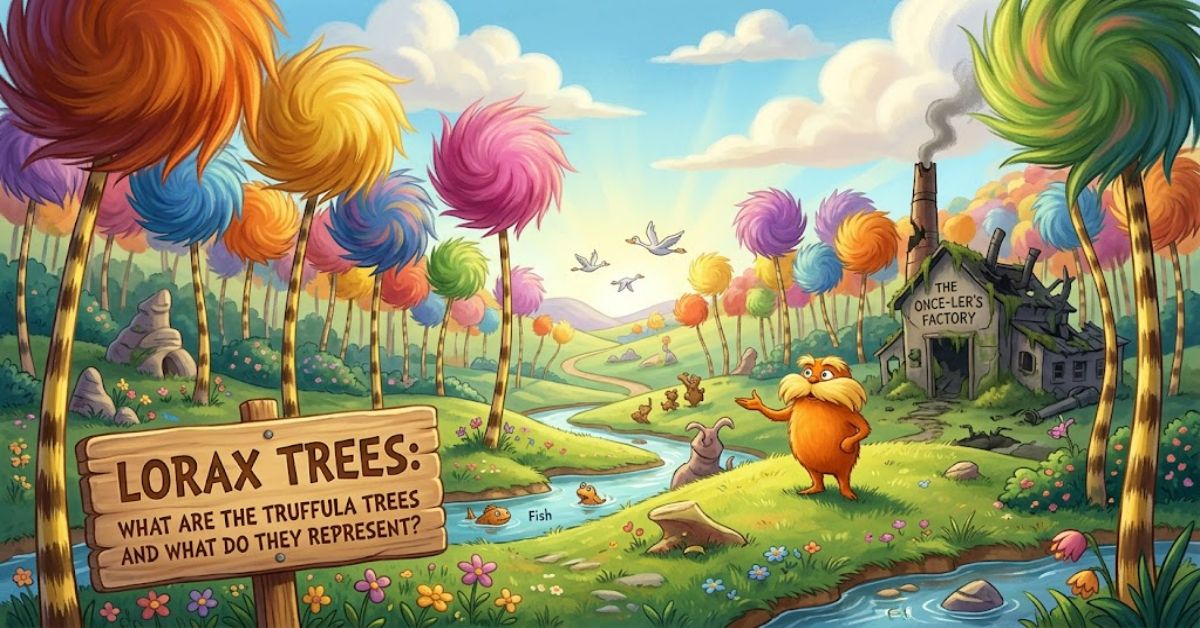
If you are searching for lorax trees, you are most likely asking about the colourful fictional trees from Dr. Seuss’s The Lorax. These trees are called Truffula Trees, and they are one of the most important elements of the story. Their bright, tufted tops make them instantly recognisable, but their role goes far beyond visual design.
Published in 1971, The Lorax tells the story of the Once-ler, who discovers that Truffula Tree tufts can be used to manufacture a popular product called a Thneed. As production expands, more trees are cut down. The Lorax, a small creature who acts as their environmental guardian, protests against the destruction.
The story presents a simple but powerful conflict: economic growth can create jobs and products, but uncontrolled exploitation can damage the natural systems that make life possible.
That message has helped the Truffula Trees remain culturally relevant decades after the book was first published. They represent forests, habitats and natural resources while also illustrating how environmental damage can begin with seemingly small decisions.
Although the trees do not exist as a naturally occurring species, their design draws attention to real ecological concerns. Their fictional world provides a child-friendly way to discuss deforestation, habitat loss, pollution and sustainability.
What Are the Lorax Trees Called?
The trees commonly referred to as lorax trees are called Truffula Trees. They are fictional plants created by Dr. Seuss for The Lorax.
Their most recognisable feature is their tall, slender trunk topped with a large, colourful tuft. The tufts appear in different colours and provide the raw material that the Once-ler uses to produce Thneeds.
The trees are also part of a larger ecological system. In the story, they support animals and contribute to the health of the environment. Once the trees disappear, the effects spread through the fictional ecosystem.
This is important because the story does not portray deforestation as simply losing individual trees. Instead, it shows how removing a natural resource can disrupt an entire interconnected environment.
| Feature | Truffula Trees in The Lorax |
| Scientific status | Fictional species |
| Creator | Dr. Seuss |
| First appearance | The Lorax, 1971 |
| Distinctive feature | Large colourful tufts |
| Main resource | Tree tufts used for Thneeds |
| Symbolism | Nature, biodiversity and natural resources |
| Main threat | Industrial overharvesting |
Why Are Truffula Trees Important?
The importance of Truffula Trees comes from what happens when they are removed.
At the beginning of the story, the Truffula landscape is presented as productive and alive. Animals depend on the environment, and the trees form part of that ecological balance. The Once-ler initially sees the trees as an opportunity rather than as part of a wider ecosystem.
His business becomes increasingly successful. More Thneeds are produced, demand grows and the operation expands. Eventually, however, the trees become scarce.
This creates the story’s central environmental lesson: a resource that appears abundant can still be exhausted.
The Truffula Trees therefore work as a fictional example of resource depletion. Their disappearance also demonstrates the difference between short-term economic value and long-term environmental value.
The Once-ler benefits financially from the trees, but the wider costs are paid by the ecosystem.
Truffula Trees and the Environmental Message
The environmental symbolism of the trees is unusually direct.
The Lorax warns the Once-ler about the consequences of cutting down the trees, but economic incentives repeatedly take priority. The Once-ler continues production until the environmental system can no longer sustain itself.
Three major environmental ideas emerge from this conflict:
Deforestation: Removing trees at a large scale can transform landscapes and reduce habitat.
Resource depletion: Renewable resources are only renewable when consumption does not exceed their ability to recover.
External costs: Businesses can benefit from natural resources while environmental costs are transferred to communities, wildlife and future generations.
These ideas are familiar in modern environmental policy. Sustainable forestry, biodiversity protection and environmental impact assessments all recognise that natural resources have value beyond their immediate commercial use.
The fictional Truffula ecosystem turns those complex ideas into a story that younger readers can understand.
What Do the Truffula Trees Symbolise?
The trees have several overlapping meanings.
| Symbol | Meaning in the Story |
| Truffula Trees | Natural resources and biodiversity |
| The Lorax | Environmental responsibility |
| The Once-ler | Industrial exploitation and consumer demand |
| Thneed | Manufactured consumption |
| Destroyed landscape | Ecological consequences |
| Remaining seed | Possibility of restoration |
One particularly important detail is the seed left at the end of the story. It introduces the possibility that environmental damage does not necessarily have to be permanent.
Restoration requires action, however. The seed is valuable because someone must choose to plant it and allow new growth to begin.
That makes the ending more complicated than a simple warning. It also introduces an element of responsibility and environmental recovery.
Truffula Trees vs Real Trees
The fictional trees should not be confused with an actual botanical species. There is no recognised real-world tree called the Truffula Tree.
However, the comparison with real forests is useful.
| Truffula Trees | Real Forests |
| Fictional plants | Biological ecosystems |
| Brightly coloured tufts | Natural foliage |
| Used to make Thneeds | Provide timber and other resources |
| Support fictional animals | Support real biodiversity |
| Destroyed through overharvesting | Can be damaged by deforestation |
| Can be replanted through the story’s final seed | Can sometimes be restored through conservation |
The difference is significant. Real forests are far more complex than the simplified ecosystem shown in the book. They contain multiple species, soil organisms, water systems and carbon cycles.
Still, the basic principle remains relevant: removing vegetation can affect much more than the plants themselves.
The Cultural Impact of the Truffula Trees
Since The Lorax was published on 23 August 1971, its environmental message has become part of popular culture.
The story has been adapted for stage productions, educational programmes and film. A major animated film adaptation was released in 2012, introducing the Truffula Trees and the Lorax to another generation.
Their visual design is particularly effective because the trees communicate environmental loss without requiring complicated explanations. A colourful forest disappearing from the landscape immediately changes the emotional atmosphere of the story.
That visual contrast has helped the Truffula Trees become a recognisable symbol of environmental storytelling.
The Future of Lorax Trees in 2027
By 2027, the cultural importance of Truffula Trees is likely to remain tied to conversations about sustainability, climate change and biodiversity.
The strongest reason is not that the fictional species itself is changing. Rather, the environmental problems represented by the trees remain relevant.
Modern conservation increasingly considers ecosystems rather than individual resources. Forest protection now involves biodiversity, carbon storage, water management, habitat connectivity and community interests.
This gives The Lorax continued educational value. The story can introduce young audiences to the idea that natural systems have limits and that economic decisions can create environmental consequences.
The fictional tree therefore remains useful precisely because its underlying lesson has not become outdated.
Key Insights
- Truffula Trees are fictional but represent real environmental concepts.
- The Once-ler’s business illustrates how commercial demand can accelerate resource depletion.
- The story connects individual choices with wider ecological consequences.
- The trees represent more than forests; they symbolise interconnected natural systems.
- The final seed introduces restoration as an alternative to permanent ecological decline.
- Their cultural influence has continued through adaptations and environmental education.
Conclusion
The lorax trees, properly known as Truffula Trees, are central to the meaning of The Lorax. Their colourful appearance makes them memorable, but their disappearance gives the story its environmental force.
Created by Dr. Seuss in 1971, the trees represent natural resources that can be exploited faster than an ecosystem can recover. The Once-ler’s pursuit of commercial success demonstrates how economic activity can become destructive when environmental limits are ignored.
The Truffula Trees also show why environmental stories remain powerful across generations. Their fictional ecosystem simplifies complex issues such as deforestation, biodiversity loss and resource depletion, making them easier to understand without removing their basic significance.
Ultimately, the trees symbolise both vulnerability and possibility. Their destruction demonstrates the consequences of careless consumption, while the surviving seed suggests that restoration remains possible when people accept responsibility for the environment.
Frequently Asked Questions
What are the trees in The Lorax called?
The trees in The Lorax are called Truffula Trees. They are fictional trees with colourful tufted tops and are the primary natural resource exploited by the Once-ler.
Are Truffula Trees real?
No. Truffula Trees are fictional creations by Dr. Seuss. They do not represent a scientifically recognised tree species.
What do the Truffula Trees represent?
They represent natural resources, forests and biodiversity. Their destruction symbolises the environmental consequences of excessive resource consumption.
Why does the Once-ler cut down the Truffula Trees?
The Once-ler discovers that the trees’ tufts can be used to manufacture Thneeds. Growing demand encourages him to expand production and cut down increasing numbers of trees.
What does the Lorax say about the trees?
The Lorax acts as their protector and speaks on their behalf. His role represents environmental advocacy and responsibility towards ecosystems that cannot defend themselves.
Why are Truffula Trees important today?
Their message remains relevant because modern societies continue to face challenges involving deforestation, biodiversity loss, resource consumption and sustainable development.
Methodology
This article distinguishes fictional details from real environmental concepts. The primary literary reference is Dr. Seuss’s The Lorax, first published in 1971. Historical context concerning the book and its later adaptation should be checked against publisher, bibliographic and film-industry records before publication.
No firsthand testing or personal observation has been claimed. The environmental interpretation is presented as literary analysis rather than as a scientific description of a real tree species. The fictional ecosystem should not be treated as a direct representation of real forestry systems.
Editorial disclosure: This article was drafted with AI assistance and should be reviewed by a human editor before publication. Named dates, quotations, statistics and bibliographic details should be independently verified against the original sources.
References
Seuss, D. (1971). The Lorax. Random House.
Seuss, D. (1971). The Lorax. Random House Books for Young Readers.
Illumination Entertainment. (2012). Dr. Seuss’ The Lorax [Film]. Universal Pictures.
U.S. Environmental Protection Agency. (2024). Forests and environmental sustainability. U.S. Environmental Protection Agency.