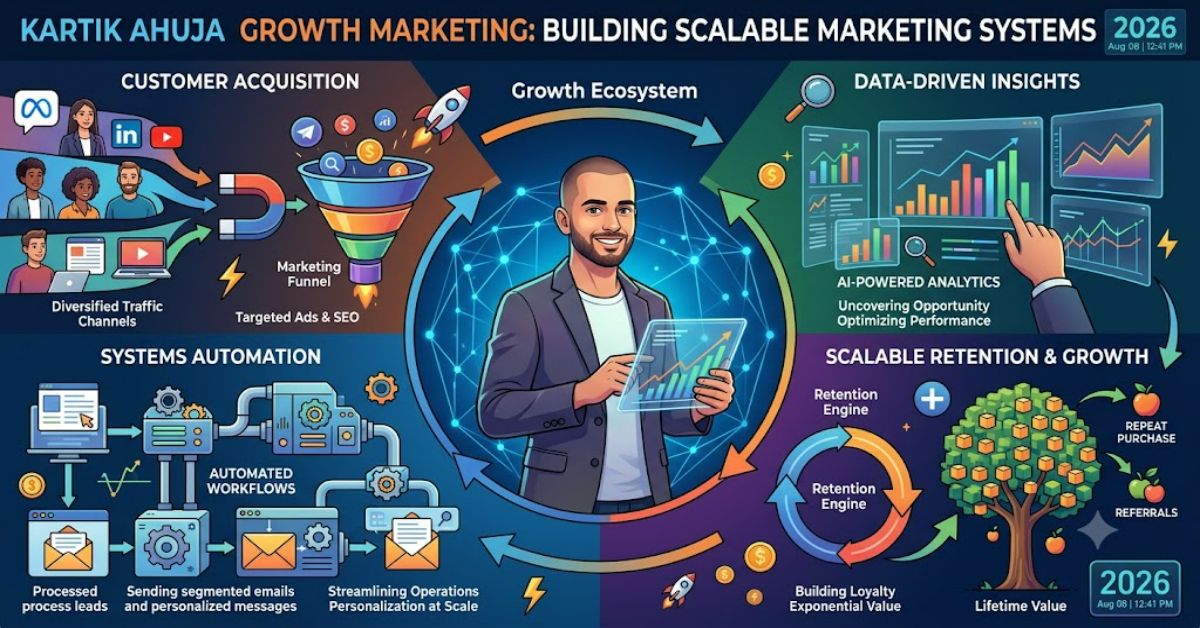
Kartik Ahuja growth marketing is closely associated with a systems-based approach to digital marketing rather than relying on a single traffic channel or advertising tactic. Ahuja is the founder and CEO of GrowthScribe, a marketing agency that works across areas including growth marketing, website and funnel development, email marketing, conversion rate optimisation, copywriting and automation. His professional profile also identifies growth marketing and marketing strategy among his services.
That combination is important because growth marketing is often reduced to acquiring more visitors. In practice, sustainable growth depends on what happens after someone arrives. A business needs a clear offer, an effective landing page, a measurable conversion path and an economically viable way to acquire customers.
Ahuja’s own published material provides a useful view of this philosophy. In a November 2025 article, he described an audit process built around four layers: unit economics, offer and messaging, funnel and conversion, and traffic and acquisition. He argued that businesses should address foundational problems before investing heavily in optimisation or new acquisition channels.
This framework helps explain why his work is relevant to founders and digital businesses looking beyond short-term campaign performance.
Who Is Kartik Ahuja?
Kartik Ahuja is an entrepreneur and marketing professional associated with GrowthScribe. His LinkedIn profile lists GrowthScribe as his company and identifies services including growth marketing, lead generation, marketing strategy, digital marketing and conversion-focused website work.
GrowthScribe’s own website identifies Ahuja as CEO and founder. The company’s history also states that he began his professional career in sales in 2011, describing an early focus on generating revenue before moving deeper into marketing.
This background is relevant to understanding his marketing philosophy. Rather than treating marketing as purely a creative discipline, his public work repeatedly connects marketing activity with revenue, customer acquisition and operational systems.
What Defines the Kartik Ahuja Growth Marketing Approach?
A useful way to understand the approach is to separate marketing into connected layers.
| Growth layer | Main question | Typical focus |
| Unit economics | Can growth make money? | CAC, LTV and channel economics |
| Offer and messaging | Is the value clear? | Positioning and copy |
| Funnel and conversion | Where are prospects lost? | Landing pages and conversion paths |
| Acquisition | Can demand be generated efficiently? | Paid, organic and outbound channels |
This structure appears directly in Ahuja’s November 2025 marketing audit framework. He described the order as unit economics first, followed by offer and messaging, funnel and conversion, then traffic and acquisition.
The strategic implication is straightforward: increasing traffic does not automatically solve a conversion problem.
If a landing page is ineffective, buying more visitors can simply increase the amount of money being spent on an inefficient funnel.
Why Unit Economics Comes First
One of the strongest aspects of Ahuja’s published framework is its focus on customer acquisition cost rather than traffic alone.
In his 2025 audit article, Ahuja presented an example involving a company that allocated 60% of its budget to Google Ads, where reported CAC was $340, while LinkedIn organic content and outreach represented 15% of spending with a reported CAC of $95. He described changing the allocation and reported that blended CAC subsequently fell to $160.
The example illustrates an important growth marketing principle: the largest channel is not necessarily the most efficient channel.
For founders, this means CAC should be examined by source rather than relying only on a blended figure. A blended number can hide major differences between acquisition channels.
The economics of growth
| Metric | Why it matters |
| CAC | Shows the cost of acquiring customers |
| LTV | Indicates potential long-term customer value |
| Conversion rate | Measures movement through the funnel |
| Revenue per customer | Connects marketing activity to commercial results |
| Channel CAC | Reveals which acquisition sources are efficient |
The practical lesson is that growth marketing should be tied to financial performance. A campaign that produces leads but cannot produce economically viable customers is not necessarily a successful growth programme.
Funnels and Conversion Optimisation
Funnels are another major component of the GrowthScribe model. The company’s listed services include website and funnel building, email marketing, conversion rate optimisation and copywriting.
A funnel gives marketers a way to examine customer behaviour as a sequence rather than as a single conversion event.
For example, a simplified funnel might move from:
Traffic → Landing Page → Lead → Sales Conversation → Customer → Repeat Purchase
A weakness at any stage can reduce the final result.
This is where conversion rate optimisation becomes strategically useful. Instead of automatically increasing advertising spend, marketers can identify friction in the existing customer journey and improve the weakest stage.
That can involve clearer messaging, stronger calls to action, faster pages, better lead qualification or more relevant follow-up.
Automation as a Growth Infrastructure
Automation is another important part of the approach. GrowthScribe describes services covering business automation, email marketing and tools such as Zapier, alongside its broader marketing services.
Automation can reduce repetitive manual work, but it should not be confused with strategy.
A useful distinction is:
- Strategy: decides what should happen.
- Automation: makes repeatable processes happen consistently.
- Analytics: determines whether those processes are producing the desired outcome.
This distinction matters because automating a weak process can make inefficiency happen faster.
A More Disciplined Alternative to “Growth at Any Cost”
Ahuja’s public audit framework offers a counterpoint to growth strategies that begin with advertising, social media or content volume.
His stated priority system places broken unit economics and unclear offers at the top, followed by funnel problems and channel allocation. Creative testing and new-channel exploration come later.
That creates a simple hierarchy:
Economics → Offer → Funnel → Acquisition → Optimisation
The advantage is that teams can avoid spending heavily on problems that are not primarily traffic problems.
The limitation is that every business has different economics and customer behaviour. A framework can guide diagnosis, but it cannot replace customer research, accurate measurement and channel-specific testing.
Evidence of Industry Engagement
Ahuja’s professional profile shows that his expertise has extended beyond GrowthScribe’s own marketing activities. His profile lists appearances and contributions connected with publications including BBC and GOBankingRates.
In April 2024, GOBankingRates quoted Ahuja as the founder, chief financial officer and chief marketing officer of GrowthScribe in an article examining leadership skills. His comments focused on leadership, communication and learning from feedback.
These appearances provide an additional signal of professional visibility, although media contributions should not be treated as independent proof that every marketing strategy produces a particular commercial outcome.
The Future of Kartik Ahuja Growth Marketing in 2027
By 2027, growth marketing is likely to become increasingly connected to automation, first-party customer data, artificial intelligence and measurable unit economics.
The underlying principles of Ahuja’s framework may therefore become more important rather than less relevant. More automated acquisition means businesses will need stronger measurement to understand which activities actually produce profitable customers.
AI may accelerate content production and campaign experimentation, but it does not remove the need for positioning, customer research or sound economics.
The main constraint will be measurement quality. If a company cannot accurately connect acquisition costs with customer value, adding more automation can increase complexity without improving decision-making.
Key Takeaways
- Growth marketing is more than traffic acquisition.
- Ahuja’s published framework starts with unit economics.
- Offers and messaging influence every later stage of a funnel.
- Conversion problems should be diagnosed before simply increasing traffic.
- Automation is most useful when the underlying process is already sound.
- Channel-level CAC can reveal inefficiencies hidden by blended metrics.
- Sustainable growth requires marketing and commercial performance to be measured together.
Conclusion
Kartik Ahuja’s growth marketing philosophy can be understood as a structured approach to scaling digital businesses. Its central idea is that growth should begin with the foundations of a business rather than with advertising spend alone.
His published four-layer audit framework places unit economics at the bottom, followed by offer and messaging, funnel and conversion, and finally traffic and acquisition. This sequence creates a useful diagnostic model for businesses trying to determine why growth has stalled.
GrowthScribe’s combination of funnel development, conversion optimisation, email marketing and automation also reflects this systems-oriented view of marketing.
The approach does not eliminate the need for experimentation. Instead, it gives experimentation a clearer place within the wider commercial system. For businesses, that distinction can be valuable: the goal is not simply to generate more activity, but to build a marketing engine capable of producing measurable and economically sustainable results.
FAQ
What is Kartik Ahuja known for?
Kartik Ahuja is known for his work in growth marketing and as the founder and CEO of GrowthScribe. His listed expertise includes marketing strategy, lead generation, conversion optimisation and digital marketing.
What is the Kartik Ahuja growth marketing framework?
His published 2025 audit framework uses four layers: unit economics, offer and messaging, funnel and conversion, and traffic and acquisition.
What does GrowthScribe do?
GrowthScribe provides services including funnel building, email marketing, conversion rate optimisation, copywriting, social media marketing and automation.
Why does Ahuja focus on unit economics?
Unit economics helps businesses determine whether customer acquisition is financially sustainable. It can also reveal when a high-spend marketing channel is less efficient than a smaller acquisition source.
Is growth marketing only about paid advertising?
No. Growth marketing can include organic acquisition, content, email, SEO, partnerships, outbound activity, conversion optimisation and paid advertising. The appropriate mix depends on customer behaviour and unit economics.
What role does automation play in growth marketing?
Automation handles repeatable processes such as lead follow-up, marketing workflows and data movement. It can improve consistency and efficiency, but it cannot replace sound positioning or strategy.
Methodology
This article was prepared using publicly available information from GrowthScribe’s official website, Kartik Ahuja’s public LinkedIn profile and published professional material. The analysis distinguishes between claims made by Ahuja or GrowthScribe and independently verifiable information. No private interviews, original performance testing or firsthand client audits were conducted for this article.
Reported performance figures from Ahuja’s own 2025 audit article are presented as his published example rather than as independently verified results. This limitation is important when assessing claims about marketing effectiveness.
References
GOBankingRates. (2024, April 3). Want better pay? Develop this key trait bosses look for when hiring.
GrowthScribe. (n.d.). About GrowthScribe.
GrowthScribe. (n.d.). GrowthScribe. LinkedIn.
Ahuja, K. (2025, November 11). I’ve audited 50+ companies in the last 3 years. LinkedIn.
Ahuja, K. (n.d.). Kartik Ahuja – GrowthScribe. LinkedIn.