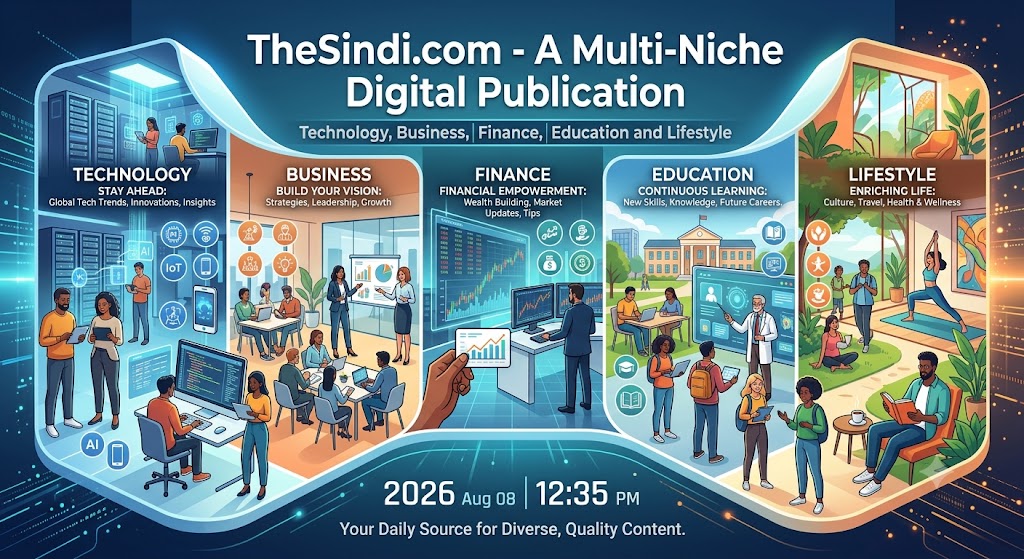
TheSindi.com is an independent multi-niche digital publication designed to provide readers with news, insights, practical guides and general knowledge across a wide range of subjects. Its coverage includes areas such as technology, business, finance, education, health, lifestyle, travel, law and other everyday topics.
The central appeal of TheSindi.com is breadth. Instead of asking readers to move between specialist websites for every question, the publication attempts to provide accessible explanations across different areas of modern life. That model is increasingly common online, particularly as readers use search engines to find quick explanations rather than visiting a publication with a narrow editorial focus.
However, breadth creates a challenge. A website covering technology, finance, health and legal subjects must maintain different standards of accuracy because the consequences of incorrect information vary sharply between categories. A basic explanation of a technology term carries a different level of risk from guidance concerning financial decisions or health.
Independent reviews of the site have described it as a functioning multi-topic content platform, while also pointing to areas where editorial transparency and sourcing can be improved.
That makes TheSindi.com an interesting example of the modern general-interest information site. Its value is not simply the number of subjects it covers. The more important question is whether it can combine accessibility with the evidence, expertise and transparency expected from a trusted digital publication.
What Is TheSindi.com?
TheSindi.com can best be understood as a general-interest digital publication rather than a specialist news organisation. Its editorial model centres on producing accessible content across multiple categories.
Available descriptions of the publication identify technology, business, finance, education, health, lifestyle and related subjects among its areas of interest.
This approach serves a clear reader need. Someone searching for an unfamiliar term may not want an academic paper or a highly technical industry report. They may simply want a clear explanation written in ordinary language.
The multi-niche structure also allows the publication to address different search intents. One reader might arrive looking for a technology explanation, while another could be researching a financial term or looking for a practical lifestyle guide.
The trade-off is subject-matter authority. A publication cannot automatically possess specialist expertise simply because it covers a topic. Strong authority requires appropriate sourcing, accurate attribution and editorial processes suited to each subject.
How Its Multi-Niche Model Works
The fundamental system behind a multi-niche publication is relatively straightforward: organise content into recognisable subject areas and create individual articles designed to answer specific reader questions.
| Editorial Element | Purpose | Main Advantage | Main Risk |
| Technology coverage | Explain digital products and concepts | Broad search interest | Rapidly changing information |
| Business and finance | Explain companies and financial topics | Strong practical relevance | Higher accuracy requirements |
| Lifestyle | Address everyday interests | Large potential audience | High competition |
| Education | Provide learning information | Useful for students and readers | Sources can become outdated |
| Health | Explain health-related subjects | Significant public interest | Requires especially careful sourcing |
| Travel | Provide destination and practical information | Strong planning intent | Dates, rules and costs change |
The model is therefore not inherently weak. Its performance depends on how editorial discipline is applied across categories.
A technology article can often remain useful for months or years if it explains a stable concept. A travel article involving prices, visa rules or opening times may require much more frequent updating.
The Main Strength: Accessibility
One of the clearest advantages of TheSindi.com is accessibility.
Multi-niche publications can reduce the friction involved in learning about unfamiliar subjects. Readers do not necessarily arrive with specialist knowledge. They often want a quick explanation before deciding whether deeper research is necessary.
This creates an important role for general-interest explainers. They can function as an orientation layer between a search query and authoritative specialist sources.
Independent reviews have similarly characterised the site as beginner-friendly and relatively straightforward to navigate, while describing its depth as more limited than specialist research sources.
That distinction matters. A publication can be useful without being the final authority on every subject.
Trust, Sources and Editorial Transparency
Trust is the most important long-term issue for any multi-niche publication.
A reader evaluating an article should be able to understand who produced it, where important claims came from and whether the information has been checked recently. This becomes particularly important for subjects involving money, health, law or other high-impact decisions.
Independent assessments of TheSindi.com have identified limited transparency around authorship and editorial oversight as areas requiring attention.
This does not automatically make information on the site inaccurate. It does, however, affect how confidently readers should interpret specialist claims.
A useful editorial distinction is:
General explanation: Useful for understanding terminology and basic concepts.
Specialist guidance: Requires stronger evidence, named expertise and current primary sources.
High-stakes advice: Should be checked against official government, medical, financial, legal or regulatory sources.
That framework is useful for readers of any general-interest publication, not just TheSindi.com.
TheSindi.com Compared With Specialist Publications
A multi-niche publication and a specialist publication serve different purposes.
| Factor | TheSindi.com Model | Specialist Publication |
| Topic range | Broad | Narrow |
| Reader accessibility | Generally high | Varies |
| Subject expertise | Varies by article | Usually concentrated |
| Search intent | Wide | More specialised |
| Research depth | Often introductory | Often deeper |
| Updating needs | High across categories | Focused on one field |
| Best use | Initial understanding | Detailed research |
The comparison shows why readers should not judge a general-interest platform using exactly the same criteria as an academic journal or specialist trade publication.
The strongest role for a broad publication is often to make complicated subjects easier to approach.
Strategic Opportunities
The multi-niche structure gives TheSindi.com several opportunities.
First, it can develop topical clusters. Instead of publishing isolated articles about unrelated subjects, it can build interconnected collections around areas such as technology, business or education.
Second, it can improve source transparency. Adding citations to primary sources, official documents and recognised institutions would make important claims easier to verify.
Third, it can strengthen author accountability. Clear author profiles showing relevant experience would help readers understand why an individual is qualified to discuss a particular subject.
These changes would also improve the relationship between accessibility and trust. Simple writing does not need to mean shallow research.
Risks and Trade-Offs
The biggest structural risk is overextension.
A publication covering many categories has to maintain editorial quality across very different information environments. Technology changes quickly. Financial information is sensitive to market conditions. Health guidance can change following new research. Travel information can become outdated because of regulations or local conditions.
The table below illustrates why updating requirements differ.
| Content Type | Typical Freshness Pressure | Verification Priority |
| Basic technology concepts | Medium | Technical documentation |
| Company information | Medium to high | Company and regulatory sources |
| Finance | High | Regulators and primary financial data |
| Health | High | Government and medical sources |
| Travel | High | Official destination and government sources |
| Lifestyle | Low to medium | Context and reputable sources |
This is one of the most important insights for a general-interest publication: content breadth increases the number of editorial systems required to maintain trust.
Publishing more subjects is therefore not simply a content-volume decision. It is an editorial governance challenge.
The Real-World Value of a Multi-Niche Publication
The broader digital publishing market increasingly relies on readers discovering individual articles through search engines rather than entering through a publication’s homepage.
That changes how publications should think about their relationship with readers.
A visitor may never become a regular reader. They may arrive with one question, find an explanation and leave. The quality of that individual interaction therefore matters.
TheSindi.com’s multi-topic approach is well suited to this behaviour because it can address many different search journeys. External reviews also describe its content as useful for readers seeking introductory explanations across unrelated categories.
The challenge is turning individual search visits into lasting trust. That requires consistent accuracy, recognisable editorial standards and reasons for readers to return.
Three Evidence-Based Insights About TheSindi.com
Breadth is both its advantage and its editorial burden. A wide subject range creates more opportunities to answer search questions, but it also requires different verification standards.
Accessibility should be treated as a gateway, not a substitute for expertise. Straightforward explanations are valuable, particularly for beginners, but high-impact decisions require stronger primary sources.
Transparency can become a competitive advantage. Clear author information, sourcing and update dates would allow a multi-niche publication to distinguish itself from generic content sites without sacrificing readability.
These observations are grounded in available assessments of the publication and broader principles of digital editorial quality rather than claims of private access or unpublished performance data.
The Future of TheSindi.com in 2027
By 2027, the strongest opportunity for TheSindi.com is likely to be deeper editorial differentiation rather than simply increasing the number of topics covered.
Search systems increasingly place emphasis on useful, reliable information and clear evidence of experience and expertise. Google’s guidance on creating helpful content also places importance on content created for people rather than solely for search-engine manipulation.
For a multi-niche publication, this points towards a practical strategy: fewer generic articles, stronger topic clusters, better sourcing and more transparent authorship.
Artificial intelligence will also increase competition in general-interest publishing. Automated systems make it easier to produce basic explainers, which means originality and verification become more valuable.
The infrastructure challenge is equally important. A publication covering many categories needs an efficient update system. Articles containing changing statistics, prices, laws or regulations cannot simply be published once and forgotten.
The future is therefore likely to favour editorial systems that combine scale with accountability.
Key Takeaways
- TheSindi.com is best understood as a broad information and explainer publication.
- Its multi-niche model gives readers convenience but creates significant editorial-quality demands.
- Accessibility is one of its strongest potential advantages.
- Specialist subjects require stronger sourcing than general-interest topics.
- Author transparency can materially improve reader trust.
- Updating systems are essential for information that changes frequently.
- Long-term differentiation will depend more on quality and authority than publishing volume alone.
Conclusion
TheSindi.com represents a familiar but increasingly important model in digital publishing: one platform attempting to answer questions across many areas of everyday life.
Its breadth gives it a practical advantage. Readers can move from technology to business, education, lifestyle or other subjects without changing platforms. For basic orientation and accessible explanations, that model can be useful.
The main challenge is maintaining trust across such a wide editorial territory. Different subjects demand different levels of evidence, expertise and updating. A simple explanation may be enough for a basic definition, but financial, health and legal topics require much stronger verification.
TheSindi.com’s future therefore depends less on how many subjects it covers and more on how effectively it establishes editorial accountability around those subjects. Transparent authorship, primary-source citations, visible update practices and clear distinctions between general information and specialist advice would strengthen its position.
For readers, the sensible approach is equally clear: use broad digital publications to understand a subject, then move to authoritative primary sources when a decision carries meaningful consequences.
Frequently Asked Questions
What is TheSindi.com?
TheSindi.com is an independent multi-niche digital publication covering subjects such as technology, business, finance, education, lifestyle and other areas of general interest.
What type of content does TheSindi.com publish?
The publication focuses on explainers, guides, news-style information and practical articles intended to make different subjects easier to understand.
Is TheSindi.com a specialist publication?
No. Its defining characteristic is its broad subject coverage. Readers should therefore distinguish between introductory information and specialist guidance from qualified sources.
Can TheSindi.com be used for financial or health decisions?
Readers should not rely on a general-interest publication as their only source for high-impact decisions. Financial and health information should be checked against current official or professional sources.
Why do multi-niche websites face trust challenges?
Different subjects require different forms of expertise and verification. A publication covering many categories must maintain appropriate editorial standards across each one.
What could improve TheSindi.com’s authority?
Clear author profiles, primary-source citations, transparent editorial policies, publication dates and visible update records could strengthen its credibility.
Methodology
This article was prepared using publicly available information about TheSindi.com, including independent assessments published during 2026 and available descriptions of the publication. The analysis distinguishes between directly observable information and broader editorial interpretation.
No private analytics, internal company records, unpublished traffic data or proprietary editorial information were used. No independent hands-on testing was claimed where testing could not be verified.
Because website structures, authorship, content and publishing practices can change, readers should treat this assessment as a time-specific analysis rather than a permanent judgement. High-impact information should always be checked against appropriate primary sources.
This article was drafted with AI assistance and requires human editorial review before publication. All data, citations and named claims should be independently checked against the original sources.
References
AppCritica. (2026). Thesindi.com review: Beginner-friendly guide hub or just another content farm?
GuideNetWorth. (2026). Thesindi.com review (2026): Features, content & is it legit?
RubbleMagazine.co.uk. (2026). DigitalConnectMag.com: Exploring authority, revenue model and 2027 growth strategy.
SoftwareCurio. (2026). TheSindi.com review (2026): Is it legit or a content farm?
Timtis. (2026). TheSindi.com reviewed: Topics, editorial style, and reader fit.
ZuloAI. (2026). Is thesindi.com legitimate, useful and worth trusting?