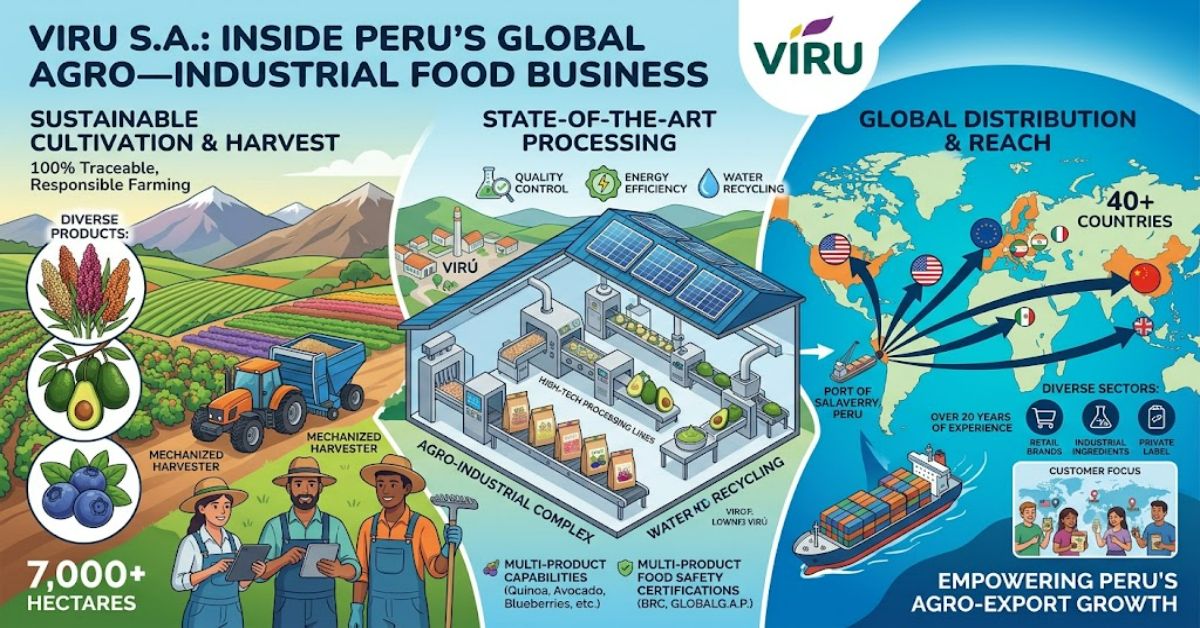
Viru S.A., also operating internationally as Grupo Viru, is a Peruvian agro-industrial company that has developed from a regional agricultural business into a global food supplier. The company began operations in 1994 with 150 hectares of cultivation and has since expanded its agricultural and processing footprint substantially. Today, Viru Group describes itself as an international food group with more than 30 years of experience, supplying products to more than 50 countries across five continents.
The company is particularly associated with vegetables and fruit sold in fresh, frozen and preserved formats. Its product portfolio includes asparagus, artichokes, piquillo peppers, avocadoes, blueberries, mangoes and hearts of palm, among others. This breadth matters because it reduces dependence on a single crop or product category while allowing the company to serve different retail, food-service and industrial requirements.
Viru’s development also reflects a wider transformation in Peru’s agricultural economy. Rather than exporting only raw produce, the company has invested in processing, packaging, logistics and international commercial operations. That approach allows agricultural output to enter global markets in forms designed for different consumer and business needs.
The result is a business whose competitiveness depends not only on farming, but also on supply-chain control, food safety, processing technology, market access and the ability to maintain consistent quality across international destinations.
How Viru S.A. Developed
The origins of Viru S.A. date to 1994, when the company began with a relatively modest agricultural base in Peru. An EY profile of founder Miguel Nicolini records the company’s establishment in August 1994 and describes the early operation as beginning with 150 hectares.
Its early focus included asparagus, a crop that became important to Peru’s emerging export-oriented agro-industrial sector. Over time, Viru expanded into additional vegetables, fruits and value-added products.
A particularly important part of this evolution was the movement from cultivation into processing. Instead of treating agriculture and manufacturing as separate activities, the company developed facilities near cultivation areas. Viru Group currently describes this as vertical integration, with production facilities positioned alongside its fields to improve control over traceability and the supply chain.
What Does Viru Produce?
The company’s portfolio covers three broad commercial formats.
| Product line | Examples | Main commercial advantage |
| Fresh | Avocado, asparagus, blueberries | Direct access to fresh-produce markets |
| Frozen | Fruits and vegetables | Longer shelf life and international distribution |
| Preserved | Artichokes, peppers, vegetables and sauces | Extended shelf life and value-added processing |
Viru states that its frozen operation uses IQF, or Individually Quick Freezing, technology. The process is designed to freeze individual pieces rapidly rather than producing a single frozen block, helping preserve product characteristics and making portions easier to handle.
This three-format model is strategically significant. Fresh produce can target consumers seeking minimally processed food, while frozen and preserved products provide greater flexibility for international shipping and storage.
A Supply Chain Built Around Integration
One of the most important characteristics of Viru’s model is vertical integration.
The company says it operates more than 15,000 hectares of cultivation and 11 production plants, while maintaining operations through subsidiaries in Europe and commercial activity in North America and Asia. It also reports more than 19,000 collaborators across the group.
Earlier independent industry data provides a useful point of comparison. ADEX described Viru as Peru’s largest producer of vegetable preserves and frozen fruits, with more than 12,000 workers and facilities across Peru, alongside subsidiaries in Italy, Spain and France.
| Business factor | Viru’s reported position |
| Established | 1994 |
| Main base | Virú, La Libertad, Peru |
| International reach | More than 50 countries |
| Production model | Fresh, frozen and preserved |
| Cultivation area | More than 15,000 hectares reported by the group |
| Production plants | 11 reported by the group |
The comparison between older and current figures also shows why Viru should be viewed as a developing group rather than a static company. Its reported footprint has expanded considerably over time.
Why Global Distribution Matters
Exporting food at scale requires more than producing a competitive crop. Temperature control, packaging, customs procedures, food-safety documentation and shipping schedules can all affect the final product.
Viru’s international structure reflects this reality. The group identifies operations in Europe through Viru Ibérica, Viru France and Viru Italy, while its website states that it distributes across five continents and more than 50 countries.
Great Place to Work Peru reported in 2024 that Viru supplied more than 50 countries and served an average of 270 clients. The same source reported more than 13,000 hectares and 10 processing plants at that time, demonstrating how the company’s footprint has continued to change.
This creates one of the company’s key competitive advantages: geographic diversification. Demand weakness in one destination does not necessarily affect the entire export network in the same way.
Risks and Trade-Offs
The integrated model also creates substantial exposure.
Agricultural production depends on water availability, weather conditions, pests and climate variability. Processing facilities add energy, labour, maintenance and food-safety requirements. International exports introduce freight costs, currency exposure, regulatory requirements and geopolitical uncertainty.
Water management is especially important for an agricultural company operating at this scale. Viru says sustainability is integrated into its operating strategy and that it is investing in technology and process improvements. The group reports investing US$128 million over the previous four years in solutions intended to improve products and operations.
Labour is another significant consideration. Great Place to Work reported 12,000 collaborators in 2024, while Viru’s current corporate information reports a larger workforce. The scale demonstrates the company’s importance as an employer but also means labour standards, workplace safety and workforce development remain material operational issues.
The Future of Viru S.A. in 2027
By 2027, Viru’s most important opportunities are likely to centre on higher-value food products, supply-chain efficiency and sustainability rather than simple expansion of agricultural acreage.
Its existing combination of fresh, frozen and preserved products provides a useful platform for diversification. IQF technology, traceability and international distribution can support products designed for convenience-focused consumers and food-service buyers.
However, expansion will remain constrained by water availability, climate risk, logistics and food-safety requirements. For a producer serving more than 50 countries, consistency can be as important as volume. The future competitive question is therefore not simply how much Viru can grow, but how efficiently it can produce, process and distribute food while managing environmental and operational risks.
Key Takeaways
- Integrated model: Viru links agricultural production with processing and distribution.
- Product diversification: Fresh, frozen and preserved formats reduce dependence on one market.
- International reach: The group reports distribution to more than 50 countries.
- Processing capability: IQF freezing and preserved-food production extend product shelf life.
- Operational exposure: Water, climate, labour, logistics and food safety remain major risks.
- Value creation: Processing agricultural products can generate more commercial flexibility than exporting raw produce.
Conclusion
Viru S.A. illustrates how Peru’s agricultural sector can develop into a sophisticated international food business. Since beginning operations in 1994, the company has expanded from its original agricultural base into an integrated group combining cultivation, processing and international distribution.
Its current structure spans fresh produce, frozen foods and preserved products, giving the business multiple routes to market. The group’s reported presence in more than 50 countries also demonstrates the importance of logistics and international commercial infrastructure in modern agro-industry.
At the same time, scale brings responsibility and exposure. Water availability, climate conditions, labour management, food safety and transportation can all influence performance. Viru’s continued investment in technology and sustainability suggests that these issues are becoming central to its long-term operating model.
The company’s story is therefore not simply one of agricultural growth. It is a case study in how production, processing and global distribution can be combined to turn regional agricultural resources into internationally marketed food products.
Frequently Asked Questions
What is Viru S.A.?
Viru S.A. is a Peruvian agro-industrial company founded in 1994. It produces and processes fruits and vegetables in fresh, frozen and preserved formats and distributes products internationally.
Where is Viru S.A. based?
The company is based in Virú, La Libertad, Peru, with its registered operating location on the Pan-American North Highway. It also maintains international operations in Europe and commercial activity in other global markets.
What products does Viru Group make?
Its portfolio includes asparagus, artichokes, piquillo peppers, avocadoes, blueberries, mangoes, hearts of palm, sauces and other fruit and vegetable products. These are sold fresh, frozen or preserved.
How many countries does Viru export to?
Viru Group currently states that it distributes products to more than 50 countries across five continents.
When was Viru S.A. founded?
Viru began operations in 1994. EY’s profile of founder Miguel Nicolini records the company’s establishment in August 1994, while industry directories also identify 1994 as its starting year.
Methodology
This article was prepared using publicly available information from Viru Group, the Peruvian Exporters Association (ADEX), Great Place to Work Peru and EY. Company scale, product categories, international reach and historical information were cross-checked where possible against multiple sources.
The main limitation is that Viru is not a publicly listed company with the same level of continuously published financial disclosure as a major listed multinational. Some workforce, land-area and facility figures therefore vary by publication date. Current company-reported figures should be treated as the latest stated position rather than a permanent measure.
No fabricated interviews, personal site visits or hands-on testing have been presented as firsthand experience.
Editorial disclosure: This article was drafted with AI assistance and should be reviewed and verified by a human editor before publication. Statistics, dates, named claims and references should be checked against the original sources.
References
ADEX. (n.d.). VIRU S.A. – Directorio ADEX. Asociación de Exportadores del Perú.
EY. (2021). Pasión por la libertad: Los inicios y el desarrollo de Virú S.A. EY Peru.
Great Place to Work Peru. (2024, 29 May). Virú S.A. Great Place to Work Peru. Viru Group. (2026). Viru — Naturally Ahead. Viru Group