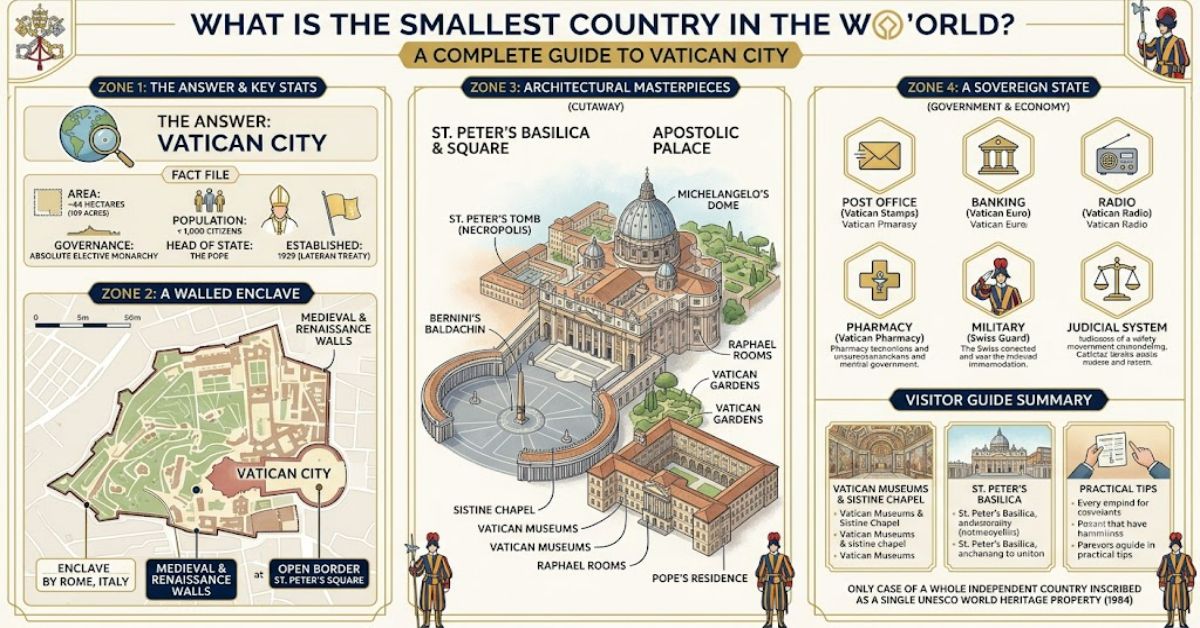
The answer to the question What Is the smallest country in the world is Vatican City, a tiny independent state located entirely within the city of Rome, Italy. Recognised as a sovereign country since the Lateran Treaty of 1929, Vatican City covers only around 0.17 square miles (0.44 square kilometres) and has a population of roughly 800 residents. Although it is smaller than many individual neighbourhoods around the world, its cultural, religious, and political importance extends far beyond its physical borders.
Unlike traditional countries that are defined by large territories, natural resources, or major populations, Vatican City demonstrates how sovereignty can exist on a very small scale. It serves as the administrative centre of the Catholic Church and the official residence of the Pope, the leader of more than one billion Catholics worldwide.
Understanding this microstate requires looking beyond its size. Vatican City contains some of the most recognised artistic and architectural achievements in history, including St Peter’s Basilica, the Sistine Chapel, and extensive museum collections. Its role in international diplomacy also gives it an influence that exceeds its geographical dimensions.
The country’s unusual position raises important questions about how nations are defined. Does a country need a large population, significant territory, or economic power to matter globally? Vatican City provides a different example, showing that historical importance, religious authority, and diplomatic relationships can create international relevance even within a very small space.
Vatican City: What Is the smallest country in the world
Vatican City holds the title of the smallest sovereign country on Earth when measured by both land area and population. It is surrounded completely by Rome, making it an example of an enclave — a country located entirely inside another country.
The state was officially created on 11 February 1929 through the Lateran Treaty between the Holy See and the Kingdom of Italy. This agreement resolved disputes that had existed since the unification of Italy in the nineteenth century and established Vatican City as an independent territory.
| Country | Approximate Area | Population | Location |
| Vatican City | 0.44 km² | Around 800 people | Rome, Italy |
| Monaco | 2.02 km² | Around 39,000 people | French Riviera |
| Nauru | 21 km² | Around 12,000 people | Pacific Ocean |
While Monaco and Nauru are also among the world’s smallest nations, neither is smaller than Vatican City in terms of land area.
How Vatican City Became an Independent State
The history of Vatican City is closely connected with the history of the Papacy. For centuries, popes controlled large territories known as the Papal States, which existed across parts of central Italy.
However, during the Italian unification movement in the nineteenth century, most Papal territories were absorbed into the newly formed Kingdom of Italy. The situation created a political conflict between the Italian government and the Vatican, known as the “Roman Question”.
This dispute lasted until 1929, when the Lateran Treaty established Vatican City as an independent nation. The agreement recognised the Pope’s sovereignty and provided a territorial base for the Holy See.
The creation of the state was not based on economic expansion or military power. Instead, it was designed to protect the independence of the Pope and ensure that religious leadership could operate without direct control from another government.
The Unique Government System of Vatican City
Vatican City operates as an absolute elective monarchy, with the Pope serving as head of state. Unlike constitutional monarchies, where power is shared with elected governments, Vatican City’s authority is concentrated around the Pope and appointed officials.
The main administrative body is the Pontifical Commission for Vatican City State, which handles internal governance. The Governorate of Vatican City manages daily operations, including security, infrastructure, and public services.
| Government Feature | Description |
| Head of State | The Pope |
| Political System | Absolute elective monarchy |
| Independence Established | 1929 |
| Official Language | Latin and Italian |
| Currency | Euro |
The country also maintains diplomatic relations through the Holy See, which has relationships with countries around the world and participates in international discussions.
Why Is Vatican City Important Despite Its Size?
The importance of Vatican City cannot be measured through traditional indicators such as population size or economic output. Its influence comes from its religious, cultural, and diplomatic roles.
The Vatican Museums attract millions of visitors every year, making them one of the world’s most significant cultural destinations. The collection includes ancient sculptures, Renaissance paintings, manuscripts, and historical artefacts.
The Sistine Chapel, famous for Michelangelo’s ceiling painted between 1508 and 1512, represents one of the greatest achievements of Renaissance art. St Peter’s Basilica, rebuilt during the sixteenth and seventeenth centuries, remains one of the largest and most recognisable churches worldwide.
A major insight about Vatican City is that its global impact comes from “soft power” rather than physical resources. The country demonstrates how cultural heritage and international relationships can create influence without a large territory.
Daily Life and Economy in the World’s Smallest Nation
Life inside Vatican City is very different from life in larger countries. Most residents are clergy members, Swiss Guards, diplomats, or employees working for Vatican institutions. Citizenship is not usually inherited but granted based on specific roles connected with Vatican service.
The economy does not function like a typical national economy. Vatican City generates income through tourism, museum tickets, publications, donations, and financial activities connected with the Catholic Church.
| Economic Activity | Role in Vatican City |
| Tourism | Major source through museums and attractions |
| Donations | Supports Church activities worldwide |
| Publishing | Religious books and official documents |
| Services | Employment and administration |
One practical limitation of being a microstate is dependency. Vatican City relies heavily on Italy for many essential services, including transport access, utilities, and infrastructure support.
Comparing the World’s Smallest Countries
Although Vatican City is the smallest country, other nations also demonstrate how small states can maintain independence.
| Country | Size Rank | Unique Feature |
| Vatican City | 1st smallest | Global religious centre |
| Monaco | 2nd smallest | Major financial and tourism hub |
| Nauru | 3rd smallest | Island nation in the Pacific |
These examples show that small countries often develop specialised identities. Monaco focuses on finance and luxury tourism, while Vatican City focuses on religion and cultural preservation.
The Future of Vatican City in 2027
By 2027, Vatican City is expected to continue balancing tradition with modern challenges. Digital preservation projects, online museum experiences, and improved visitor management are likely to remain important areas of development.
Climate concerns may also influence how the Vatican protects historic buildings and artworks. Conservation experts increasingly focus on managing environmental risks such as humidity changes and pollution exposure.
The country’s future influence will likely remain connected to diplomacy, cultural preservation, and religious leadership rather than territorial growth.
Key Takeaways
- Vatican City is the smallest sovereign nation by both land area and population.
- Its independence began with the Lateran Treaty signed in 1929.
- The country’s influence comes from religion, culture, diplomacy, and history.
- Its government operates as an absolute elective monarchy led by the Pope.
- Tourism and heritage preservation are central to its economy.
- Vatican City shows that global importance is not determined only by physical size.
Conclusion
Vatican City proves that national importance cannot always be measured through territory or population. Although it occupies less space than many modern cities, it holds extraordinary cultural, religious, and diplomatic significance.
Its creation in 1929 provided independence for the Holy See and established a unique model of statehood. The country’s historic buildings, priceless artworks, and global religious role continue to attract millions of visitors and international attention.
The story of Vatican City challenges traditional ideas about what makes a country powerful or influential. Its example demonstrates that heritage, identity, and global relationships can allow even the smallest nations to maintain a lasting presence on the world stage.
Frequently Asked Questions
What is the smallest country in the world by land area?
Vatican City is the smallest country by land area, covering approximately 0.44 square kilometres. It is located entirely within Rome, Italy.
What is the What Is the smallest country in the world by population?
Vatican City is also the least populated sovereign state, with fewer than 1,000 residents.
Why is Vatican City a separate country?
Vatican City became independent through the Lateran Treaty of 1929, which recognised the sovereignty of the Holy See.
Who rules Vatican City?
The Pope is the head of state and holds supreme authority within Vatican City’s government system.
Can people become citizens of Vatican City?
Citizenship is granted based on specific roles, such as working for the Vatican or serving the Holy See, rather than being automatically gained through birth.
Is Vatican City part of Italy?
No. Although it is surrounded by Rome, Vatican City is an independent sovereign state.
Methodology
This article What Is the smallest country in the world was prepared using historical records, geographic references, and information from recognised institutions including Vatican publications, international geographic databases, and official government sources. The analysis focuses on verified facts about territory, population, governance, and cultural importance.
Limitations include changes in population figures due to Vatican citizenship rules and differences in measurement methods used by geographic organisations. While Vatican City’s influence is widely recognised, interpretations of cultural and political importance may vary.
References
Holy See. (2024). Vatican City State: Official Information and Institutional Structure. Vatican City.
Encyclopaedia Britannica. (2025). Vatican City: History, Geography, and Facts. Encyclopaedia Britannica.
United Nations. (2024). Member States and International Relations Information. United Nations Publications.
CIA. (2025). The World Factbook: Holy See. Central Intelligence Agency.