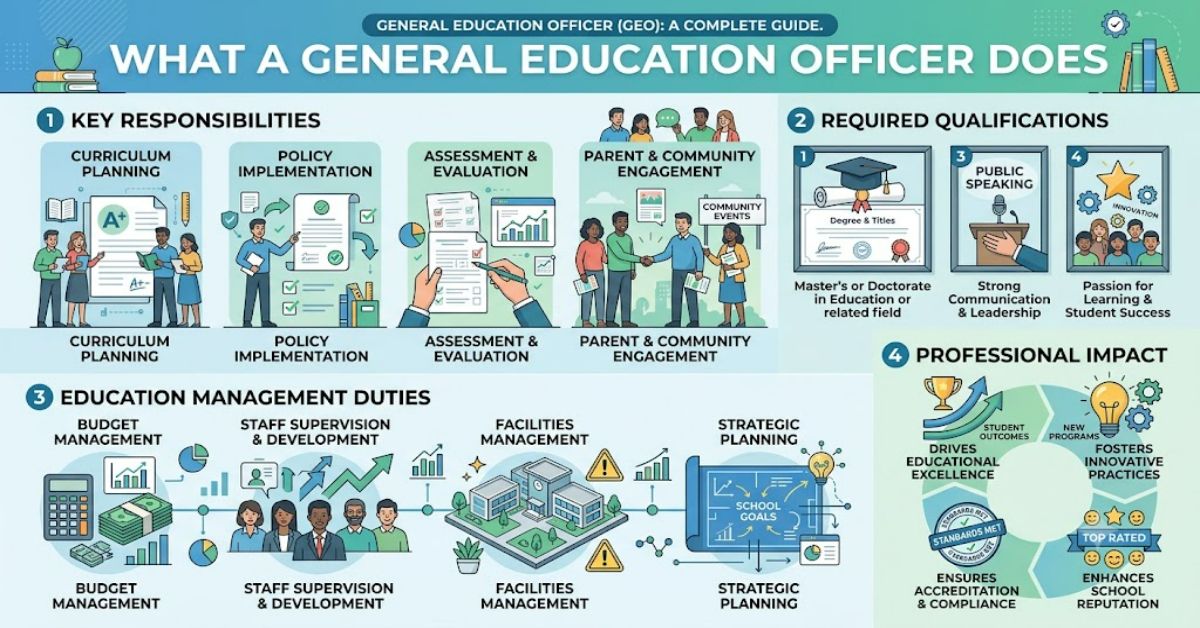
A General Education Officer is a trained education official who supports the delivery, monitoring, and improvement of general education subjects such as English, Mathematics, and Sciences. The role exists in different forms across countries, with responsibilities depending on national education structures. In Pakistan, similar duties are often performed by Subject Specialists, lecturers, and District Education Officers (DEOs), while countries such as Singapore use formal education officer classifications within their Ministry of Education system.
Education officers operate between policy and classroom practice. They help ensure that curriculum standards are followed, teachers receive academic support, and schools maintain effective learning environments. Their work combines educational expertise, administrative coordination, and quality assurance.
As education systems face challenges such as digital transformation, learning gaps, teacher shortages, and changing workforce requirements, the role of education management professionals has become increasingly important. A capable education officer can influence thousands of students by improving teaching practices and supporting schools at regional and institutional levels.
Understanding the Role of a General Education Officer
The responsibilities of this position depend on the education system where the officer works. However, the central purpose remains consistent: improving educational outcomes through professional supervision and support.
A General Education Officer may be involved in:
- Curriculum implementation and review
- Teacher guidance and professional development
- Academic inspections and school evaluations
- Education policy execution
- Student performance analysis
- Coordination between schools and education departments
Unlike classroom teachers who focus directly on student instruction, education officers work at a broader level. Their decisions can influence teaching approaches, resource allocation, and institutional performance.
Responsibilities Across Different Education Systems
The title may differ internationally, but many education officer roles share common functions.
In Singapore, education officers are part of a structured professional pathway managed by the Ministry of Education. Teachers can progress through different career tracks that recognise classroom expertise, leadership ability, and specialist knowledge.
In Pakistan, equivalent responsibilities are distributed among several positions. District Education Officers oversee educational administration at district levels, while Subject Specialists provide expertise in specific academic disciplines.
| Country | Equivalent Role | Main Responsibilities |
| Singapore | Education Officer | Teaching, curriculum development, professional growth |
| Pakistan | District Education Officer / Subject Specialist | School supervision, academic support, administration |
| United Kingdom | Local authority education advisers | School improvement and education guidance |
| International organisations | Education programme officers | Policy support and development projects |
Academic Expertise and Professional Skills Required
A successful education officer requires more than administrative ability. Strong knowledge of pedagogy, curriculum design, and assessment methods is essential.
Important professional skills include:
Curriculum Knowledge:
Education officers must understand learning outcomes, subject standards, and teaching frameworks to evaluate whether educational goals are being achieved.
Leadership Skills:
The role requires communication with teachers, school leaders, government departments, and communities.
Data Analysis:
Modern education management increasingly depends on evidence-based decisions. Officers analyse examination results, attendance records, and school performance indicators to identify areas requiring improvement.
Policy Understanding:
Education officers must translate government policies into practical strategies for schools.
Comparison: Classroom Teacher vs Education Officer
| Area | Classroom Teacher | Education Officer |
| Primary focus | Direct student learning | System-level improvement |
| Daily interaction | Students and parents | Teachers, schools, departments |
| Main responsibility | Lesson delivery | Quality assurance and support |
| Performance measurement | Student progress | School and programme outcomes |
| Decision-making level | Classroom level | Institutional or regional level |
Why General Education Officer Role Matter for Learning Outcomes
Education quality depends on more than curriculum documents. Effective implementation requires trained professionals who understand both policy goals and classroom realities.
Education officers help identify gaps between educational plans and actual practice. For example, a curriculum reform may appear successful on paper but fail if teachers lack training or resources. Officers help bridge this gap by supporting professional development and monitoring implementation.
One important insight is that education improvement often depends on middle-level leadership. While governments create policies and teachers deliver lessons, officers connect these two areas. Without effective coordination, educational reforms may struggle to reach classrooms.
Challenges and Limitations of the Role
Despite their importance, education officers face several challenges.
Administrative Pressure
In many education systems, officers manage large geographical areas with limited resources. Excessive administrative duties can reduce the time available for academic support.
Balancing Inspection and Support
A traditional inspection-based approach may create tension between officers and teachers. Modern education systems increasingly favour coaching and professional development rather than only monitoring compliance.
Digital Transformation Challenges
As schools adopt online learning platforms and education technology, officers need digital skills to evaluate and support technology integration.
Data Insight: Changing Priorities in Education Management
| Priority Area | Why It Matters |
| Teacher development | Improves classroom quality |
| Digital literacy | Supports modern learning environments |
| Data-driven decisions | Helps identify performance gaps |
| Inclusive education | Ensures access for diverse learners |
| Curriculum alignment | Connects education with future skills |
The Future of General Education Officer Role in 2027
By 2027, education officer roles are expected to become more focused on data analysis, digital education management, and instructional leadership.
Artificial intelligence tools may assist education departments by identifying learning patterns and helping officers analyse school performance data. However, technology will not replace professional judgement. Human expertise will remain necessary for understanding local challenges and supporting teachers.
Education systems will also place greater emphasis on inclusive education, mental wellbeing, and personalised learning approaches. Officers will increasingly need skills beyond traditional administration, including technology management and change leadership.
Countries investing in teacher development and evidence-based education policies are likely to expand the role of education officers as strategic contributors to education improvement.
Key Takeaways
- Education officers connect government education policies with classroom practice.
- The role includes curriculum support, teacher development, and school improvement.
- Different countries use different titles for similar responsibilities.
- Strong education leadership is essential for sustainable learning improvements.
- Future officers will need digital, analytical, and leadership skills.
Conclusion
The role of a General Education Officer reflects the growing complexity of modern education systems. These professionals provide the link between educational policy, teaching practice, and institutional improvement.
Although job titles and responsibilities differ internationally, the central objective remains the same: creating better learning environments for students. In Pakistan, Singapore, and other education systems, officers contribute by supporting teachers, monitoring standards, and helping schools respond to changing educational demands.
As education continues to evolve, these roles will require stronger expertise in technology, data analysis, and instructional leadership. The future success of education systems will depend not only on classroom teachers but also on the professionals who guide and strengthen the wider educational structure.
Frequently Asked Questions
What does a General Education Officer do?
A General Education Officer supports education quality through curriculum monitoring, teacher development, school evaluation, and educational administration.
Is a General Education Officer the same as a teacher?
No. A teacher focuses mainly on classroom instruction, while an education officer works on broader academic planning, supervision, and improvement.
What is the equivalent of this role in Pakistan?
In Pakistan, similar responsibilities may be performed by District Education Officers, Subject Specialists, and other education department officials.
What qualifications are needed for this career?
Requirements vary, but many positions require advanced education qualifications, teaching experience, subject expertise, and administrative skills.
Why are education officers important?
They help ensure that education policies are effectively implemented and that schools receive the guidance needed to improve learning outcomes.
Methodology
This article was developed using publicly available information from education ministries, international education organisations, and recognised education policy resources. The analysis compares the role across different education systems while acknowledging that job titles and responsibilities vary by country. No private interviews or firsthand field observations were used. Readers should verify specific employment requirements with relevant education departments.
References (APA Style)
Ministry of Education Singapore. (2024). Education service and professional development information. Singapore Ministry of Education.
UNESCO. (2023). Global education monitoring report: Technology in education. United Nations Educational, Scientific and Cultural Organization.
OECD. (2023). Education policy outlook: Empowering teachers and school leaders. Organisation for Economic Co-operation and Development.
Government of Pakistan, Ministry of Federal Education and Professional Training. (2024). Education policy and institutional frameworks. Government of Pakistan.