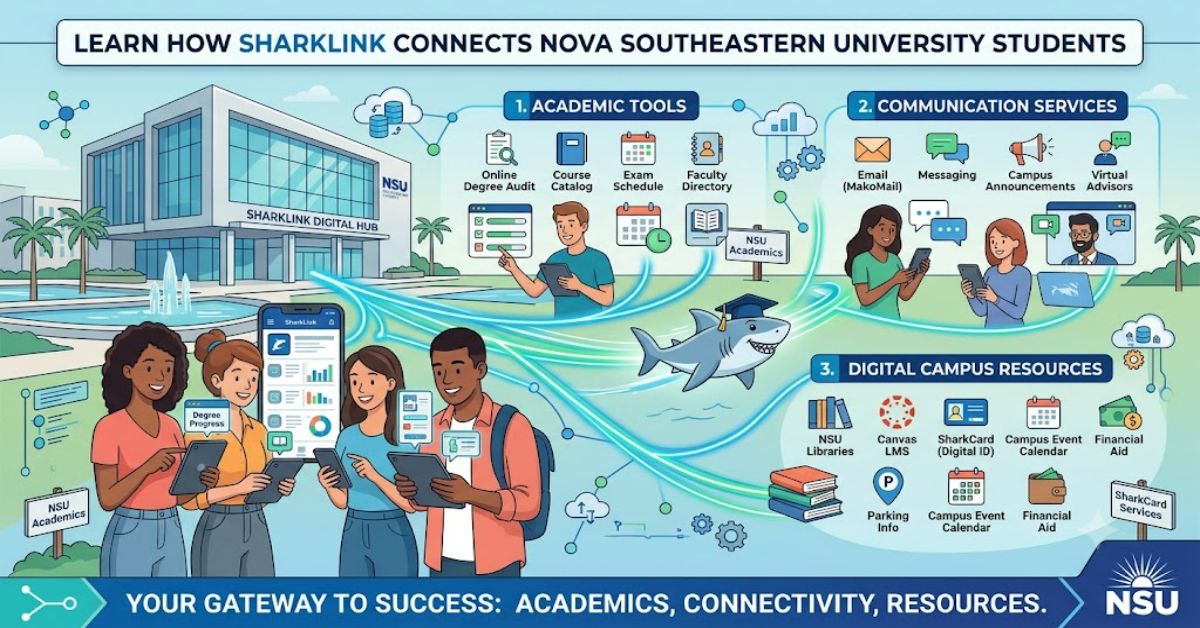
SharkLink is Nova Southeastern University’s central online portal designed to give students, faculty, staff, and alumni access to essential university services from one location. Instead of requiring users to manage multiple separate systems, the platform acts as a single sign-on environment where members of the NSU community can access academic records, communication tools, learning resources, and administrative services.
Modern universities increasingly rely on digital ecosystems to improve the student experience. A portal like SharkLink reduces administrative complexity by connecting different university systems through one interface. For students, this means easier access to important information such as class schedules, grades, financial aid details, campus announcements, and university communication.
Nova Southeastern University, a private research institution based in Florida, has invested heavily in digital infrastructure to support its diverse student population. With thousands of students studying across undergraduate, graduate, and professional programmes, a reliable digital hub is essential for maintaining communication and operational efficiency.
Although the term “sharklink” can refer to different organisations and online services, the most common education-related meaning is NSU’s student portal. Understanding how this platform works helps students make better use of available university resources and navigate their academic journey more efficiently.
Understanding the Purpose of SharkLink
University portals have evolved from simple information pages into complete digital environments. SharkLink follows this broader trend by combining multiple services into a connected platform.
The main purpose of the system is accessibility. Students no longer need to visit different websites or contact separate departments for routine tasks. Through one login, they can reach important academic and administrative services.
Typical functions include:
- Access to university email accounts
- Academic record management
- Course-related resources
- Financial information
- Campus announcements
- Student support services
- Links to university platforms
This integrated approach reflects a wider movement towards digital transformation in higher education. Institutions are using technology not only for convenience but also to improve student retention, communication quality, and operational efficiency.
How SharkLink Supports the Student Experience
A successful student portal does more than provide information. It creates a digital connection between learners and their institution.
For new students, platforms like SharkLink help reduce confusion during the transition into university life. Important tasks such as checking enrolment details, reviewing academic information, or accessing institutional messages become easier when available through a single platform.
For continuing students, the portal becomes a daily academic tool. Instead of searching across multiple systems, students can quickly find information related to their studies.
The platform also supports university administration by reducing repetitive enquiries. When students can independently access information, departments can focus more resources on complex support needs.
Comparison: Traditional University Access vs Digital Portal Systems
| Feature | Traditional Approach | SharkLink-Style Digital Portal |
| Information access | Multiple offices and websites | Centralised online platform |
| Student communication | Email lists and physical notices | Integrated digital updates |
| Academic information | Separate systems | Connected dashboard |
| Administrative tasks | Manual processes | Online self-service |
| User experience | Less personalised | More streamlined |
Security and Digital Access Considerations
While university portals offer significant advantages, they also create responsibilities around cybersecurity and data protection.
Student portals contain sensitive information, including academic records and personal details. As a result, universities must maintain strong authentication systems, secure infrastructure, and appropriate privacy controls.
Common security priorities include:
- Multi-factor authentication
- Secure password practices
- Data encryption
- Regular system monitoring
- Access management controls
Users also play an important role in protecting their accounts. Students should avoid sharing login details, use strong passwords, and remain cautious about suspicious messages requesting personal information.
Digital accessibility is another important consideration. Educational technology platforms must support users with different abilities and comply with accessibility standards. Features such as clear navigation, readable layouts, and compatibility with assistive technologies improve usability for everyone.
Practical Benefits for Students and Faculty
The value of SharkLink comes from reducing friction in everyday university activities.
Students benefit from:
- Faster access to academic information
- Improved communication with university departments
- Easier management of administrative tasks
- Greater independence in completing routine processes
Faculty and staff also gain advantages. Centralised systems help educators communicate with students more effectively and manage academic information with fewer administrative barriers.
The growth of remote and hybrid learning has made these systems even more important. Universities increasingly need digital platforms that can support students regardless of location.
Digital Transformation in Higher Education
The development of platforms like SharkLink reflects broader changes across universities worldwide. Higher education institutions are moving towards connected technology environments that combine learning management systems, student services, and communication platforms.
A 2023 report from EDUCAUSE highlighted that digital transformation remains a major priority for universities, particularly in areas such as student experience, cybersecurity, and technology integration.
However, technology alone cannot solve every educational challenge. A portal must be supported by effective training, reliable technical support, and continuous improvement based on user feedback.
Data Insight: Why University Portals Are Becoming Essential
| Digital Trend | Impact on Universities |
| Online learning growth | Greater demand for reliable platforms |
| Mobile access expectations | Need for responsive systems |
| Cybersecurity concerns | Increased investment in protection |
| Student self-service | Reduced administrative workload |
| Data integration | Better operational decision-making |
The Future of SharkLink in 2027
By 2027, university portals are likely to become more personalised and intelligent. Artificial intelligence, predictive analytics, and improved mobile experiences are expected to influence how students interact with digital campus systems.
Future developments may include smarter recommendations for academic resources, automated support assistants, and improved integration between learning platforms and administrative services.
However, adoption will depend on balancing innovation with privacy protection. Universities must ensure that new technologies improve student outcomes without creating unnecessary data risks.
The future of platforms like SharkLink will likely focus less on simply providing access and more on creating personalised digital experiences that support students throughout their academic journey.
Key Takeaways
- SharkLink provides NSU students and staff with a central point for accessing university services.
- Digital portals improve efficiency by reducing the need for separate systems.
- Security and accessibility are essential parts of successful educational technology.
- Student portals support both academic success and administrative efficiency.
- Future improvements will likely involve artificial intelligence and personalised digital services.
Conclusion
SharkLink represents the important role digital platforms now play in higher education. By connecting academic resources, communication channels, and administrative services, the portal helps create a smoother experience for Nova Southeastern University students and staff.
The effectiveness of any university technology system depends on more than its features. Security, accessibility, reliability, and user experience determine whether a platform genuinely supports its community.
As universities continue investing in digital transformation, systems like SharkLink will remain central to how students interact with their institutions. The challenge for future development will be maintaining simplicity and trust while introducing more advanced technologies.
Frequently Asked Questions
What is SharkLink used for?
SharkLink is used by Nova Southeastern University students, faculty, and staff to access academic, administrative, and communication services through one online platform.
How do students access SharkLink?
Students typically access the portal through NSU’s official website using their university login credentials.
Is SharkLink only for students?
No. The platform is designed for students, faculty, staff, and other members of the NSU community who require access to university services.
What information can students find on SharkLink?
Students can use the portal to access academic information, university communication, course-related resources, and administrative services.
Why are university portals important?
University portals improve efficiency by combining different digital services into one accessible system, making it easier for users to manage academic responsibilities.
Methodology
This article was prepared using publicly available information about Nova Southeastern University digital services, higher education technology trends, and recognised education technology research. Sources were reviewed to provide balanced context around university portals, accessibility, and cybersecurity. The analysis does not include private testing of SharkLink systems, and specific portal features may change as NSU updates its technology infrastructure.
References (APA Style)
EDUCAUSE. (2023). 2023 EDUCAUSE Horizon Report: Teaching and Learning Edition. EDUCAUSE.
Nova Southeastern University. (2025). Student resources and digital services information. Nova Southeastern University.
National Institute of Standards and Technology. (2024). Cybersecurity framework guidance and digital security practices. U.S. Department of Commerce.