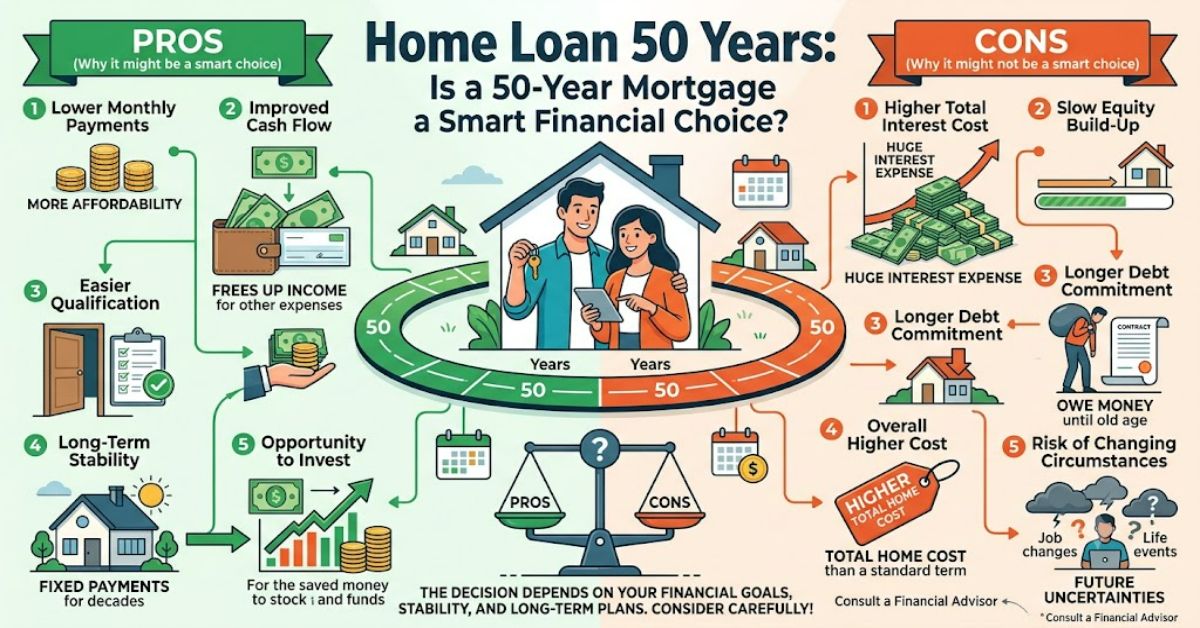
A home loan 50 years is one of the longest mortgage repayment options available in some markets. Unlike traditional 15-, 20-, or 30-year mortgages, a 50-year mortgage spreads repayments across half a century. The immediate benefit is lower monthly instalments, making home ownership more accessible for borrowers with limited income or high property prices. However, the trade-off is substantial: borrowers pay interest for much longer, often resulting in significantly higher overall borrowing costs.
As housing prices continue to challenge first-time buyers, lenders and policymakers have occasionally explored longer mortgage terms to improve affordability. While these products remain uncommon compared with standard mortgage options, understanding how they work helps borrowers make informed decisions.
What Is a 50-Year Home Loan?
A 50-year mortgage is a long-term housing loan that extends repayment over fifty years instead of the traditional mortgage periods.
The longer repayment schedule means each monthly payment is smaller because the principal is divided over more months. However, interest continues accumulating throughout the loan term.
Typical Characteristics
| Feature | 50-Year Home Loan |
| Loan Term | 50 years |
| Monthly Payments | Lower |
| Total Interest | Much higher |
| Equity Growth | Slower |
| Popularity | Limited in most markets |
How Does It Compare With Traditional Mortgages?
Longer repayment periods reduce financial pressure each month but increase the lifetime cost of borrowing.
| Loan Term | Monthly Payment | Total Interest Paid | Equity Growth |
| 15 Years | Highest | Lowest | Fastest |
| 20 Years | High | Low | Fast |
| 30 Years | Moderate | Moderate | Standard |
| 50 Years | Lowest | Highest | Slowest |
This comparison highlights why affordability and total cost often move in opposite directions.
Advantages of a Home Loan 50 Years
Several borrowers may find value in extended mortgage terms.
Lower Monthly Repayments
Because repayments are spread across more months, borrowers generally pay less each month.
Easier Qualification
Lower monthly obligations may improve debt-to-income ratios, allowing some buyers to qualify for larger loans.
Increased Cash Flow
Lower mortgage payments leave additional disposable income for:
- Emergency savings
- Education expenses
- Investments
- Family needs
- Business opportunities
Disadvantages to Consider
Despite lower repayments, long-term mortgages carry significant financial drawbacks.
Much Higher Interest Costs
The greatest disadvantage is the total amount of interest paid over fifty years.
Even modest interest rates can result in borrowers paying considerably more than the home’s original purchase price.
Slower Equity Building
Because more of each payment initially goes toward interest, homeowners accumulate equity much more slowly than with shorter mortgages.
Longer Financial Commitment
A 50-year loan may outlast multiple career changes, relocations, or even retirement planning.
Who Might Consider a 50-Year Mortgage?
Although uncommon, this type of financing may suit:
- First-time buyers in expensive housing markets
- Self-employed borrowers with fluctuating income
- Buyers expecting future income growth
- Families seeking maximum monthly affordability
However, financial advisers generally encourage borrowers to repay faster whenever possible.
Risks and Trade-Offs
Before choosing a long-term mortgage, borrowers should evaluate several risks.
| Risk | Potential Impact |
| Higher lifetime interest | Increased borrowing costs |
| Slow equity growth | Delayed wealth building |
| Rising property maintenance costs | Greater long-term ownership expenses |
| Inflation uncertainty | Changing purchasing power |
| Future refinancing risk | Uncertain lending conditions |
These considerations demonstrate why the lowest monthly payment does not always represent the best financial decision.
Practical Considerations Before Applying
Before selecting an extended mortgage term, borrowers should:
- Compare total repayment costs.
- Review interest rate structures.
- Consider making additional repayments when possible.
- Maintain an emergency fund.
- Seek independent mortgage advice.
A detailed affordability assessment should examine both current finances and long-term financial goals.
The Future of Home Loan 50 Years in 2027
Housing affordability continues to influence discussions about alternative mortgage structures. Some lenders may explore longer repayment options to help buyers enter expensive property markets, particularly where average house prices continue to outpace wage growth.
At the same time, regulators are likely to remain cautious about extremely long mortgage terms because of concerns regarding consumer debt, retirement affordability, and financial resilience. Rather than becoming the standard, 50-year mortgages are likely to remain specialist products designed for specific borrowing circumstances.
Key Takeaways
- Lower monthly payments come at the expense of much higher lifetime interest.
- Extended mortgage terms improve short-term affordability.
- Slower equity growth delays wealth accumulation.
- Extra repayments can significantly reduce total borrowing costs.
- Borrowers should compare the total cost, not just monthly repayments.
- Professional mortgage advice remains valuable for complex borrowing decisions.
Conclusion
A home loan 50 years offers an alternative approach to home financing by prioritising affordability through lower monthly repayments. For some buyers, particularly those entering expensive property markets, this flexibility may make home ownership possible when traditional mortgage terms do not.
However, the long repayment period dramatically increases the total interest paid and slows equity growth. Borrowers should carefully balance immediate affordability against long-term financial wellbeing before committing to such a mortgage. Understanding both the benefits and limitations enables more informed borrowing decisions and supports healthier long-term financial planning.
Frequently Asked Questions
What is a home loan 50 years?
It is a mortgage with a repayment period extending over fifty years, reducing monthly repayments while increasing total interest costs.
Are 50-year mortgages common?
No. They remain relatively uncommon and are generally offered only by selected lenders in certain markets.
Who benefits most from a 50-year mortgage?
Borrowers prioritising lower monthly repayments, such as first-time buyers or those purchasing in high-cost housing markets, may benefit.
Can I repay a 50-year mortgage early?
Many lenders allow early repayments, although some may charge early repayment fees. Always review the mortgage agreement carefully.
Is a 50-year mortgage cheaper?
Monthly repayments are lower, but the total cost over the life of the loan is typically much higher because interest accrues for a longer period.
Methodology
This article was prepared using the information provided in the prompt about 50-year home loans and general mortgage principles. It explains the financial characteristics, potential advantages, and trade-offs of extended mortgage terms without relying on unverified lender-specific claims. Readers should compare current mortgage products, interest rates, eligibility criteria, and regulations with qualified financial advisers and official lender documentation before making borrowing decisions.