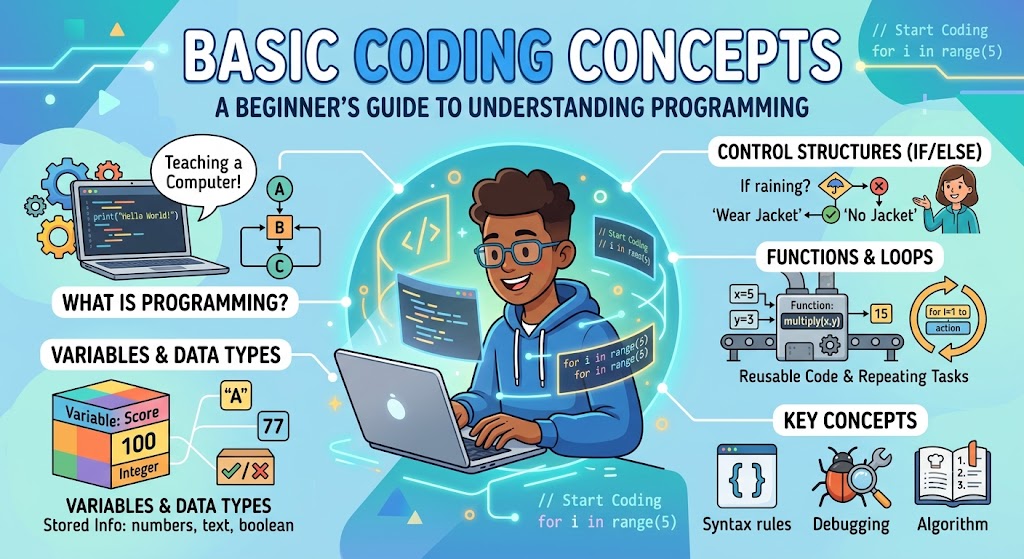
Understanding basic coding concepts is the first step towards becoming a successful programmer. Programming is the process of writing instructions that tell a computer how to perform a task. While there are many programming languages, they all share a core set of fundamental building blocks used to solve problems and automate processes. Learning these principles before focusing on syntax helps beginners think like programmers instead of simply memorising commands.
Whether your goal is web development, mobile app creation, artificial intelligence, game development, or data science, every programming journey begins with the same essential concepts. Once you understand how variables, conditions, loops, functions, and data structures work together, learning new languages becomes significantly easier.
What Is Programming?
Programming is the process of creating instructions that computers follow to complete tasks. These instructions are written using programming languages such as Python, Java, JavaScript, C++, and C#.
Although each language has different syntax, they all rely on similar logical principles. This is why learning programming concepts is often more valuable than learning a specific language first.
Essential Coding Concepts
The following concepts form the foundation of almost every programming language.
| Concept | Purpose |
| Variables | Store information |
| Data Types | Define what kind of data is stored |
| Operators | Perform calculations and comparisons |
| Conditions | Make decisions |
| Loops | Repeat tasks automatically |
| Functions | Organise reusable code |
| Arrays & Lists | Store multiple values |
| Algorithms | Solve problems step by step |
Variables and Data Types
Variables act as containers for information. They store values that can change while a program is running.
Common data types include:
- Integer
- Float
- String
- Boolean
- Character
- Array
Choosing the correct data type helps programs run efficiently and reduces errors.
Operators
Operators allow programs to perform mathematical calculations and logical comparisons.
Examples include:
- Addition (+)
- Subtraction (-)
- Multiplication (*)
- Division (/)
- Equal to (==)
- Greater than (>)
- Less than (<)
These operators help computers process information and make decisions.
Conditional Statements
Programs often need to make choices.
Conditional statements such as if, else, and switch allow software to respond differently depending on specific conditions.
For example:
- If a password is correct, allow login.
- Otherwise, display an error message.
This decision-making ability is fundamental to interactive software.
Loops
Loops repeat instructions automatically until a condition changes.
The most common loop types include:
- For Loop
- While Loop
- Do-While Loop
Instead of writing the same instruction hundreds of times, loops execute it repeatedly, saving time and reducing code duplication.
Functions
Functions group related instructions into reusable blocks.
Benefits include:
- Cleaner code
- Easier maintenance
- Reduced repetition
- Better organisation
- Improved readability
Professional software projects rely heavily on functions to keep code manageable.
Algorithms
An algorithm is a sequence of logical steps used to solve a problem.
Examples include:
- Sorting numbers
- Searching for information
- Calculating averages
- Finding the shortest route
Good programmers focus on designing efficient algorithms before writing code.
Comparison of Popular Programming Languages
| Language | Best For | Difficulty |
| Python | Beginners, AI, Automation | Easy |
| JavaScript | Web Development | Moderate |
| Java | Enterprise Applications | Moderate |
| C++ | Systems & Games | Advanced |
| C# | Desktop & Game Development | Moderate |
Although these languages differ, the same coding principles apply to all of them.
Common Beginner Mistakes
Many beginners struggle because they focus on memorising syntax instead of understanding concepts.
Common mistakes include:
- Ignoring problem-solving skills.
- Writing code without planning.
- Not practising regularly.
- Copying code without understanding it.
- Giving up after encountering errors.
Debugging mistakes is an important part of learning programming.
Why Coding Concepts Matter
Strong programming fundamentals make learning additional languages much easier.
Developers who understand concepts rather than syntax can quickly adapt to new technologies and frameworks. Employers also value candidates who demonstrate logical thinking and problem-solving abilities.
The Future of Programming Education in 2027
Programming education continues evolving as artificial intelligence assists developers with code generation and debugging. However, understanding core programming concepts will remain essential because AI-generated code still requires human review, testing, and logical reasoning. Developers who master fundamentals will continue to adapt more easily to emerging technologies and programming tools.
Key Takeaways
- Learn concepts before memorising syntax.
- Practice coding consistently.
- Break large problems into smaller tasks.
- Debugging is part of the learning process.
- Strong fundamentals apply across all programming languages.
- Logical thinking is as important as writing code.
Conclusion
Learning basic coding concepts provides the foundation for every programming career. While languages and technologies continue to evolve, the principles of variables, loops, functions, conditions, algorithms, and data structures remain constant. Beginners who invest time in understanding these fundamentals develop stronger problem-solving abilities and learn new programming languages more efficiently. Rather than rushing into advanced topics, building a solid foundation creates lasting confidence and prepares learners for real-world software development projects.
FAQ
What are the most important coding concepts for beginners?
Variables, data types, loops, conditions, functions, algorithms, and data structures are the most important concepts.
Which programming language should beginners learn first?
Python is widely recommended because of its simple syntax and large learning community.
How long does it take to learn coding basics?
With consistent practice, most beginners understand the fundamentals within a few months.
Do I need mathematics to learn programming?
Basic mathematics helps, but logical thinking and problem-solving skills are generally more important.
Can I learn programming without a computer science degree?
Yes. Many successful developers are self-taught through online courses, books, and practical projects.
Methodology
This article is based on established programming principles shared across major programming languages and introductory computer science resources. It focuses on universally accepted coding fundamentals rather than language-specific syntax. Readers should supplement these concepts with hands-on coding practice and official language documentation.
References
- Python Software Foundation. (2024). Python Documentation. https://docs.python.org/
- Mozilla Developer Network. (2024). JavaScript Guide. https://developer.mozilla.org/
- Microsoft Learn. (2024). Introduction to Programming. https://learn.microsoft.com/