If you’ve ever asked what is an em dash, you’re not alone. The em dash (—) is one of the most flexible punctuation marks in English. It can replace commas, parentheses, or colons to create emphasis, set off additional information, or signal an abrupt shift in thought. Visually, it is the longest of the three common dashes, making it easy to distinguish from the shorter en dash (–) and the standard hyphen (-).
Although many writers recognise the symbol, they often hesitate to use it because they are unsure of its purpose. In reality, the em dash is straightforward once you understand its function. It allows sentences to flow naturally while drawing attention to important ideas.
From novels and newspapers to blogs and professional reports, the em dash appears across many forms of writing. Knowing when to use it—and when not to—can make your writing more polished and easier to read.
What Is an Em Dash?
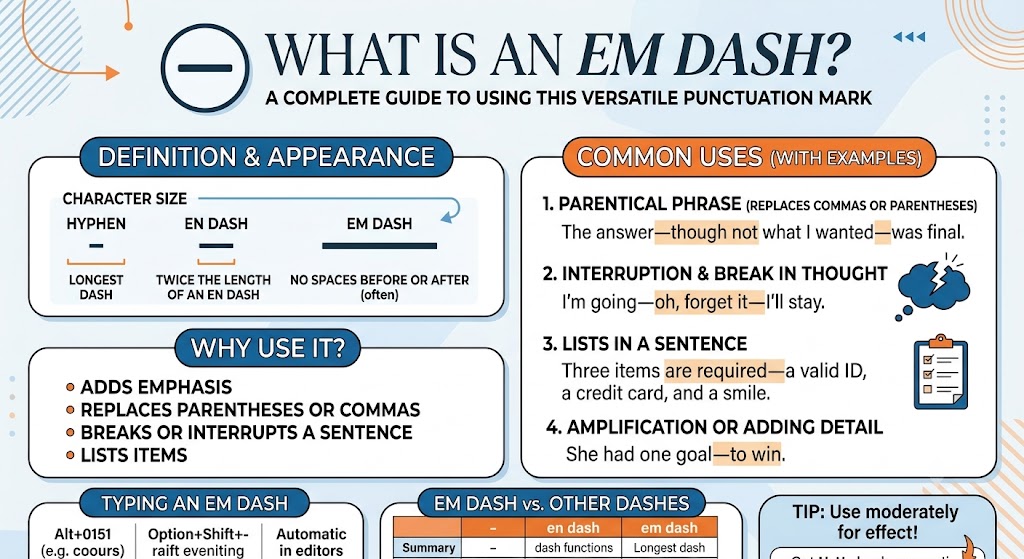
An em dash (—) is a punctuation mark approximately the width of the capital letter “M” in traditional typography. It is primarily used to create emphasis, separate thoughts, or introduce additional information without interrupting the flow of a sentence.
Unlike commas, which often create a subtle pause, an em dash creates a stronger break that immediately captures the reader’s attention.
For example:
- The meeting—which everyone expected to last an hour—continued well into the afternoon.
- She opened the envelope—and couldn’t believe what she saw.
In both examples, the em dash adds emphasis while keeping the sentence smooth.
Em Dash vs. En Dash vs. Hyphen
Many people confuse these three punctuation marks because they look similar.
| Punctuation Mark | Symbol | Primary Use |
| Hyphen | – | Joins words such as “well-known” |
| En dash | – | Shows ranges like 2019–2024 |
| Em dash | — | Creates emphasis or separates ideas |
Remembering their lengths helps identify them:
- Hyphen = Shortest
- En dash = Medium
- Em dash = Longest
Each serves a different grammatical purpose.
When Should You Use an Em Dash?
The em dash is incredibly versatile.
To Add Emphasis
An em dash highlights information more strongly than commas.
Example:
There was only one solution—leave immediately.
To Insert Extra Information
Instead of parentheses, you can use em dashes.
Example:
The museum—one of London’s oldest attractions—welcomes thousands of visitors every week.
To Show an Interrupted Thought
Writers often use em dashes in dialogue.
Example:
“I was going to tell you—but never mind.”
This reflects natural speech and sudden interruptions.
To Replace a Colon
An em dash can introduce a list or explanation with a slightly more conversational tone.
Example:
She packed everything she needed—passport, tickets, phone charger, and camera.
Common Mistakes to Avoid
While the em dash is useful, overusing it can make writing difficult to follow.
Common mistakes include:
- Using multiple em dashes in every sentence.
- Confusing an em dash with a hyphen.
- Replacing every comma unnecessarily.
- Mixing punctuation styles inconsistently.
Professional writers generally use em dashes only where they genuinely improve clarity or emphasis.
Comparison Table
| Situation | Comma | Parentheses | Em Dash |
| Minor pause | ✔ | ✖ | ✔ |
| Strong emphasis | ✖ | Limited | ✔ |
| Extra information | ✔ | ✔ | ✔ |
| Interrupted thought | ✖ | ✖ | ✔ |
The table shows why the em das’h is often considered one of the most flexible punctuation marks.
Where You’ll See Em Dashes
The em das’h appears across many forms of writing:
- Newspapers
- Magazines
- Novels
- Business reports
- Academic essays
- Blogs
- Marketing copy
- Online articles
Many respected style guides encourage its careful use because it improves readability when applied appropriately.
Benefits of Using Em Dashes
Using em dashes correctly offers several advantages:
- Creates stronger emphasis
- Makes writing sound more natural
- Improves sentence rhythm
- Reduces unnecessary punctuation
- Helps readers follow complex ideas
These benefits explain why many professional editors favour the em das’h over excessive commas or brackets.
The Future of Punctuation in 2027
As AI writing tools, grammar checkers, and digital publishing platforms become more sophisticated, punctuation guidance is expected to become increasingly automated. Many modern editors already recommend em dashes where they improve sentence flow.
However, human judgement will remain essential. Grammar software can recognise punctuation patterns, but it cannot always understand tone, emphasis, or style. Writers who understand the purpose of the em das’h will continue to produce clearer, more engaging content regardless of the tools they use.
Key Takeaways
- An em das’h is the longest standard dash used in English punctuation.
- It adds emphasis, introduces interruptions, and separates additional information.
- It differs from both the en dash and the hyphen.
- Overusing em dashes can reduce readability.
- Proper use creates smoother, more expressive writing.
Conclusion
Understanding what is an em dash is an important step towards becoming a stronger writer. Although it may seem like a small punctuation mark, it plays a significant role in shaping sentence structure and emphasising key ideas.
Whether you are writing professional documents, academic assignments, creative stories, or online articles, the em dash offers flexibility that commas and parentheses sometimes cannot provide. By learning when to use it—and when to choose other punctuation instead—you can improve both clarity and style. Like any writing tool, the em das’h works best when used with purpose rather than frequency.
Frequently Asked Questions
What is an em dash used for?
An em das’h is used to add emphasis, introduce extra information, replace commas or parentheses, and indicate interrupted thoughts.
Is an em dash the same as a hyphen?
No. A hyphen joins words together, while an em das’h separates ideas or creates emphasis.
What is the difference between an en dash and an em dash?
An en das’h usually shows ranges or relationships (such as 2020–2025), while an em das’h separates parts of a sentence or adds emphasis.
Should there be spaces around an em das’h?
It depends on the style guide. Many UK publishers omit spaces (word—word), while some organisations use spaces on either side (word — word). Consistency is more important than the chosen style.
Can I use an em das’h in formal writing?
Yes. Many newspapers, publishers, and academic style guides permit em dashes when they improve clarity and sentence flow.
Methodology
This article is based on established English grammar and punctuation guidance from recognised language authorities and editorial style resources. The explanations focus on practical usage, common writing conventions, and widely accepted grammar rules. Before publication, editors should verify examples and references against the latest editions of their preferred style guides.
References (APA Style)
- Oxford University Press. (2023). New Hart’s Rules: The Oxford Style Guide. Oxford University Press.
- Cambridge University Press & Assessment. (2023). Cambridge Grammar of English Usage. Cambridge University Press.
- Merriam-Webster. (2024). Dictionary and punctuation guidance. https://www.merriam-webster.com