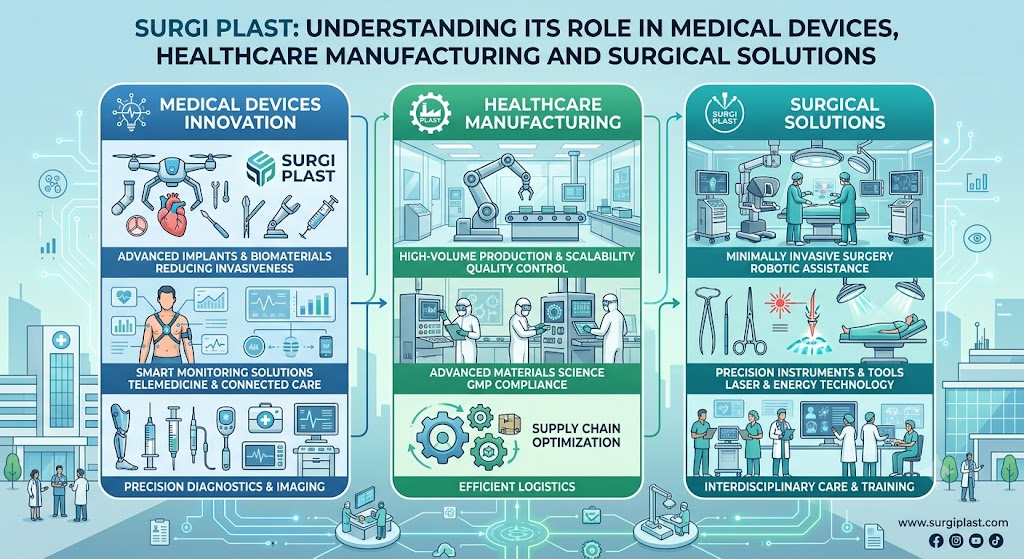
Surgi Plast is a term connected with the medical device and healthcare manufacturing industry, where precision-engineered plastic components support surgical procedures, patient care and medical equipment production. The name may refer to different manufacturers or suppliers depending on geographic context, but its broader relevance comes from the increasing importance of specialised medical plastics.
Modern healthcare depends heavily on polymer-based materials. From disposable surgical instruments and protective components to diagnostic equipment parts and sterile packaging systems, medical plastics provide flexibility, durability and cost efficiency. Unlike ordinary plastics used in consumer products, healthcare-grade polymers must meet strict requirements involving biocompatibility, sterilisation resistance and regulatory approval.
Companies operating in this space must balance several priorities: producing reliable products, maintaining sterile manufacturing environments, reducing environmental impact and complying with international medical device regulations. These demands have transformed medical plastics from simple manufacturing materials into highly engineered solutions.
Understanding Surgi Plast requires looking beyond the name itself. The wider sector demonstrates how healthcare suppliers combine material science, manufacturing technology and regulatory expertise to support hospitals, clinicians and patients. As healthcare systems continue to expand globally, specialised medical manufacturing will remain an important part of the medical supply chain.
What Does Surgi Plast Represent in the Medical Industry?
The term Surgi Plast is primarily associated with medical plastic manufacturing and healthcare-related products. In this sector, manufacturers develop components designed specifically for medical environments where reliability and safety are essential.
Medical plastics are used across multiple areas, including:
- Surgical instruments and accessories
- Disposable healthcare products
- Medical device housings
- Laboratory equipment components
- Sterile packaging solutions
- Diagnostic equipment parts
The advantage of polymers is their adaptability. Materials such as polypropylene, polyethylene, polycarbonate and specialised engineering plastics can be shaped into complex designs while maintaining strength and chemical resistance.
A company operating under a Surgi Plast identity or similar name typically focuses on producing products that meet healthcare manufacturing standards rather than general consumer plastic requirements.
Why Medical Plastics Require Specialised Manufacturing
Manufacturing healthcare products involves significantly higher standards than conventional plastic production.
A medical-grade plastic component may need to withstand:
- High-temperature sterilisation processes
- Chemical exposure
- Repeated mechanical stress
- Long storage periods
- Strict contamination controls
Medical manufacturers often operate under controlled environments, including cleanrooms where airborne particles are carefully monitored.
The manufacturing process usually involves:
- Material selection
- Product design and engineering
- Prototype development
- Injection moulding or specialised production
- Quality inspection
- Regulatory testing
- Packaging and distribution
Each stage affects the final safety and performance of the product.
Comparison: Medical Plastic Manufacturing Approaches
| Manufacturing Approach | Main Strength | Common Application | Main Challenge |
| Injection moulding | High-volume precision production | Disposable medical components | Expensive tooling development |
| 3D printing | Rapid prototyping and customised designs | Patient-specific devices | Limited mass production capability |
| Extrusion manufacturing | Continuous production efficiency | Tubes and medical profiles | Design limitations |
| CNC machining | High precision for complex parts | Specialist medical components | Higher production costs |
The choice of manufacturing method depends on the product’s purpose, expected volume and regulatory requirements.
The Role of Surgi Plast in Healthcare Supply Chains
Healthcare supply chains require consistency. Hospitals and medical providers cannot rely on unpredictable production cycles because shortages can directly affect patient care.
Manufacturers in this sector contribute by providing:
- Reliable production capacity
- Consistent material quality
- Sterile packaging systems
- Traceable manufacturing records
Traceability has become increasingly important following global supply chain disruptions experienced during the COVID-19 pandemic. Between 2020 and 2022, healthcare organisations worldwide faced challenges involving shortages of protective equipment, medical devices and raw materials.
The experience highlighted the importance of having resilient suppliers capable of maintaining production during periods of disruption.
Quality Standards and Regulatory Requirements
Medical plastic manufacturers operate within strict regulatory frameworks.
In Europe, medical device companies must comply with the Medical Device Regulation (EU) 2017/745, commonly known as MDR. The regulation introduced stricter requirements for product documentation, clinical evaluation and post-market monitoring.
Key compliance areas include:
| Requirement | Purpose |
| Biocompatibility testing | Ensures materials are safe for human contact |
| Sterilisation validation | Confirms products remain safe after sterilisation |
| Quality management systems | Maintains manufacturing consistency |
| Risk management procedures | Identifies potential product failures |
| Documentation controls | Supports regulatory approval |
For manufacturers similar to Surgi Plast, compliance is not simply administrative. It directly affects market access and customer confidence.
Material Science Behind Healthcare Plastics
The performance of medical plastics depends heavily on material selection.
Common materials include:
Polypropylene
Polypropylene is widely used because it is lightweight, chemically resistant and suitable for many disposable medical applications.
Typical uses include:
- Syringe components
- Laboratory containers
- Surgical packaging
Polycarbonate
Polycarbonate offers transparency and impact resistance, making it useful for medical equipment requiring visibility and durability.
Applications include:
- Diagnostic device covers
- Protective components
- Medical equipment housings
Silicone and Specialised Polymers
Some healthcare applications require flexible materials capable of interacting safely with the human body.
These materials are used in:
- Tubing systems
- Medical seals
- Implant-related applications
Strategic Challenges Facing Medical Plastic Manufacturers
Although medical plastics provide significant advantages, manufacturers face several challenges.
Sustainability Pressure
Healthcare plastics create an environmental challenge because many products are designed for single use to prevent infection risks.
The industry must balance:
- Infection control
- Patient safety
- Waste reduction
- Recycling limitations
A disposable surgical component may be essential for preventing contamination, but its environmental impact remains a growing concern.
Regulatory Complexity
Different regions maintain different approval requirements. A product approved in one market may require additional testing before entering another.
This creates additional costs and longer development timelines.
Material Availability
Specialised medical polymers require controlled supply chains. Disruptions affecting chemical production can influence manufacturing capacity.
Original Industry Insights: What Many Discussions Miss
1. Medical Plastic Design Is Increasingly Influenced by Logistics
A product’s success is not determined only by clinical performance. Packaging size, transport efficiency and storage requirements increasingly influence design decisions.
A smaller component that performs equally well may reduce shipping costs and improve hospital inventory management.
2. Compliance Is Becoming a Competitive Advantage
Regulatory requirements are often viewed as barriers, but companies with strong quality systems can use compliance capabilities as a market advantage.
Reliable documentation, traceability and testing processes can make suppliers more attractive to healthcare organisations.
3. Sustainability Solutions Must Respect Clinical Reality
Replacing all medical plastics with alternative materials is unrealistic because many healthcare products require sterility and contamination prevention.
The more practical approach is likely to involve improved recycling systems, better material selection and reduced unnecessary packaging.
Surgi Plast and the Future of Medical Manufacturing
Healthcare manufacturing is moving towards greater automation and digital control.
Modern facilities increasingly use:
- Automated inspection systems
- Digital production monitoring
- Advanced robotics
- Data-based quality management
These technologies help manufacturers detect defects earlier and improve production consistency.
The expansion of personalised medicine may also create demand for specialised plastic components designed for individual patient requirements.
The Future of Surgi Plast in 2027
By 2027, medical plastic manufacturing is expected to experience continued pressure from three major forces: regulation, sustainability and technological advancement.
European healthcare manufacturers will continue adapting to stricter environmental policies, including initiatives connected with circular economy goals. However, adoption of fully recyclable medical plastics will depend on safety validation and healthcare approval processes.
Automation will likely become more common in manufacturing facilities. Artificial intelligence-assisted inspection systems may help identify production defects faster than traditional manual checks.
Another important trend will be supply chain localisation. Following disruptions experienced during the pandemic years, healthcare organisations and governments have shown greater interest in strengthening regional manufacturing capacity.
The sector’s future will not depend on replacing plastics entirely. Instead, progress will likely come from smarter materials, improved manufacturing efficiency and responsible lifecycle management.
Key Takeaways
- Surgi Plast represents the wider importance of specialised medical plastic manufacturing.
- Healthcare plastics require advanced engineering and strict regulatory compliance.
- Material selection directly affects safety, performance and product reliability.
- Sustainability challenges must be addressed without compromising infection control.
- Automation and digital manufacturing will influence future healthcare production.
- Strong quality systems will remain a major competitive advantage.
Conclusion
Surgi Plast reflects a wider healthcare manufacturing sector where precision, safety and innovation intersect. Medical plastics play an essential role in modern healthcare by supporting surgical procedures, diagnostic systems and everyday medical operations.
The industry faces complex challenges, particularly around environmental responsibility and regulatory demands. However, advances in materials science, automation and supply chain management are creating opportunities for more efficient and responsible manufacturing.
As healthcare systems continue to evolve, suppliers operating in medical plastics will need to maintain high quality standards while adapting to changing expectations. The future of the sector will depend on balancing patient safety with sustainability and technological progress.
Frequently Asked Questions
What is Surgi Plast used for?
Surgi Plast is associated with medical plastic manufacturing and healthcare product solutions. Depending on the specific company reference, it may involve surgical components, medical devices or healthcare manufacturing services.
Are medical plastics different from normal plastics?
Yes. Medical plastics must meet stricter requirements for safety, sterilisation resistance, chemical stability and regulatory compliance.
Why are plastics commonly used in healthcare?
Plastics are lightweight, adaptable and can be manufactured into sterile disposable products that reduce infection risks.
What regulations affect medical plastic manufacturers?
Medical device manufacturers must comply with regulations such as the European Medical Device Regulation and quality management standards.
Is medical plastic manufacturing becoming more sustainable?
The industry is exploring improved recycling systems, alternative materials and more efficient production methods while maintaining safety standards.
Will automation change medical plastic production?
Automation is expected to improve manufacturing accuracy, inspection processes and production efficiency.
Methodology
This article was developed using publicly available information about medical device manufacturing, healthcare polymer applications and regulatory frameworks. Sources reviewed include regulatory guidance from European healthcare authorities, medical manufacturing standards and industry research covering polymer technology.
The analysis focuses on the broader medical plastics sector because the term Surgi Plast may refer to different organisations or product manufacturers depending on regional context.
Limitations include the absence of publicly available internal manufacturing data, pricing information or proprietary operational details from individual companies using the name.
This article was drafted with AI assistance and should be reviewed and verified by a human editor before publication. All regulatory claims, statistics and references should be independently confirmed before going live.
References (APA Style)
European Parliament and Council. (2017). Regulation (EU) 2017/745 on medical devices. Official Journal of the European Union.
International Organization for Standardization. (2016). ISO 13485:2016 Medical devices — Quality management systems — Requirements for regulatory purposes. ISO.
International Organization for Standardization. (2020). ISO 10993-1: Biological evaluation of medical devices. ISO.
World Health Organization. (2022). Global strategy on health, environment and climate change: The transformation towards sustainable healthcare systems. WHO.
Organisation for Economic Co-operation and Development. (2022). Global plastics outlook: Economic drivers, environmental impacts and policy options. OECD.