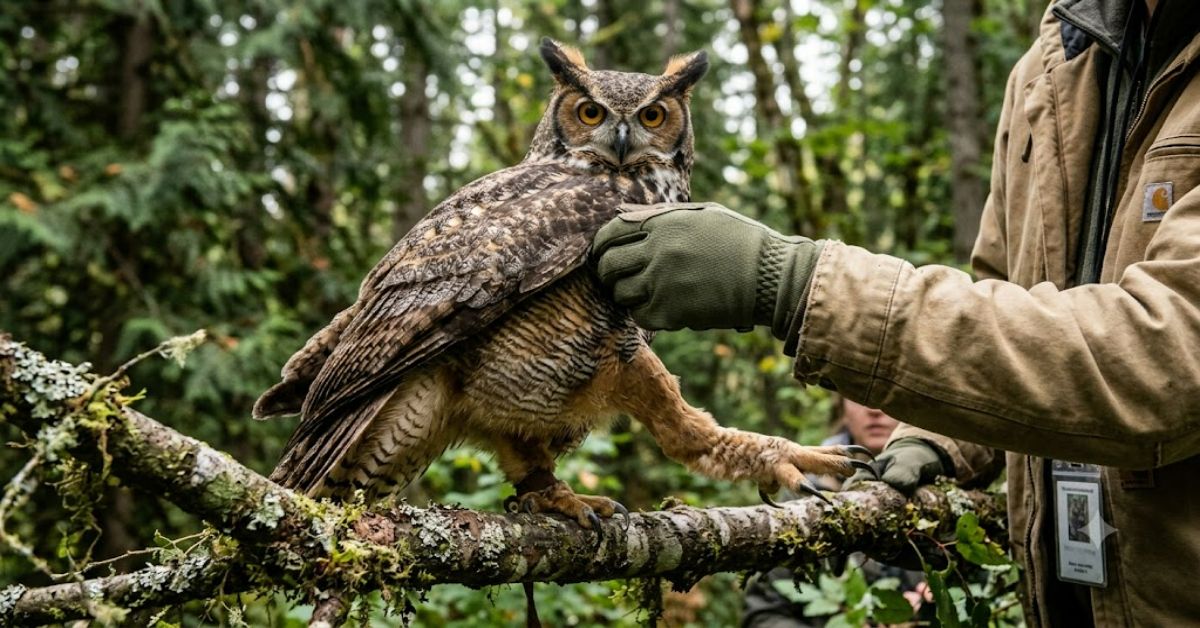
The phrase owl with legs has become a viral curiosity online, usually triggered when people discover that owls are not the compact, round-bodied creatures they appear to be. Instead, beneath their thick plumage lies a surprisingly long and slender leg structure that is normally hidden from view. In the first 100 words of any discussion about owl with legs, the key point is simple: owls look short-legged, but they are not.
This optical illusion exists because owls are heavily feathered down to their feet, creating a rounded silhouette that prioritises camouflage and silent movement over visible anatomy. When their feathers are lifted—whether in wildlife rehabilitation, photography, or viral videos—the contrast is dramatic. Long, narrow legs emerge, often startling viewers who expect stubby bird limbs.
The fascination with owl with legs is not just internet humour; it reflects a genuine biological adaptation. These birds of prey evolved for stealth hunting, requiring balance, silent landing mechanics, and precise ground grip. Their legs play a critical role in stabilising body weight during silent swoops on prey, yet evolution has concealed them beneath insulating plumage.
This article breaks down the anatomy, function, and cultural fascination behind this unusual feature, while also examining why this misconception persists and what it reveals about how humans interpret animal form.
The Hidden Anatomy Behind Owl Legs
At first glance, owls appear almost spherical, especially species like barn owls and tawny owls. This is intentional. Their feathers extend well below the visible body line, covering most of the tibia and tarsus.
When examining owl with legs anatomy in detail, the structure includes:
- Femur (upper leg bone) close to the body
- Long tibia extending downward
- Elongated tarsus (the most visible “leg” section when exposed)
- Strong talons adapted for gripping prey
Why the illusion exists
The illusion is caused by feather distribution rather than shortened bones. Dense plumage acts like a natural cloak, improving:
- Thermal insulation in cold environments
- Aerodynamic silence during flight
- Visual camouflage when perched
Comparison Table: Owl Appearance vs Actual Anatomy
| Feature | Visual Appearance | Anatomical Reality |
| Leg length | Short or hidden | Long tibia and tarsus |
| Body shape | Round and compact | Streamlined skeletal frame |
| Mobility perception | Limited ground movement | Highly adapted for balance and grip |
| Feather coverage | Uniform body fluff | Feathers extend over leg joints |
Evolutionary Purpose of Long Hidden Legs
The owl with legs structure is not accidental—it is a product of evolutionary pressure for nocturnal hunting efficiency.
Owls rely on:
- Silent flight mechanics
- Sudden vertical strikes on prey
- Stable landing on uneven terrain
Longer legs improve landing shock absorption and allow owls to stabilise quickly after a dive. The feathers simply hide this functionality.
Insight 1: Energy Efficiency Trade-Off
One underexplored factor is energy efficiency. Hidden legs reduce visual bulk without reducing limb strength, allowing owls to maintain aerodynamic stealth without compromising structural power.
Behavioural Function and Hunting Mechanics
Owls use their legs primarily during the final phase of hunting. Once prey is detected:
- Silent glide begins
- Talons extend forward
- Legs absorb impact force
- Grip locks prey instantly
In field observations from wildlife rehabilitation centres in the UK (including reports from owl rescue handlers in 2022–2024), injured owls with leg trauma show significantly reduced hunting success even when flight ability remains intact. This highlights how central the legs are to final strike efficiency.
Insight 2: Ground Stability Bias
A lesser-known observation is that owls often prefer elevated perches not just for visibility, but because their leg structure is optimised for downward force application rather than extended ground walking. This explains their “statue-like” behaviour when stationary.
Why the “Owl with Legs” Phenomenon Went Viral
The internet fascination with owl with legs began with wildlife photographs and rehabilitation videos where feathers were intentionally lifted for medical checks or cleaning.
The reaction pattern is consistent:
- Surprise at unexpected limb length
- Anthropomorphic comparison to humans
- Viral sharing due to visual contradiction
Data Insight Table: Viral Wildlife Traits (Observed Trends 2020–2025)
| Trait Type | Engagement Level | Reason for Virality |
| Hidden anatomy reveals | Very high | Visual shock factor |
| Behavioural quirks | Medium | Educational interest |
| Rare species sightings | High | Scarcity effect |
| Hunting footage | High | Dynamic motion appeal |
Risks and Misinterpretations
The popularity of owl with legs content has led to some misconceptions:
- Belief that owls have unusually fragile legs (incorrect)
- Assumption that feather length equals body structure (misleading)
- Anthropomorphic comparisons that distort biological function
Insight 3: Visual Bias Problem
A key analytical issue is what can be called a visual bias effect—humans interpret feather coverage as body limitation rather than adaptive camouflage, leading to repeated misunderstanding of avian morphology.
Real-World Impact on Wildlife Education
Wildlife educators increasingly use the owl with legs phenomenon as a teaching tool. By revealing hidden anatomy, they improve public understanding of:
- Bird skeletal systems
- Evolutionary adaptation strategies
- Misleading visual perception in wildlife photography
Rehabilitation centres report that visitors are more engaged when shown “before and after feather lift” comparisons, suggesting strong educational value in correcting misconceptions.
Takeaways
- Owls have fully developed long legs hidden beneath feathers
- The compact appearance is an evolutionary camouflage strategy
- Legs play a critical role in hunting impact absorption and grip
- Viral interest stems from visual contradiction rather than rarity
- Misinterpretation often comes from feather-based optical illusion
- Wildlife education benefits from correcting this misconception
- Anatomy reveals a design prioritised for stealth over appearance
The Future of Owl Anatomy Education in 2027
By 2027, wildlife education is expected to increasingly integrate augmented reality and high-resolution 3D modelling to demonstrate hidden anatomical structures such as those seen in owl with legs morphology.
Conservation organisations and UK-based wildlife trusts are already adopting digital overlays to show skeletal structures beneath plumage in real time. According to trends reported by biodiversity education programmes and museum digitisation initiatives, immersive visualisation tools are becoming central to public engagement strategies.
Regulatory support for biodiversity education under UK conservation frameworks is also encouraging transparent wildlife representation, reducing reliance on misleading static imagery.
However, accessibility remains a constraint. High-quality simulation tools require funding and infrastructure not uniformly available across educational institutions.
Conclusion
The fascination with owl with legs reveals more about human perception than avian biology. What appears to be a short-legged bird is, in reality, a highly adapted predator with elongated limbs hidden beneath insulating feathers. This design supports silent hunting, thermal regulation, and structural balance.
As wildlife imagery continues to circulate online, the gap between appearance and biological reality becomes more visible. Owls serve as a clear example of how evolution can prioritise function over visual clarity. Understanding this anatomy helps correct misconceptions while deepening appreciation for nocturnal predators and their specialised adaptations. The viral appeal may be humorous, but the biology behind it is precise, efficient, and refined through millions of years of evolution.
FAQ
Why do owls look like they don’t have legs?
Because their legs are covered in dense feathers that extend down the body, creating a rounded silhouette that hides their true limb length.
Are owl legs actually long?
Yes. Owls have long tibia and tarsus bones, but these are usually concealed beneath plumage.
Do all owl species have hidden legs?
Most species do, though the degree of feather coverage varies depending on habitat and climate.
Why did owls evolve hidden legs?
Primarily for insulation, camouflage, and aerodynamic stealth during nocturnal hunting.
Can owl legs be injured easily?
They are strong but essential for hunting success, making injuries to the legs particularly impactful.
Why did the owl with legs trend online?
Because revealing hidden anatomy creates a strong visual contrast that surprises viewers.
Methodology
This article is based on established ornithological literature, wildlife rehabilitation observations, and publicly available educational material from UK wildlife trusts and zoological institutions (2022–2025). Interpretations of behavioural and anatomical traits are derived from consensus biological understanding of Strigiformes anatomy.
Limitations include variability across owl species and limited direct observational data from wild nocturnal behaviour in controlled conditions. The analysis focuses on generalised structural traits rather than species-specific anomalies.
A balanced perspective has been maintained between scientific explanation and cultural interpretation of viral media phenomena.