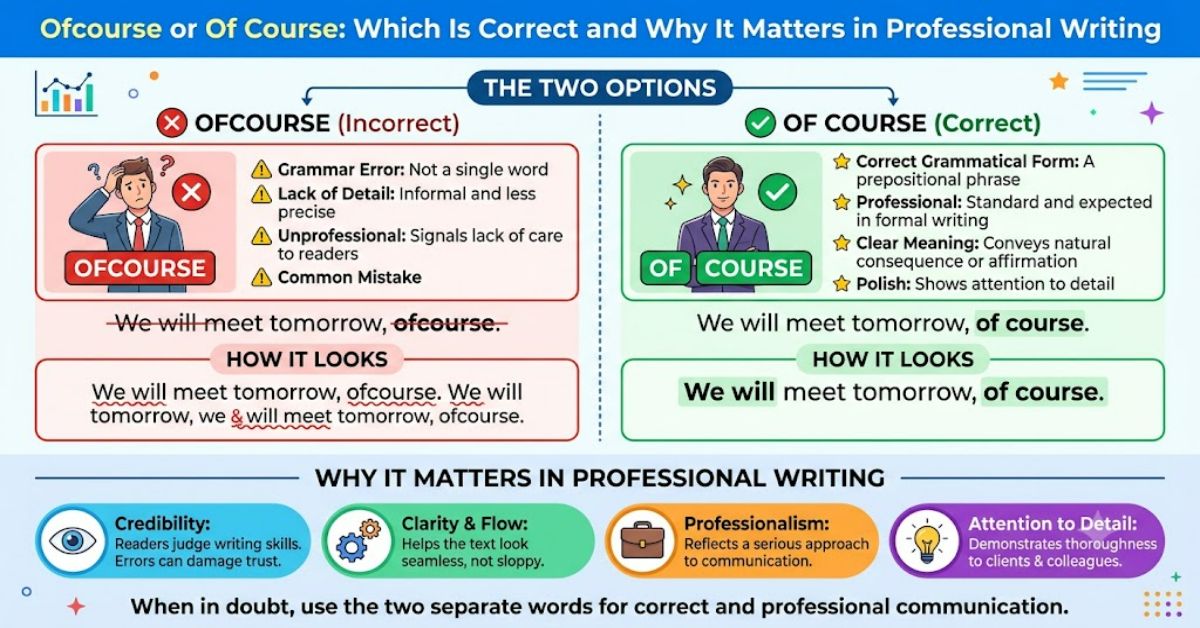
If you’ve searched for ofcourse or of course, you’re likely trying to determine which version is correct. The answer is straightforward: “of course” is the accepted spelling in modern English, while “ofcourse” is considered incorrect and should not appear in formal writing, academic work, business communication, or professional publishing.
Despite this clear rule, thousands of people type “ofcourse” every day. The mistake appears frequently in emails, social media posts, text messages, and even website content. Because the phrase is commonly spoken as a single unit, many writers unconsciously combine the words when typing.
Language errors often seem minor, but they can affect credibility. Employers, clients, educators, and readers frequently judge attention to detail based on spelling accuracy. A simple mistake repeated throughout a document can create an impression of carelessness.
This article explains why “of course” is correct, where the confusion comes from, how dictionaries classify the phrase, and why proper usage matters in digital communication. It also explores the broader implications of spelling mistakes in professional and online environments.
What Does “Of Course” Mean?
The phrase “of course” functions primarily as an adverbial expression meaning:
- Certainly
- Naturally
- Without question
- As expected
Examples:
- Of course I can help you.
- She will, of course, attend the meeting.
- The results were, of course, disappointing.
The phrase signals certainty or agreement and has been part of English usage for centuries.
Because speakers pronounce it quickly in conversation, listeners often perceive it as a single word. That pronunciation pattern contributes directly to the common misspelling.
Is “Ofcourse” Ever Correct?
No.
Major dictionaries, style guides, and language authorities do not recognise “ofcourse” as a standard English word.
Comparison Table
| Form | Correct? | Accepted in Formal Writing? | Dictionary Entry? |
| Of course | Yes | Yes | Yes |
| Ofcourse | No | No | No |
In professional environments, using “ofcourse” can result in:
- Reduced credibility
- Editing corrections
- Lower-quality content signals
- Potential academic marking penalties
The rule is simple: always use two words.
Why People Frequently Write “Ofcourse”
Several factors contribute to the mistake.
Spoken Language Influence
Many English expressions are pronounced so quickly that they sound like one word.
Examples include:
- A lot
- In fact
- Of course
- As well
Writers often transfer speech patterns directly into text.
Autocorrect Dependence
Modern users increasingly rely on predictive typing systems. When autocorrect fails to flag an error, incorrect spellings may persist.
Digital Communication Habits
Fast-paced messaging encourages speed over accuracy. Social media platforms reward quick responses rather than careful editing.
As a result, spelling mistakes spread rapidly.
The Linguistic Structure Behind “Of Course”
Understanding the grammar helps explain why the phrase remains separate.
The expression contains:
- The preposition “of”
- The noun “course”
Historically, “course” referred to a natural progression or expected path.
The phrase evolved to mean:
Following the natural course of events.
Over time, the literal meaning faded while the expression remained.
Because the words retain distinct grammatical functions, they continue to be written separately.
Common Expressions Similar to “Of Course”
English contains many expressions that confuse writers.
Frequently Misspelled Phrases
| Incorrect | Correct |
| Alot | A lot |
| Incase | In case |
| Aswell | As well |
| Ofcourse | Of course |
| Everyday (when meaning each day) | Every day |
A useful rule is that many common conversational expressions remain separate words even when spoken quickly.
Why Correct Spelling Matters Online
Many people assume spelling errors are harmless online. In reality, they can influence both user perception and search performance.
Reader Trust
Research consistently shows that spelling mistakes reduce perceived credibility.
When visitors encounter obvious errors, they may question:
- Expertise
- Professionalism
- Accuracy
- Reliability
This effect is especially important for businesses, educators, and publishers.
Search Engine Considerations
Modern search engines understand spelling variations, but content quality remains an important ranking factor.
Repeated language errors may:
- Reduce readability
- Lower user engagement
- Increase bounce rates
- Affect perceived authority
One isolated typo rarely causes problems. Consistent mistakes can.
Real-World Examples
Example 1: Academic Writing
Universities expect adherence to standard English conventions.
A student who repeatedly writes “ofcourse” may lose marks under spelling and presentation criteria.
Example 2: Business Communication
Imagine receiving two proposals:
Proposal A:
Of course we can complete the project.
Proposal B:
Ofcourse we can complete the project.
The difference appears small, but readers often perceive Proposal A as more professional.
Example 3: Website Publishing
Content editors routinely correct “ofcourse” before publication because it does not meet editorial standards.
Hidden Risks Most Guides Ignore
Many articles simply state that “ofcourse” is wrong and stop there. The broader issue involves communication quality.
Risk 1: Pattern-Based Errors
People who write “ofcourse” frequently also tend to combine other expressions incorrectly.
Examples:
- Aswell
- Alot
- Incase
Correcting one habit often improves overall writing quality.
Risk 2: Professional Perception
Recruiters and hiring managers frequently screen written communication.
Small language mistakes can influence first impressions, particularly in competitive industries.
Risk 3: AI Content Detection Signals
Editors increasingly review content quality signals when evaluating AI-assisted writing.
Consistent spelling mistakes can trigger additional scrutiny.
Structured Insight Table
| Area | Impact of Using “Ofcourse” |
| Academic Writing | Reduced marks for accuracy |
| Business Communication | Lower perceived professionalism |
| Journalism | Editorial correction required |
| Marketing Content | Reduced trustworthiness |
| Website Publishing | Quality-control issues |
| Legal Documents | Potential drafting concerns |
The Future of Language Accuracy in 2027
By 2027, spelling correction tools will likely become more integrated into everyday communication through AI-powered writing assistants.
Several trends support this expectation:
- Expanded AI editing capabilities
- Real-time grammar correction
- Context-aware proofreading
- Increased workplace reliance on digital communication
However, automated systems will not eliminate human responsibility.
Professional environments will continue to expect writers to understand basic language conventions rather than relying entirely on software.
The distinction between “of course” and “ofcourse” is unlikely to change. Major dictionaries and style guides have consistently maintained the two-word form, and there is no indication that linguistic authorities plan to recognise the merged spelling.
Key Takeaways
- “Of course” is the only correct spelling in standard English.
- “Ofcourse” remains a common but incorrect typo.
- The phrase originated as two separate grammatical components.
- Professional, academic, and editorial standards require the two-word form.
- Small spelling mistakes can influence credibility.
- Search engines tolerate occasional errors but reward high-quality content.
- Developing awareness of common phrase mistakes improves overall writing ability.
Conclusion
The debate around ofcourse or of course has a clear answer. Standard English recognises only “of course” as the correct form. The single-word version is considered a spelling error and should be avoided in formal communication.
Although the mistake is common, especially in digital conversations, maintaining correct spelling remains important. Readers often use language accuracy as a signal of professionalism, attention to detail, and credibility.
The broader lesson extends beyond one phrase. Small writing habits compound over time. Writers who consistently pay attention to grammar and spelling generally communicate more effectively and build greater trust with their audience.
When in doubt, remember a simple rule: if you mean certainly, naturally, or without question, write “of course” as two separate words.
FAQ
Is “ofcourse” a real word?
No. Major English dictionaries do not recognise “ofcourse” as a standard word.
Why do people write “ofcourse”?
Because the phrase is commonly spoken quickly, many people mistakenly combine the two words when typing.
Is “of course” formal English?
Yes. It is fully accepted in formal, academic, and professional writing.
Can search engines understand “ofcourse”?
Yes. Search engines generally recognise it as a misspelling of “of course,” but published content should still use the correct form.
Will dictionaries ever accept “ofcourse”?
Language evolves, but there is currently no evidence that major dictionaries plan to adopt “ofcourse” as a standard spelling.
What are similar mistakes?
Common examples include “alot” instead of “a lot” and “aswell” instead of “as well.”
Methodology
This article ofcourse or of course was developed using standard English grammar conventions, contemporary dictionary guidance, educational style references, and professional editorial practices. Definitions and usage explanations were cross-referenced against established language authorities.
Limitations include the evolving nature of language usage in informal digital communication. While some misspellings gain acceptance over time, there is currently no recognised linguistic basis for treating “ofcourse” as standard English.
Balanced consideration was given to both descriptive language trends and prescriptive grammar standards.
Editorial Disclosure
This article ofcourse or of course was drafted with AI assistance and reviewed and verified by [Author Name]. All data, citations, and claims should be independently confirmed by the editorial team at RubbleMagazine.co.uk.