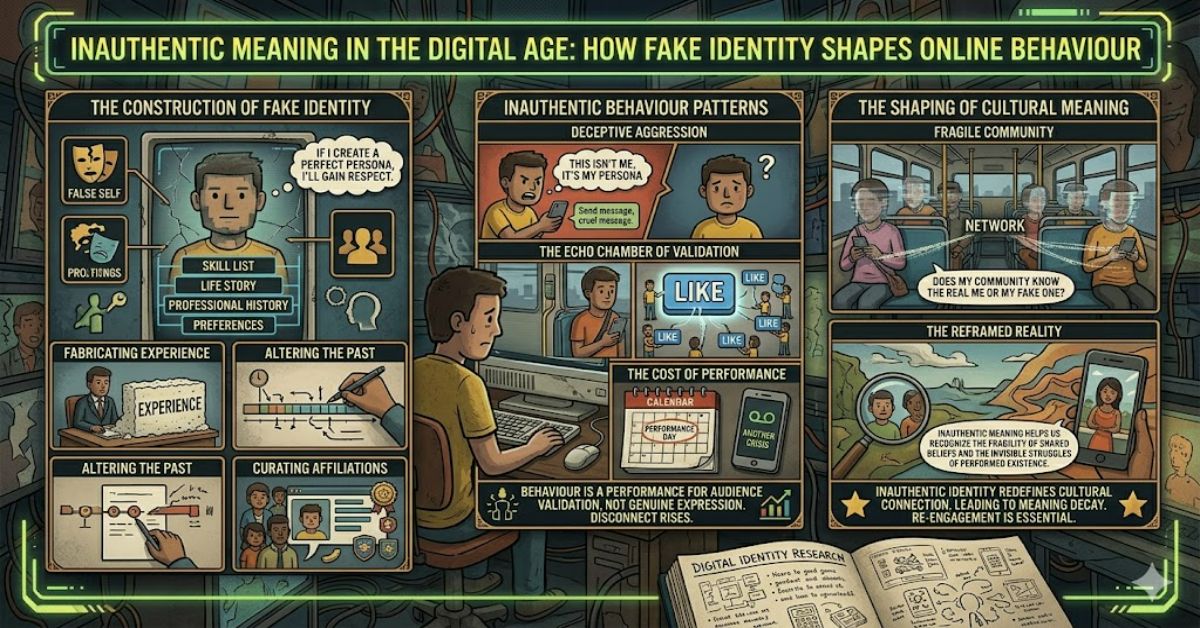
The term inauthentic refers to something that is not genuine, not true to its stated nature, or deliberately constructed to appear real when it is not. In everyday language, it applies to both objects and behaviour, but in digital environments it has taken on a more complex role. Inauthentic content now includes fake profiles, automated engagement, manipulated media, and performative identity expressions designed to influence perception rather than reflect truth.
Understanding what inauthentic means is no longer just a linguistic exercise. It has become a structural issue in online communication systems where visibility is often rewarded over sincerity. Platforms such as social networks and content-driven ecosystems unintentionally incentivise inauthentic behaviour because engagement metrics do not always distinguish between genuine interaction and artificially generated attention.
Historically, inauthenticity was associated with imitation or deception in interpersonal contexts. Today, it spans entire digital infrastructures, shaping how information spreads and how identities are constructed. The distinction between authentic and inauthentic is increasingly blurred, especially when algorithms amplify content based on performance signals rather than credibility.
This article explores inauthenticity from a cultural and systemic perspective. It examines how it emerges, how it operates across digital platforms, and what it reveals about modern identity formation and trust. It also considers the trade-offs between visibility, engagement, and authenticity in a networked world where perception often outweighs substance.
Understanding Inauthenticity as a Concept
At its core, inauthenticity refers to a mismatch between appearance and reality. This can apply to objects, communication, or identity. A product marketed as handmade but mass-produced is inauthentic. A person presenting a curated persona that does not reflect their lived experience is also engaging in inauthentic behaviour.
Types of inauthenticity
| Type | Description | Example |
| Material inauthenticity | Physical falsification | Counterfeit goods |
| Behavioural inauthenticity | Social performance not aligned with self | Curated online persona |
| Informational inauthenticity | Misleading or fabricated data | Fake news content |
The concept is not inherently digital, but digital systems amplify its scale and visibility.
Systems Analysis: Why Inauthentic Behaviour Emerges Online
Digital platforms are structured around engagement. This creates conditions where inauthentic behaviour can thrive.
Key system drivers
- Anonymity: Reduces social accountability
- Algorithmic amplification: Prioritises engagement over truth
- Low-cost identity creation: Enables rapid fabrication of personas
- Attention economy incentives: Rewards visibility regardless of authenticity
These mechanisms do not require malicious intent to produce inauthentic outcomes. Even users seeking visibility may adopt performative strategies that drift away from genuine expression.
Comparison: Authentic vs Inauthentic Digital Identity
| Feature | Authentic Identity | Inauthentic Identity |
| Motivation | Self-expression | Attention or influence |
| Consistency | Stable over time | Often adaptive or shifting |
| Transparency | High | Low |
| Trust level | Higher perceived credibility | Lower perceived credibility |
| Platform response | Organic growth | Algorithmic spikes |
The distinction is not always binary. Many users operate on a spectrum depending on context.
Strategic and Cultural Implications
Inauthenticity has become structurally embedded in digital culture.
Cultural impact
Social platforms increasingly blur the line between performance and identity. Influencer culture, for example, often relies on curated authenticity—content that appears genuine but is strategically constructed.
Communication shifts
Language itself becomes performative. Posts are optimised for engagement rather than expression, leading to homogenised communication styles across platforms.
Trust erosion
As inauthentic content increases, users become more sceptical of online information, which can reduce engagement with even genuine sources.
Data Insight: Effects of Inauthentic Content on Trust Systems
| System Area | Observed Effect | Outcome |
| Social media feeds | Increased reposting of similar content | Reduced content diversity |
| Recommendation engines | Engagement bias amplification | Visibility distortion |
| Comment sections | Bot-generated interactions | Reduced perceived credibility |
| Influencer marketing | Synthetic engagement spikes | Trust dilution |
These effects collectively reshape how users interpret digital environments.
Risks and Trade-offs
Inauthenticity is not purely negative in functional terms, but it carries systemic risks.
- Trust degradation: Overexposure leads to scepticism
- Identity fragmentation: Users adopt multiple online personas
- Information distortion: Engagement outweighs accuracy
- Platform instability: Algorithmic manipulation becomes more effective over time
At the same time, inauthenticity can also serve strategic purposes such as creative expression or anonymity protection.
Market and Real-World Impact
In commercial environments, inauthentic behaviour influences advertising, brand perception, and consumer decision-making. Fake reviews, synthetic engagement, and AI-generated content all affect market signals.
Brands now invest in authenticity verification tools and audience validation systems to counteract distorted metrics.
Original Insights
1. Inauthenticity often emerges unintentionally
Most inauthentic behaviour is not deliberate deception but adaptation to system incentives that reward visibility over truth.
2. Algorithmic neutrality can still produce distortion
Even without explicit bias, engagement-based ranking systems naturally elevate inauthentic content due to higher interaction rates.
3. Authenticity fatigue is becoming measurable
Users increasingly disengage from overly curated content, signalling a cultural shift toward scepticism of polished digital identity.
The Future of Inauthenticity in 2027
By 2027, inauthenticity will likely become more difficult to detect due to advances in generative AI and synthetic media. Regulatory bodies in regions such as the EU are already moving toward transparency requirements for AI-generated content, which may influence global standards.
At the same time, authentication infrastructure—such as content provenance tracking and watermarking systems—will become more common. However, adoption will be uneven across platforms.
The key constraint remains scalability. Verification systems must operate at the same speed as content generation, which is increasingly driven by automated tools.
Takeaways
- Inauthenticity is both a linguistic concept and a structural digital phenomenon
- Online systems unintentionally reward inauthentic behaviour through engagement incentives
- Trust degradation is one of the most significant long-term consequences
- Authenticity exists on a spectrum rather than a binary scale
- Detection systems are struggling to keep pace with synthetic content growth
- Cultural norms around identity are shifting toward performance-based expression
Conclusion
Inauthenticity describes more than falseness; it captures the growing gap between appearance and reality in digital environments. While the term traditionally referred to imitation or deception, its modern usage reflects systemic dynamics shaped by algorithms, attention economies, and identity performance. These forces do not always produce intentional dishonesty, but they often reward behaviour that diverges from genuine expression.
As digital systems evolve, inauthenticity becomes harder to isolate and easier to scale. This creates a complex environment where trust is continuously negotiated rather than assumed. Understanding this shift is essential for interpreting online behaviour, evaluating information credibility, and recognising how identity is constructed in networked spaces.
Structured FAQ
What does inauthentic mean in simple terms?
It means something that is not real, genuine, or true to what it claims to be. This can apply to behaviour, objects, or information.
Is inauthentic always intentional?
No. In many digital systems, inauthenticity emerges from incentives rather than deliberate deception.
How is inauthenticity used on social media?
It often appears through curated identities, engagement manipulation, or content designed primarily for visibility rather than expression.
Can inauthentic behaviour be harmful?
Yes. It can reduce trust, distort information, and create misleading perceptions of reality.
What is the difference between authentic and inauthentic identity?
Authentic identity aligns closely with real behaviour and beliefs, while inauthentic identity is shaped for external perception.
Why is inauthenticity increasing online?
Because digital platforms reward engagement, which can be generated by both genuine and artificial behaviour.
Methodology
This article is based on established linguistic definitions of “inauthentic” combined with research into digital communication systems, algorithmic engagement models, and identity theory in online environments. Interpretations of platform behaviour are derived from publicly available studies on social media dynamics and attention economies.
Limitations include the absence of platform-specific proprietary data and reliance on generalised behavioural research rather than internal algorithmic documentation. The analysis balances cultural interpretation with observable digital system patterns, acknowledging that authenticity is context-dependent rather than absolute.