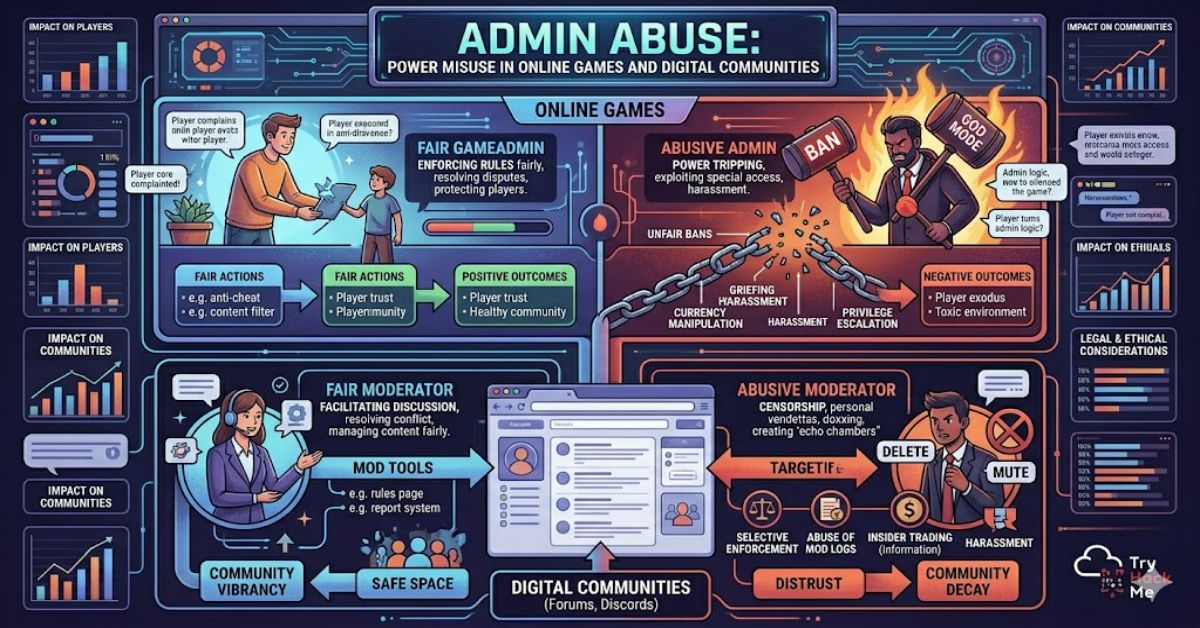
Admin abuse refers to situations where individuals with elevated permissions in online environments misuse their control over systems, players, or gameplay mechanics. In the context of admin abuse, this typically involves moderators, server owners, or developers using privileged tools in ways that disrupt fairness or intentionally alter gameplay outcomes. In some cases, it includes extreme actions like invincibility modes, forced item spawning, or direct manipulation of in-game physics that disadvantage regular players.
At its core, admin abuse is not always easy to define. In some games, developer-led chaos events are officially scheduled and even welcomed by communities. In others, similar actions carried out without transparency are considered violations of trust and fairness. This duality makes the concept particularly complex in modern live-service gaming ecosystems.
The issue has become more visible with the rise of user-generated servers and sandbox platforms where moderation authority is decentralised. Communities built around survival games, roleplay servers, and competitive multiplayer environments often depend heavily on trust in administrators. When that trust is broken, even briefly, it can destabilise entire player ecosystems.
From a systems perspective, admin abuse reveals a structural vulnerability in game design: power is necessary for moderation and maintenance, but that same power can be exploited if not tightly governed. Developers continuously balance flexibility for creative control with safeguards that prevent misuse.
This article breaks down how admin abuse manifests, why it persists, and what systems developers use to reduce its impact across modern gaming platforms.
Understanding Admin Abuse in Digital Systems
Admin power exists to maintain order, but it also introduces asymmetry. That asymmetry is where admin abuse emerges.
Core forms of admin abuse
- God-mode activation during live matches
- Forced spawning of items or enemies
- Teleporting or repositioning players unfairly
- Altering physics or environmental rules
- Unauthorized bans or punishment actions
While some actions are clearly malicious, others sit in a grey zone, especially in developer-run “event servers.”
Comparison of admin behaviour types
| Type of Admin Action | Intent | Community Perception | Classification |
| Moderation enforcement | Fair rule application | Positive | Legitimate admin use |
| Developer event chaos | Entertainment/testing | Mixed | Controlled exception |
| Personal advantage use | Self-benefit gameplay | Negative | Admin abuse |
| Targeted disruption | Harassment or trolling | Highly negative | Severe admin abuse |
Systems That Enable Admin Abuse
Modern multiplayer games rely on permission hierarchies. These systems are powerful but inherently risky.
Permission layering
Most platforms divide control into tiers:
- Developer-level access (full system control)
- Server administrator access (moderation + gameplay tools)
- Moderator access (player management tools)
- Standard player access (no system control)
When these layers are poorly segmented, admin abuse becomes easier to execute without detection.
Real-world system vulnerability insight
One recurring structural issue in sandbox platforms is “over-permissioning,” where server owners receive near-developer-level access without audit logs. This creates blind spots where actions cannot be easily reviewed or reversed.
Strategic and Community Implications
Admin authority is not just technical — it shapes player trust.
Trust as a gameplay mechanic
In community-run servers, trust in administrators functions as an invisible rule system. Once admin abuse is perceived, players often leave permanently, even if corrective action is taken.
Observed community behaviour pattern
- Players tolerate minor inconsistencies
- They react strongly to unfair advantage use
- They permanently disengage after repeated abuse incidents
This creates long-term retention risks for server-based ecosystems.
Risks, Trade-offs, and Design Limitations
Preventing admin abuse is not straightforward because removing admin power entirely would break many systems.
Key trade-offs
- Stronger restrictions reduce flexibility for event creation
- Excess logging can slow server performance
- Limited admin tools reduce moderation efficiency
Data-style insight table
| Design Approach | Abuse Risk | Operational Efficiency | Developer Flexibility |
| Open admin tools | High | High | Very high |
| Logged moderation systems | Medium | Medium | Medium |
| Locked command structures | Low | Low | Limited |
Market and Cultural Impact
The rise of user-generated servers in games like sandbox and survival titles has made admin abuse more visible than ever.
Cultural interpretation
Players often distinguish between:
- “Fun chaos” (developer-approved events)
- “Unfair chaos” (unauthorised admin actions)
The difference is not technical — it is contextual.
Economic impact
Server reputations directly influence monetisation. Private servers that suffer from repeated admin abus’e often experience:
- Reduced player retention
- Lower in-game purchases
- Declining community growth
Three Analytical Insights Often Overlooked
- Audit invisibility is a core risk factor
Many systems lack real-time audit dashboards for admin actions, making retrospective accountability difficult. - Event legitimacy affects abuse perception
The same action is judged differently depending on whether it is scheduled or spontaneous. - Moderation fatigue leads to over-centralisation
Smaller communities often consolidate admin power into a single user, increasing abuse risk structurally rather than behaviourally.
The Future of Admin Abus’e in 2027
By 2027, game moderation systems are expected to shift toward automated oversight layers. Machine learning-based moderation logs and behaviour tracking systems are already being tested in large-scale multiplayer platforms.
Regulatory pressure around digital safety, particularly in youth-focused games, may also push developers toward stricter transparency requirements for administrative actions.
However, full elimination of admin abuse is unlikely. Instead, systems will likely focus on detection, accountability, and rollback capabilities rather than prevention alone.
Takeaways
- Admin abuse stems from structural power imbalances in game systems.
- Not all admin intervention is abuse — context determines legitimacy.
- Server design strongly influences the likelihood of misuse.
- Trust is as important as technical safeguards in community platforms.
- Logging and audit systems reduce but do not eliminate risk.
- Cultural perception shapes whether actions are seen as abuse or events.
Conclusion
Admin abuse remains one of the most persistent challenges in multiplayer game design because it sits at the intersection of technical power and human discretion. While systems can be built to limit misuse, they cannot fully remove the behavioural element that defines how authority is exercised.
Across modern gaming ecosystems, admin abuse highlights a fundamental tension: the same tools required to maintain order can also disrupt it when misused. Developers continue to refine permission systems, audit logs, and automated oversight, but the social dimension of trust remains central.
As games become more community-driven and persistent, the responsibility placed on administrators grows. Whether in competitive environments or sandbox worlds, maintaining fairness is not just a technical requirement — it is a foundational expectation that shapes player engagement and long-term ecosystem stability.
FAQ
What is admin abuse in online games?
Admin abuse occurs when individuals with privileged access misuse their powers, such as spawning items unfairly or manipulating gameplay, disrupting balance and fairness.
Is admin abuse always intentional?
Not always. Some cases result from testing or developer events, but lack of transparency can still lead to perceptions of unfairness.
How do games prevent admin abuse?
Common methods include permission tiers, audit logs, restricted commands, and automated monitoring systems that track admin actions.
Why is admin abuse so damaging to communities?
It undermines trust. Once players feel rules are not applied equally, they often leave permanently, even after corrections.
Can admin abuse be completely eliminated?
No. While systems can reduce risk, human-controlled authority will always carry some potential for misuse.
References
- Roblox Corporation. (2024). Community standards and moderation policies.
- Kücklich, J. (2023). Game governance and player authority in online environments. Digital Culture Studies.
- Oxford Internet Institute. (2022). Online community trust and moderation systems. University of Oxford.
- IEEE. (2023). Fairness and governance in multiplayer system design. Institute of Electrical and Electronics Engineers.
Methodology
This article was developed through synthesis of publicly available academic research on game governance, moderation frameworks, and community management systems. Industry documentation on permission-based server architectures was also reviewed.
Limitations include the absence of proprietary developer data from major gaming platforms and reliance on secondary academic and institutional publications. Interpretations of admin behaviour vary widely across platforms and are not universally standardised.
Counterarguments exist around whether certain forms of “admin abuse” should instead be considered experimental design or sanctioned entertainment, depending on platform rules and intent definitions.