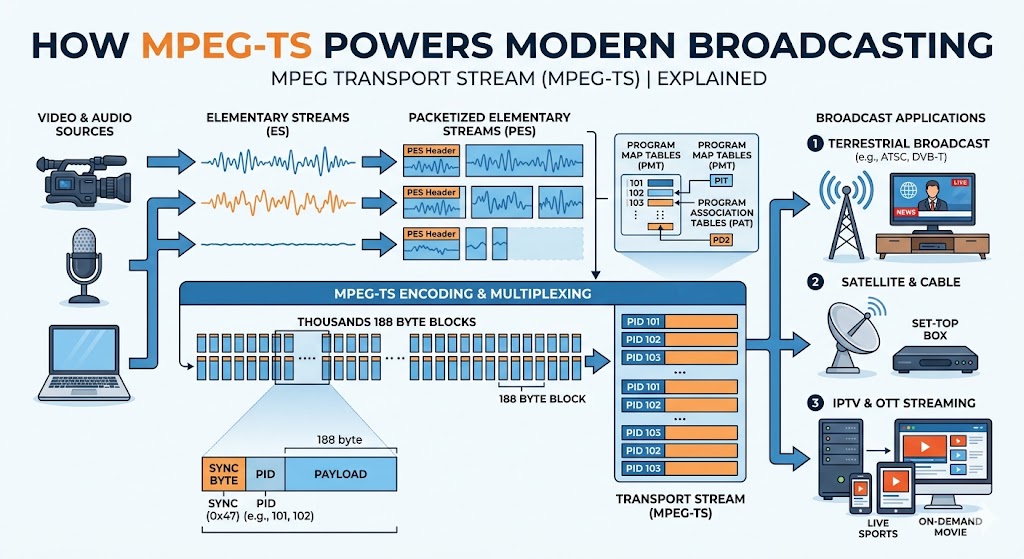
Most people consume digital video every day without realising that a decades-old technology still powers much of the world’s broadcast infrastructure. Whether you’re watching live football on satellite TV, receiving digital terrestrial television, or operating a professional IPTV network, there’s a good chance MPEG Transport Streams are involved somewhere in the delivery chain.
A transport stream (TS) is a digital container format defined by the MPEG-2 Systems standard (ISO/IEC 13818-1). It was designed to transport audio, video, and metadata across networks where transmission errors are expected. Unlike file formats intended primarily for storage, MPEG-TS prioritises reliability, synchronisation, and error recovery.
That design decision is precisely why transport streams remain relevant in 2026 despite the growth of HLS, DASH, and cloud-native streaming platforms.
What Is a Transport Stream?
A transport stream is a packet-based container that carries multiple media services simultaneously.
The format packages data into fixed-length 188-byte packets. Each packet contains information that allows receiving equipment to identify, reconstruct, and synchronise the original content.
A single transport stream can carry:
- Multiple television channels
- Several audio tracks
- Closed captions
- Electronic programme guides
- Emergency alert information
- Timing and synchronisation data
This capability makes MPEG-TS ideal for broadcast environments where efficiency and reliability matter more than storage optimisation.
The Engineering Problem MPEG-TS Solved
When MPEG engineers developed the standard, the primary challenge was simple:
How do you deliver television reliably across unreliable networks?
Satellite signals experience atmospheric interference. Terrestrial broadcasts face noise and signal degradation. Cable systems introduce transmission errors.
Instead of assuming perfect delivery, transport streams assume that packet loss will happen.
Key mechanisms include:
| Feature | Purpose |
| Fixed packet size | Simplifies hardware processing |
| Packet identifiers (PID) | Separates services |
| Continuity counters | Detects missing packets |
| Program Clock Reference (PCR) | Maintains timing |
| Multiplexing support | Combines multiple channels |
These features explain why transport streams remain trusted in mission-critical broadcasting.
How MPEG-TS Works
At a basic level, audio and video are first encoded using compression standards such as MPEG-2, H.264, or HEVC.
The encoded streams are then multiplexed into a transport stream.
Each packet receives a Packet Identifier (PID), which tells receivers what type of content it contains.
For example:
| PID Type | Function |
| Video PID | Video content |
| Audio PID | Audio tracks |
| PAT | Program Association Table |
| PMT | Program Map Table |
| PCR | Timing reference |
The receiver uses these identifiers to reconstruct the original programme.
Think of it like sorting thousands of letters travelling through the same postal system.
Why Broadcasters Continue Using Transport Streams
A common question is:
“If newer streaming technologies exist, why hasn’t MPEG-TS disappeared?”
The answer comes down to operational reliability.
Proven Infrastructure
Broadcasters have invested billions in systems designed around MPEG transport streams.
Replacing these systems rarely generates enough operational benefit to justify the cost.
Low-Latency Delivery
Transport streams can achieve predictable latency characteristics that are valuable for live sports, news, and event coverage.
Equipment Compatibility
Virtually every major broadcast vendor supports MPEG-TS.
That level of ecosystem maturity is difficult to replace.
Transport Streams vs Modern Streaming Formats
Many people confuse transport streams with streaming protocols.
They are related but not identical.
| Technology | Primary Purpose |
| MPEG-TS | Broadcast transport |
| HLS | Internet video delivery |
| MPEG-DASH | Adaptive streaming |
| MP4 | File storage |
| CMAF | Unified streaming format |
A modern streaming service may actually use transport streams internally before converting content into HLS or DASH segments.
This hybrid approach is now common across large media platforms.
Three Insights Most Articles Miss
1. MPEG-TS Is Not Being Replaced—It’s Being Hidden
Many discussions frame MPEG-TS as outdated.
In reality, transport streams often remain active behind the scenes even when viewers consume content through modern apps.
The viewer sees HLS. The broadcaster may still operate MPEG-TS throughout the production chain.
2. Synchronisation Is More Valuable Than Compression Efficiency
Storage-focused discussions often emphasise bitrate savings.
Broadcast engineers frequently prioritise timing accuracy instead.
A perfectly compressed stream is useless if audio and video drift out of sync during a live event.
3. Broadcast and Streaming Are Converging
Historically, broadcast and internet delivery used separate infrastructures.
Today, organisations increasingly build workflows that combine both.
Transport streams often serve as the bridge between traditional broadcasting and cloud-based distribution.
Common Problems Engineers Encounter
Packet Loss
Missing packets can create visual artefacts and audio interruptions.
PCR Jitter
Poor clock accuracy may cause synchronisation issues.
PID Conflicts
Incorrect PID assignments can prevent receivers from identifying services correctly.
Multiplexer Configuration Errors
Improper stream configuration remains one of the most common causes of deployment problems.
These challenges explain why specialised transport stream analysers remain essential tools in professional environments.
Real-World Applications
Transport streams continue to power:
Digital Television
DVB-T, DVB-S, and DVB-C systems rely heavily on MPEG-TS.
Satellite Broadcasting
Satellite networks use transport stream’s because of their resilience under imperfect transmission conditions.
IPTV Networks
Many managed IPTV systems distribute channels using MPEG-TS over IP.
Contribution Feeds
Broadcasters exchange content between facilities using transport streams before final distribution.
The Future of Transport Streams in 2027
Transport streams are unlikely to disappear by 2027.
Several trends support continued adoption:
- Growth of live streaming
- Expansion of IPTV infrastructure
- Demand for low-latency delivery
- Continued broadcast modernisation projects
- Hybrid cloud-broadcast workflows
However, their role will evolve.
Rather than serving as a consumer-facing technology, MPEG-TS will increasingly operate as an infrastructure layer hidden beneath modern streaming experiences.
The future is not transport streams versus internet streaming.
The future is transport streams working alongside adaptive delivery technologies.
Key Takeaways
- Transport streams were built specifically for unreliable transmission environments.
- MPEG-TS remains a foundational technology for broadcasting.
- Fixed packet architecture improves resilience and error recovery.
- Modern streaming services often still depend on transport streams internally.
- Synchronisation remains one of MPEG-TS’s greatest strengths.
- Hybrid broadcast-IP workflows are increasing the format’s relevance.
- Transport streams will likely remain a core professional media technology through 2027 and beyond.
Conclusion
Transport streams rarely receive attention outside broadcast engineering circles, yet they remain one of the most influential technologies in digital media distribution. Their design reflects a practical engineering philosophy: expect transmission problems and build systems capable of surviving them.
That philosophy has proven remarkably durable. While consumer-facing technologies continue to evolve, the fundamental requirements of professional media delivery—reliability, synchronisation, and interoperability—have not changed.
For broadcasters, IPTV operators, and media infrastructure providers, MPEG-TS continues to solve critical operational problems. Its future may be less visible than its past, but transport streams remain deeply embedded in the architecture of modern video delivery.
The technology is no longer the headline. It is the foundation underneath it.