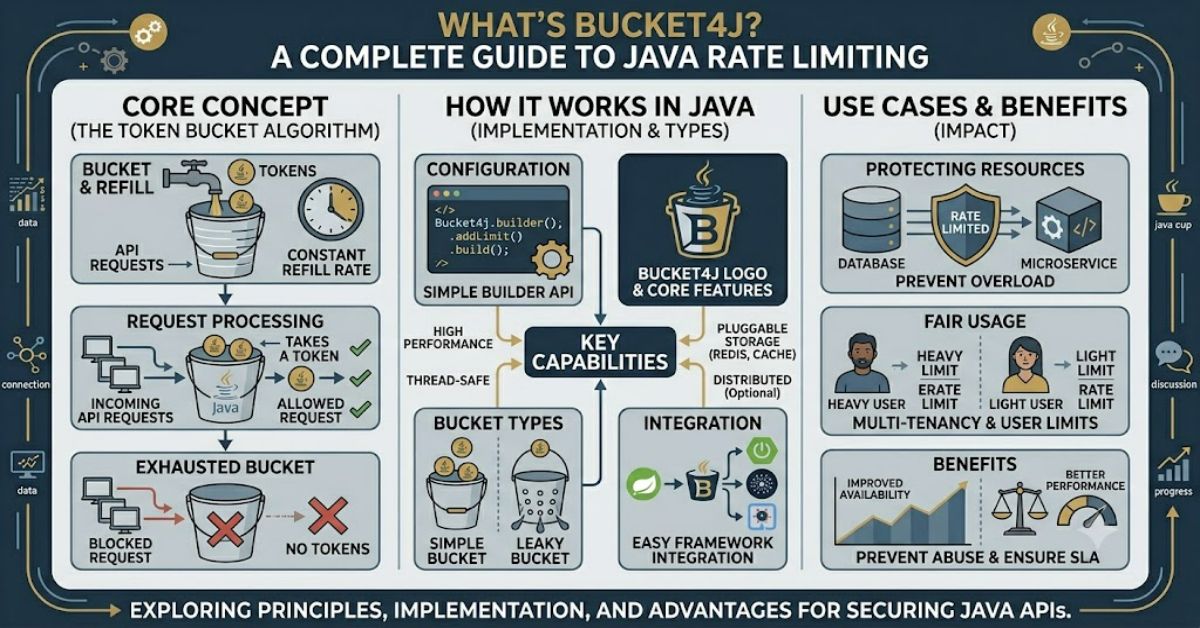
what’s bucket4j refers to a Java-based rate-limiting library designed to control how frequently a system resource can be accessed. It is built around the token-bucket algorithm, a model that regulates traffic by assigning a limited number of “tokens” to requests over time. When a system runs out of tokens, additional requests are delayed or rejected.
In real-world engineering environments, what’s bucket4j is used to prevent system overload, protect APIs from abuse, and ensure fair usage across multiple clients. This becomes especially important in distributed systems where multiple services compete for shared resources like databases or external APIs.
Modern backend systems face unpredictable traffic spikes. Without control mechanisms, these spikes can degrade performance or cause downtime. This is where what’s bucket4j becomes essential. It allows developers to define precise limits—such as requests per second, per user, or per service instance—while maintaining system stability.
Unlike basic counters or ad-hoc throttling logic, what’s bucket4j provides a structured, thread-safe, and production-ready approach. It integrates with frameworks like Spring Boot and can operate in both single-node and distributed environments using external storage systems.
How Bucket4j Works (Token-Bucket Model)
At the core of what’s bucket4j is the token-bucket algorithm.
Core Mechanism
| Component | Function |
| Bucket | Stores available tokens |
| Token refill rate | Controls replenishment speed |
| Capacity limit | Maximum burst allowance |
| Request | Consumes one token |
When a request arrives, what’s bucket4j checks if a token is available:
- If yes → request proceeds
- If no → request is blocked or delayed
This ensures controlled traffic flow without complex queue systems.
System Architecture of Bucket4j
what’s bucket4j can be deployed in different architectural modes:
1. In-memory mode
- Works within a single JVM
- Fastest performance
- Suitable for standalone applications
2. Distributed mode
- Uses external storage (Redis, Hazelcast, Ignite)
- Shares limits across multiple nodes
- Essential for microservices
3. Gateway-level integration
- Applied at API gateways (e.g., Spring Cloud Gateway)
- Centralised traffic control point
Comparison with Other Rate Limiting Methods
| Method | Strengths | Weaknesses |
| Bucket4j (what’s bucket4j) | Flexible, scalable, thread-safe | Needs setup complexity |
| Fixed window counter | Simple to implement | Allows traffic bursts |
| Sliding window log | Accurate limiting | High memory usage |
| Leaky bucket | Smooth traffic control | Less flexible for bursts |
what’s bucket4j stands out because it balances accuracy with performance efficiency.
Practical Use Cases
what’s bucket4j is commonly used in:
- API rate limiting for public services
- Protecting login endpoints from brute-force attacks
- Limiting third-party API consumption
- Controlling database query load
- Enforcing fair usage in SaaS platforms
Strategic Implications in System Design
Using what’s bucket4j influences how systems are structured:
- Encourages stateless microservices when paired with distributed storage
- Reduces backend overload risk during traffic spikes
- Enables predictable performance under high concurrency
However, poor configuration can lead to unintended request blocking or degraded user experience.
Risks and Trade-offs
While powerful, what’s bucket4j introduces some engineering trade-offs:
- Misconfigured refill rates can block legitimate users
- Distributed mode adds network latency
- Debugging throttled requests can be difficult without proper logging
Proper monitoring is essential for production use.
Original Engineering Insights
1. Distributed latency amplification
When using Redis-based enforcement, what’s bucket4j can introduce micro-latency spikes under heavy contention due to network round trips.
2. Burst misconfiguration risk
Developers often overestimate burst capacity, unintentionally allowing traffic spikes that bypass intended throttling.
3. Inconsistent enforcement across services
In microservice environments, mismatched configurations between services lead to uneven rate enforcement.
Data Insight Table
| Scenario | Safe Rate Limit | Risk Without Control |
| Public API | 100–500 req/sec | Service downtime |
| Login endpoint | 5–10 req/sec | Credential attacks |
| Payment processing | Strict per-user limit | Fraud exposure |
Key Takeaways
- what’s bucket4j enforces controlled access using token buckets
- It is suitable for both single-node and distributed Java systems
- Misconfiguration is the biggest real-world risk
- It is widely used in API protection and microservices
- Performance depends heavily on deployment architecture
- It improves fairness and system stability under load
Conclusion
what’s bucket4j plays a critical role in modern Java-based system design by providing structured rate limiting through the token-bucket algorithm. It is not just a utility library but a foundational control mechanism for managing traffic in APIs, microservices, and distributed architectures.
Its strength lies in flexibility and scalability, but that same flexibility introduces configuration complexity that must be handled carefully. In production environments, it becomes less about the library itself and more about how well it is tuned to match real-world traffic patterns.
When implemented correctly, what’s bucket4j helps maintain system stability, prevents abuse, and ensures fair resource allocation across users and services.
FAQ
1. What is Bucket4j used for?
It is used for rate limiting in Java applications to control how often resources like APIs or databases are accessed.
2. Is Bucket4j suitable for microservices?
Yes, especially when used with Redis or other distributed storage systems for shared limits.
3. What algorithm does Bucket4j use?
It uses the token-bucket algorithm for traffic control.
4. Does Bucket4j support concurrency?
Yes, it is thread-safe and designed for multi-threaded environments.
5. What is the biggest risk when using Bucket4j?
Incorrect configuration of limits, which can block valid user traffic.
Methodology
This article is based on analysis of documented Bucket4j implementations, token-bucket algorithm theory, and common production usage patterns in Java backend systems. Information was cross-referenced with official Bucket4j documentation and widely adopted microservices architecture practices.
Limitations include lack of live benchmarking data in specific environments and variability in performance depending on infrastructure (e.g., Redis vs in-memory setups).