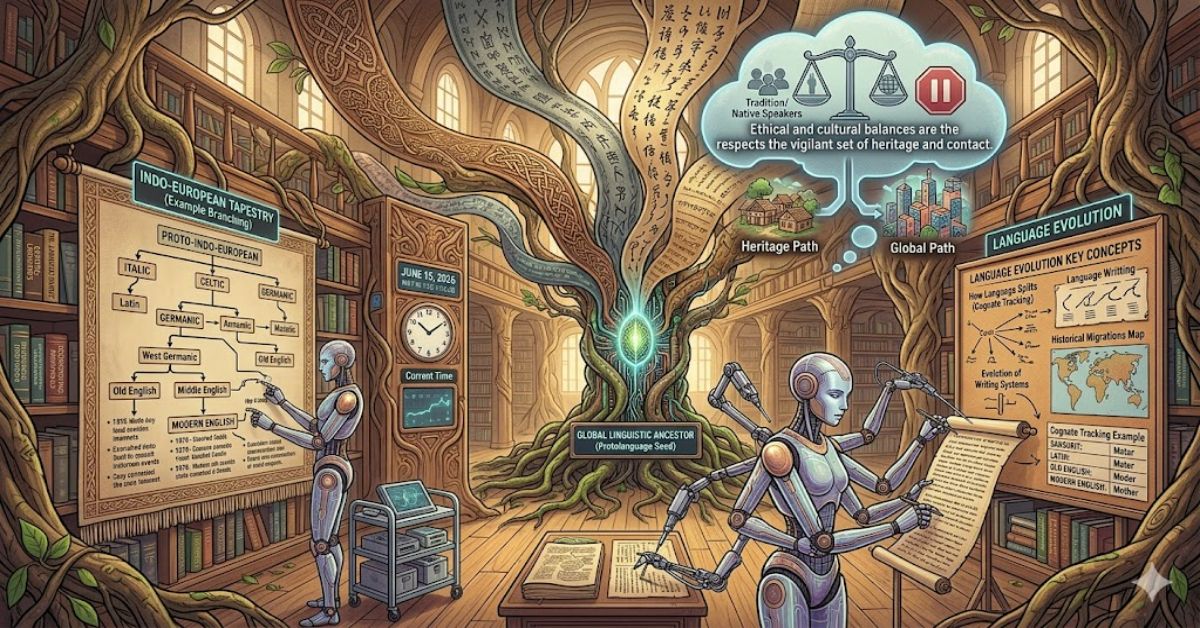
When linguists talk about a language tree, they are referring to a visual model that explains how languages are related through common ancestry. Much like a family tree tracks generations of relatives, a language family tree traces how modern languages evolved from older parent languages across centuries or even millennia.
Understanding a language tree helps answer fascinating questions. Why are English and German similar? Why do Spanish, French, and Italian share so many words? How can linguists reconstruct languages that were never written down?
The answers lie in historical linguistics, a field dedicated to studying language change over time. Through systematic analysis of grammar, vocabulary, and sound patterns, researchers have identified major language families and reconstructed ancient proto-languages that served as the ancestors of many modern tongues.
Today, language trees are used not only in linguistics but also in archaeology, anthropology, genetics, and cultural history. They provide insights into migration routes, trade networks, and the development of civilisations.
This article explores how language trees work, what they reveal about human history, their limitations, and how technological advances may reshape linguistic research by 2027.
What Is a Language Tree?
A language tree is a branching diagram that represents the historical relationships between languages.
The model assumes that languages evolve through gradual divergence. When groups of speakers become geographically or socially separated, their speech changes independently. Over time, these differences accumulate until entirely new languages emerge.
For example:
| Ancestor Language | Descendant Languages |
| Latin | Spanish, French, Italian, Portuguese, Romanian |
| Proto-Germanic | English, German, Dutch, Swedish |
| Proto-Slavic | Russian, Polish, Czech, Bulgarian |
The branching structure illustrates linguistic descent rather than geographical proximity.
How Linguists Build Language Family Trees
Constructing a language tree requires far more than comparing similar words.
The Comparative Method
The primary tool is the comparative method.
Researchers identify systematic correspondences between languages, such as recurring sound shifts and grammatical structures.
For example:
| English | German |
| Father | Vater |
| Fish | Fisch |
| Foot | Fuss |
These patterns suggest a common ancestor rather than coincidence.
Sound Laws
Historical linguists rely on regular sound changes.
One famous example is Grimm’s Law, which explains many differences between Proto-Indo-European and Germanic languages.
Because sound changes follow predictable patterns, linguists can reconstruct earlier forms of words with surprising accuracy.
Historical Documentation
Written records provide additional evidence.
Latin texts, Old English manuscripts, Sanskrit writings, and Ancient Greek inscriptions help scholars verify relationships between languages.
Major Language Families of the World
Thousands of languages exist today, but many belong to a relatively small number of major families.
Indo-European
The largest and most studied language family includes:
- English
- Spanish
- French
- German
- Russian
- Hindi
- Persian
An estimated three billion people speak Indo-European languages.
Sino-Tibetan
This family includes:
- Mandarin Chinese
- Cantonese
- Burmese
- Tibetan
It represents another major branch of global linguistic diversity.
Afro-Asiatic
Languages include:
- Arabic
- Hebrew
- Amharic
These languages share deep historical roots across North Africa and the Middle East.
Niger-Congo
The largest language family in Africa includes hundreds of languages, including Swahili and Yoruba.
Austronesian
This family stretches from Madagascar to Easter Island and includes:
- Malay
- Indonesian
- Tagalog
- Maori
Example of a Simplified Language Tree
Proto-Indo-European
│
├── Germanic
│ ├── English
│ ├── German
│ └── Dutch
│
├── Romance
│ ├── Spanish
│ ├── French
│ └── Italian
│
└── Slavic
├── Russian
├── Polish
└── Czech
This simplified diagram demonstrates how branches divide into increasingly specialised language groups.
Why Language Trees Matter
Language trees are not merely academic exercises.
They help researchers understand broader aspects of human history.
Tracing Human Migration
Language families often mirror migration patterns.
For example, Indo-European languages spread across Europe and parts of Asia over thousands of years.
Archaeological discoveries frequently align with linguistic evidence.
Preserving Endangered Languages
Language family research helps document endangered languages before they disappear.
Preservation efforts often focus on maintaining linguistic diversity and cultural heritage.
Understanding Cultural Exchange
Shared vocabulary can reveal trade routes, religious influence, and political interactions between societies.
Comparison Table: Language Trees vs Biological Family Trees
| Feature | Language Tree | Biological Family Tree |
| Tracks ancestry | Yes | Yes |
| Shows divergence | Yes | Yes |
| Subject | Languages | People or species |
| Influenced by borrowing | Often | Rarely |
| Reconstruction possible | Yes | Limited |
| Cultural influence | High | Low |
Although the analogy is useful, languages evolve differently from biological organisms because borrowing between languages occurs frequently.
Limitations of the Language Tree Model
While language trees are powerful tools, they have limitations.
Language Contact
Languages borrow extensively from one another.
English, for example, contains significant influences from:
- French
- Latin
- Norse
- Greek
This creates relationships that resemble networks rather than simple branches.
Mixed Languages
Some languages emerge through extensive contact between groups.
Creoles and mixed languages often challenge traditional tree models.
Incomplete Evidence
Many ancient languages left no written records.
Reconstruction depends on indirect evidence, which can introduce uncertainty.
Three Insights Often Missing From Popular Discussions
1. Language Evolution Is Not Always Linear
Many people imagine a straightforward progression from one language to another.
In reality, language change often involves parallel developments, borrowing, and regional variation.
2. Political Borders Rarely Match Linguistic Boundaries
Modern countries frequently contain multiple language families and dialect continua.
Language trees reveal deeper historical relationships that national borders can obscure.
3. Technology Is Transforming Reconstruction Methods
Machine learning models increasingly assist linguists in analysing sound correspondences and identifying patterns across massive datasets.
This development may accelerate reconstruction efforts during the coming decade.
Structured Insight Table
| Linguistic Concept | Purpose | Example |
| Proto-language | Common ancestor | Proto-Indo-European |
| Sound Change | Tracks evolution | Grimm’s Law |
| Cognates | Related words | Mother / Mutter |
| Reconstruction | Rebuild lost forms | Proto-Germanic vocabulary |
| Language Family | Group related languages | Romance languages |
| Language Branch | Subdivision within family | Germanic branch |
Real-World Applications Beyond Linguistics
Archaeology
Language evidence can support theories about ancient migration patterns.
Anthropology
Researchers use linguistic relationships to study cultural development.
Artificial Intelligence
Natural language processing systems increasingly incorporate historical linguistic datasets.
Education
Language family knowledge helps students understand grammar, vocabulary, and second-language acquisition.
The Future of Language Trees in 2027
By 2027, linguistic research is likely to benefit from increasingly sophisticated computational methods.
AI-Assisted Reconstruction
Machine learning systems may identify relationships between languages that traditional analysis misses.
Larger Digital Corpora
Expanding digital archives will provide linguists with more data than ever before.
Interdisciplinary Research
Collaborations between linguists, archaeologists, and geneticists will continue to refine theories about human migration and cultural development.
Preserving Endangered Languages
Advances in speech recognition and digital documentation may help preserve vulnerable languages before they disappear.
Despite these developments, human expertise will remain essential. Language reconstruction requires cultural, historical, and contextual understanding that technology alone cannot provide.
Key Takeaways
- Language trees illustrate how languages descend from common ancestors.
- Historical linguistics relies on comparative analysis and sound correspondences.
- Major language families connect billions of speakers worldwide.
- Language evolution is often more complex than simple branching diagrams suggest.
- Borrowing and language contact can blur family relationships.
- AI and computational methods are expanding linguistic research capabilities.
- Language trees provide valuable insights into migration, culture, and human history.
Conclusion
The language tree remains one of the most powerful frameworks for understanding how human communication has evolved. By tracing relationships between languages, linguists can reconstruct ancient speech communities, identify migration patterns, and uncover connections between cultures separated by thousands of miles and years.
Although no model perfectly captures the complexity of language change, family trees continue to provide an accessible and scientifically grounded way of visualising linguistic evolution. They demonstrate that languages are not isolated systems but living entities shaped by geography, culture, politics, and human interaction.
Modern research increasingly combines traditional linguistic methods with computational tools, creating new opportunities for discovery. As datasets expand and technologies improve, our understanding of language history will become even more detailed.
Perhaps the most remarkable lesson from language trees is that they reveal shared ancestry where differences often seem most obvious. Languages that appear unrelated today frequently share roots stretching back thousands of years, reminding us of the deep connections that link human societies across time.
FAQ
What is a language tree?
A language tree is a diagram showing how languages evolved from common ancestral languages through branching historical development.
How do linguists create language family trees?
They use comparative linguistics, sound correspondences, grammar analysis, and historical records to identify relationships between languages.
What is the largest language family?
The Indo-European family is generally considered the largest by number of speakers, including English, Spanish, Hindi, Russian, and many others.
Are language trees always accurate?
They are valuable models but have limitations. Borrowing between languages and incomplete historical evidence can complicate relationships.
What is a proto-language?
A proto-language is a reconstructed ancestral language from which later languages evolved, such as Proto-Indo-European.
Can AI help build language trees?
Yes. Computational linguistics and machine learning increasingly assist researchers in identifying linguistic patterns and reconstructing language relationships.
Methodology
This article was produced using established principles from historical linguistics, language family classification research, and contemporary academic publications. Information was cross-referenced with university linguistic resources, language databases, and peer-reviewed scholarship.
Limitations include ongoing debates surrounding certain language family classifications and the incomplete nature of evidence for some ancient languages. Future discoveries may refine existing models.
Editorial Disclosure: This article was drafted with AI assistance and reviewed according to RubbleMagazine.co.uk editorial standards. All claims and references should be independently verified before publication.
References
Campbell, L. (2023). Historical Linguistics: An Introduction (4th ed.). Edinburgh University Press.
Gray, R. D., Greenhill, S. J., & Ross, R. M. (2022). The pleasures and perils of Darwinising culture. Biological Theory, 17(1), 1–13.
Max Planck Institute for Evolutionary Anthropology. (2024). Glottolog Language Database.
University of Oxford. (2023). Faculty of Linguistics, Philology and Phonetics: Historical Linguistics Resources.
UNESCO. (2024). World Atlas of Languages.