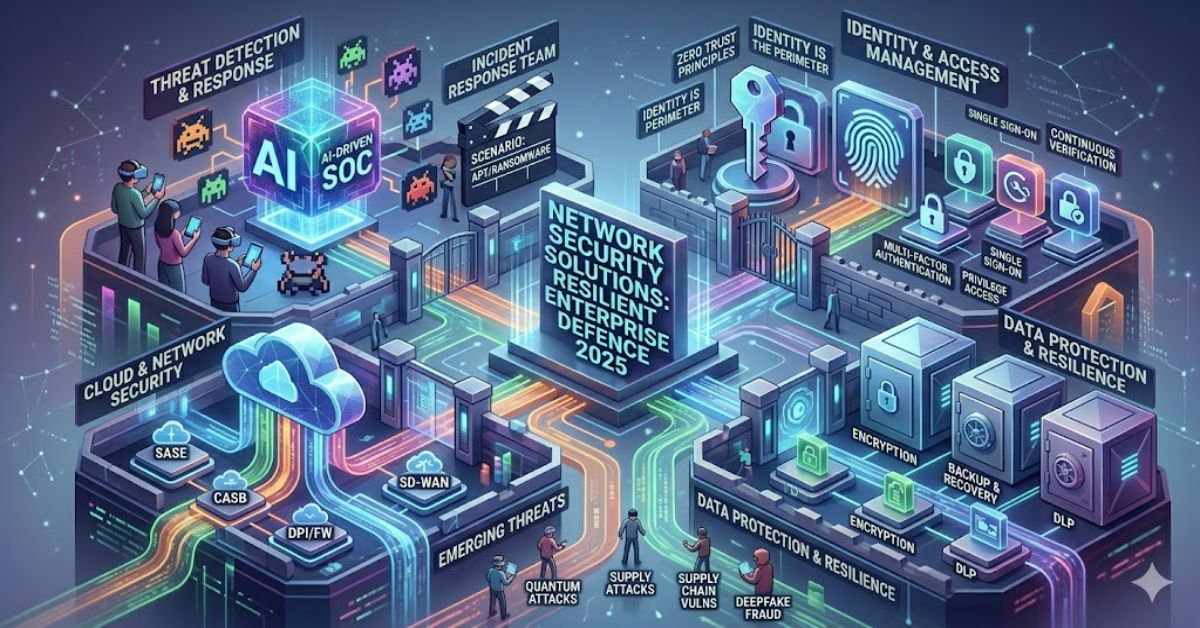
Network security solutions are no longer limited to firewalls and antivirus software. Modern enterprises operate across multiple cloud environments, remote workforces, SaaS platforms, mobile devices, and interconnected supply chains. As a result, organisations require structured frameworks of technologies, policies, and operational controls designed to protect critical assets from increasingly sophisticated cyber threats.
The challenge is significant. According to IBM’s 2024 Cost of a Data Breach Report, the global average cost of a data breach reached US$4.88 million, the highest level recorded by the study. Organisations managing data across cloud, on-premises, and hybrid environments face particularly complex security challenges.
For business leaders, the question is no longer whether security matters. The real question is which security architecture provides meaningful protection without creating excessive operational friction.
This article explores the components, benefits, limitations, and future direction of enterprise network defence strategies.
What Are Network Security Solutions?
Network security solutions encompass the technologies, policies, monitoring capabilities, and governance frameworks used to protect digital infrastructure.
Their primary objectives include:
- Preventing unauthorised access
- Detecting malicious activity
- Protecting sensitive information
- Ensuring regulatory compliance
- Maintaining business continuity
Rather than relying on a single security product, organisations typically deploy multiple overlapping controls.
This layered approach is commonly known as defence-in-depth.
Core Components
| Security Layer | Purpose |
| Firewalls | Filter network traffic |
| Intrusion Detection Systems (IDS) | Identify suspicious activity |
| Intrusion Prevention Systems (IPS) | Block detected threats |
| Identity and Access Management (IAM) | Control user permissions |
| Endpoint Detection and Response (EDR) | Protect user devices |
| Secure Web Gateways | Monitor web traffic |
| Data Loss Prevention (DLP) | Protect sensitive information |
| Security Information and Event Management (SIEM) | Centralise security monitoring |
| Zero Trust Access Controls | Verify all users and devices |
Each component addresses different attack vectors.
Why Traditional Perimeter Security Is No Longer Enough
For many years, organisations secured a central office network and assumed anything inside the perimeter could be trusted.
That assumption has largely disappeared.
Several developments have reshaped enterprise infrastructure:
- Remote and hybrid work
- Multi-cloud adoption
- SaaS proliferation
- Third-party integrations
- Mobile device usage
- Internet of Things (IoT) deployments
These changes have expanded the attack surface dramatically.
Research and industry guidance increasingly emphasise identity-based security rather than perimeter-based trust models.
Original Insight #1
One of the most overlooked risks is not external hacking but internal complexity.
Many organisations add new security products annually while failing to reduce overlapping controls. This creates visibility gaps, alert fatigue, and configuration errors that attackers frequently exploit.
The Rise of Zero Trust Security
Zero Trust has become one of the most influential concepts in enterprise cybersecurity.
Its principle is straightforward:
Never trust. Always verify.
Rather than automatically trusting users inside a network, Zero Trust continuously validates:
- Identity
- Device health
- User behaviour
- Location
- Access requests
Key Zero Trust Principles
| Principle | Description |
| Least Privilege | Users receive minimum required access |
| Continuous Verification | Trust is constantly reassessed |
| Microsegmentation | Networks divided into smaller zones |
| Identity-Centric Security | Access based on verified identity |
| Real-Time Monitoring | Continuous threat detection |
Recent research demonstrates how Zero Trust architectures can significantly reduce lateral movement opportunities for attackers.
Critical Technologies Driving Modern Security
Next-Generation Firewalls
Modern firewalls perform much more than packet filtering.
Capabilities now include:
- Application awareness
- Threat intelligence integration
- Deep packet inspection
- User-based policies
- Malware detection
Identity and Access Management
Identity has become the new security perimeter.
IAM solutions commonly include:
- Multi-factor authentication (MFA)
- Single sign-on (SSO)
- Privileged access management
- Identity governance
According to industry analysts, identity-related weaknesses remain among the most common causes of successful breaches.
Endpoint Detection and Response
With employees working from virtually anywhere, endpoint protection is critical.
EDR platforms monitor:
- Device behaviour
- Malware activity
- Suspicious processes
- Credential abuse
- Lateral movement attempts
Security Information and Event Management
SIEM platforms aggregate logs from across the organisation.
Benefits include:
- Faster incident detection
- Regulatory reporting
- Threat correlation
- Security analytics
Enterprise Security Architecture Comparison
| Approach | Advantages | Challenges |
| Traditional Perimeter Security | Simpler deployment | Limited cloud visibility |
| Defence-in-Depth | Multiple protection layers | Higher management complexity |
| Zero Trust Architecture | Strong access control | Significant implementation effort |
| SASE (Secure Access Service Edge) | Cloud-native flexibility | Vendor dependency risks |
| Hybrid Security Model | Adaptable to large enterprises | Governance complexity |
For most organisations, hybrid security architectures currently offer the most practical balance between protection and operational efficiency.
Real-World Business Impact
Cybersecurity discussions often focus on technical threats.
Executives focus on business consequences.
IBM’s research found the average global breach cost reached US$4.88 million in 2024, reflecting a significant year-on-year increase. Operational disruption, regulatory penalties, customer churn, and recovery expenses all contribute to these costs.
Structured Insight Table
| Impact Area | Potential Consequences |
| Financial | Incident response, legal costs, fines |
| Operational | Service outages and downtime |
| Regulatory | GDPR and compliance penalties |
| Reputational | Customer trust erosion |
| Strategic | Delayed digital transformation initiatives |
Original Insight #2
The most damaging effect of many breaches is not the immediate financial loss. It is the delay imposed on future projects. Organisations frequently pause cloud migrations, AI deployments, and innovation programmes while recovering from security incidents.
Risks and Trade-Offs
No security architecture is perfect.
Every solution introduces compromises.
Common Challenges
Security vs User Experience
Additional authentication improves security but can frustrate users.
Visibility vs Privacy
Monitoring improves threat detection but requires careful governance and compliance controls.
Centralisation vs Resilience
Consolidated platforms simplify management but may create single points of failure.
Cost vs Risk Reduction
Security budgets remain finite, requiring careful prioritisation.
Original Insight #3
Many organisations underestimate configuration risk.
Industry breach investigations repeatedly show that misconfigured cloud services and identity controls often cause more damage than sophisticated malware campaigns.
The Influence of AI on Network Security
Artificial intelligence is transforming both attack and defence.
Security teams increasingly use AI for:
- Threat detection
- Behaviour analytics
- Automated investigations
- Risk scoring
- Security operations automation
IBM research indicates AI and automation deployments can significantly reduce breach-related costs when properly integrated into prevention and response workflows.
However, attackers are also leveraging AI to improve phishing, reconnaissance, and social engineering campaigns.
The result is an accelerating security arms race.
The Future of Network Security Solutions in 2027
By 2027, several developments are likely to reshape enterprise cybersecurity.
Identity-Centric Security Expansion
User and machine identities will increasingly replace network location as the primary trust mechanism.
AI-Augmented Security Operations
Security Operations Centres (SOCs) will rely heavily on AI-assisted triage and response capabilities.
Multi-Cloud Security Consolidation
As organisations continue adopting hybrid and multi-cloud strategies, demand for unified visibility platforms will increase.
Greater Regulatory Oversight
UK and international regulators are expected to continue strengthening cybersecurity governance requirements, particularly for critical infrastructure sectors.
Continued Growth of Zero Trust
Research momentum and enterprise adoption trends indicate Zero Trust will move from strategic recommendation to operational baseline across many industries.
Key Takeaways
- Defence-in-depth remains the foundation of enterprise security strategy.
- Identity management is becoming more important than network location.
- Multi-cloud environments create new visibility and governance challenges.
- Zero Trust architectures continue to gain adoption across sectors.
- AI improves detection and response but also strengthens attacker capabilities.
- Security complexity itself is emerging as a major organisational risk.
- Effective governance is as important as technology investment.
Conclusion
Modern organisations operate in an environment where digital assets, cloud infrastructure, remote employees, and third-party integrations are deeply interconnected. This reality has fundamentally changed how cybersecurity must be approached.
The strongest network security solutions are not individual products. They are integrated frameworks that combine technology, governance, monitoring, and identity controls into a coherent strategy. Organisations that continue relying on perimeter-only security models risk exposing themselves to modern attack techniques that exploit cloud environments, identity systems, and supply chain relationships.
At the same time, security leaders must avoid the trap of accumulating disconnected tools that increase complexity without improving outcomes. Effective cybersecurity depends on visibility, operational discipline, and continuous improvement.
As cyber threats continue to evolve through 2027 and beyond, organisations that prioritise resilience, Zero Trust principles, and proactive risk management will be better positioned to protect both their infrastructure and their long-term business objectives.
Frequently Asked Questions
What are network security solutions?
Network security solutions are technologies, processes, and policies designed to protect networks, systems, users, and data from unauthorised access, cyberattacks, and operational disruptions.
Why are network security solutions important?
They reduce the likelihood of breaches, protect sensitive information, support regulatory compliance, and help maintain business continuity during cyber incidents.
What is defence-in-depth security?
Defence-in-depth is a layered security strategy that deploys multiple protective controls across networks, endpoints, applications, and identities to reduce risk.
How does Zero Trust differ from traditional security?
Traditional security assumes internal users can be trusted. Zero Trust continuously verifies every user, device, and access request regardless of location.
What role does AI play in cybersecurity?
AI helps automate threat detection, analyse large datasets, identify anomalies, and improve incident response times while also assisting security analysts.
Are firewalls still necessary?
Yes. Modern firewalls remain a foundational component of network protection, though they now operate alongside many additional security technologies.
What is the biggest challenge facing enterprise security teams today?
Managing security across hybrid, cloud, and remote environments while maintaining visibility and consistent policy enforcement is one of the most significant challenges.
Methodology
This analysis was developed using publicly available cybersecurity research, enterprise security guidance, academic studies on Zero Trust architectures, and industry reporting published between 2024 and 2026.
Primary validation sources included IBM Security’s Cost of a Data Breach research, academic Zero Trust studies, enterprise infrastructure publications, and current cybersecurity reporting.
Limitations include the rapidly changing nature of cybersecurity threats, vendor-specific implementation differences, and varying organisational risk profiles. Recommendations presented here should be considered strategic guidance rather than prescriptive technical advice.
Counterarguments exist regarding the complexity and cost of large-scale Zero Trust deployments. While many organisations benefit from these approaches, implementation success depends heavily on governance maturity, infrastructure readiness, and organisational resources.
Editorial Disclosure
This article was drafted with AI assistance and reviewed and verified by [Author Name]. All data, citations, and claims should be independently confirmed by the editorial team at RubbleMagazine.co.uk before publication.
References
IBM Security. (2024). Cost of a Data Breach Report 2024. IBM.
IBM Security. (2024). Surging data breach disruption drives costs to record highs. IBM Think.
Mavroudis, V. (2024). Zero-Trust Network Access (ZTNA). arXiv.
Katsis, C., & Bertino, E. (2024). ZT-SDN: An ML-powered Zero-Trust Architecture for Software-Defined Networks. arXiv.
Arora, S., & Hastings, J. (2024). Microsegmented Cloud Network Architecture Using Open-Source Tools for a Zero Trust Foundation. arXiv.
TechRadar Pro. (2025). The Single-Cloud Trap: Why UK Businesses’ Multi-Cloud Strategy Risks Leaving Them Exposed.
ITPro. (2025). Post-Cloud Strategy: Architecting the Next Enterprise Stack.