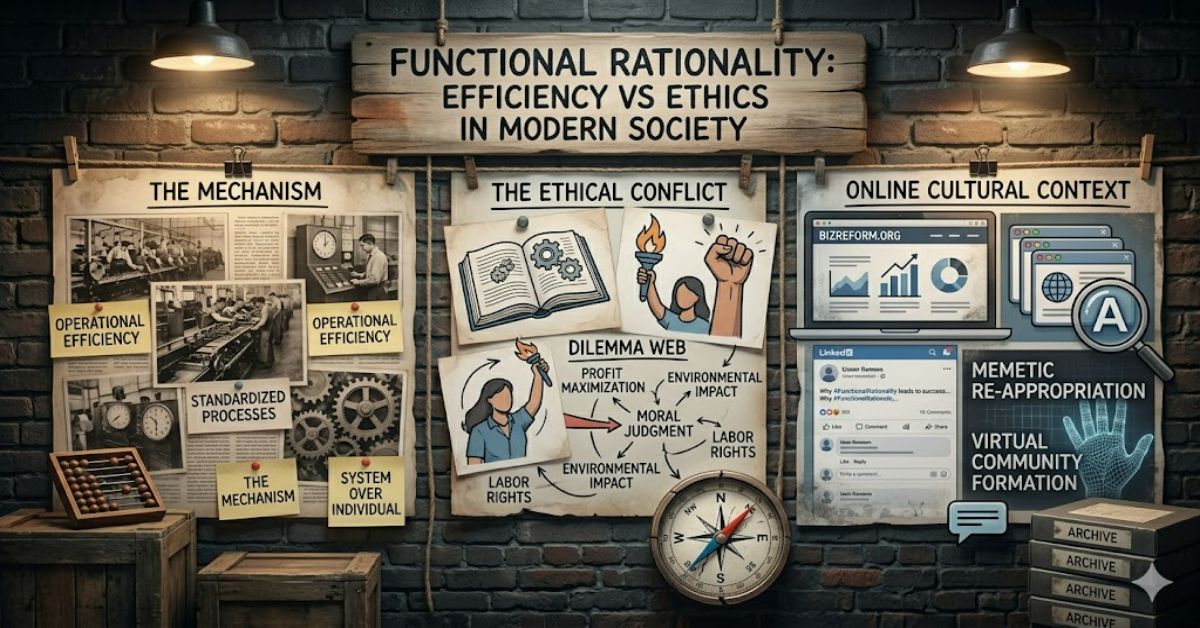
Functional rationality is one of the most influential yet least discussed concepts in modern social science. At its core, functional rationality refers to decision-making that concentrates on achieving a specific objective in the most efficient, predictable, and measurable way possible. The objective itself is treated as fixed. The central question is not whether the goal is good, fair, or ethical. Instead, the focus is on identifying the most effective route to reach it.
The concept is deeply associated with sociological theories developed by German sociologist Max Weber. Weber observed that modern institutions increasingly relied on calculation, bureaucracy, standardisation, and measurable outcomes. These systems produced remarkable efficiency but often reduced complex human experiences into administrative processes.
Today, the influence of this form of reasoning extends far beyond traditional bureaucracies. Corporations optimise supply chains. Governments use performance metrics. Universities rely on rankings and assessment frameworks. Technology firms deploy algorithms designed to maximise engagement and productivity.
The rise of artificial intelligence, remote work infrastructures, and data analytics has intensified these trends. Organisations now possess unprecedented capabilities to measure performance, predict outcomes, and automate decisions. Yet the same systems often raise difficult questions about accountability, fairness, and human values.
Understanding how this logic operates is no longer an academic exercise. It is essential for understanding how contemporary society functions.
What Is Functional Rationality?
Functional rationality focuses exclusively on the relationship between means and ends.
A decision is considered rational if it efficiently achieves a predefined objective. The quality of the objective itself is largely irrelevant to the analysis.
For example:
- A logistics company seeks to reduce delivery times.
- A hospital seeks to increase patient throughput.
- A university seeks to improve graduation rates.
- A social media platform seeks to maximise user engagement.
In each case, functional reasoning evaluates which methods best achieve the target.
The key distinction is that the goal remains largely unquestioned.
Core Characteristics
| Characteristic | Description |
| Efficiency | Maximising output while minimising resources |
| Predictability | Creating consistent and measurable outcomes |
| Calculation | Using data and metrics for decision-making |
| Control | Standardising processes and reducing uncertainty |
| Goal Orientation | Treating objectives as fixed and given |
These characteristics explain why functional rationality became central to modern organisations.
Functional Rationality vs Substantive Rationality
One of Weber’s most important distinctions was between functional rationality and substantive rationality.
| Functional Rationality | Substantive Rationality |
| Focuses on efficiency | Focuses on values and ethics |
| Asks “How?” | Asks “Why?” |
| Measures outcomes quantitatively | Evaluates outcomes morally |
| Assumes goals are fixed | Questions whether goals are desirable |
| Favours standardisation | Allows value-based judgement |
Consider a company reducing staff to improve profitability.
From a functional perspective, the question is whether layoffs increase efficiency and shareholder returns.
From a substantive perspective, broader concerns emerge:
- Is the decision socially responsible?
- What happens to affected communities?
- Are there alternatives?
Both approaches matter. Problems arise when one completely replaces the other.
How Functional Rationality Shapes Modern Organisations
Modern organisations depend heavily on measurable performance indicators.
Key Performance Indicators (KPIs), productivity metrics, customer acquisition costs, and operational benchmarks all reflect this logic.
Corporate Management
Large enterprises increasingly rely on data-driven decision systems.
Examples include:
- Workforce analytics
- Supply chain optimisation
- Predictive maintenance
- Revenue forecasting
- Customer segmentation
These systems create substantial efficiency gains. However, they can also encourage employees to prioritise metrics over broader organisational values.
A sales team may focus solely on targets rather than customer relationships. A customer service department may optimise call times while reducing service quality.
The metric becomes the objective.
Public Sector Administration
Government agencies increasingly use performance management frameworks.
Healthcare systems track waiting times.
Educational institutions track attainment scores.
Police departments monitor response times.
These measurements provide accountability. Yet they may unintentionally encourage behaviour aimed at improving statistics rather than addressing underlying issues.
This phenomenon is often referred to as Goodhart’s Law:
When a measure becomes a target, it ceases to be a good measure.
The Relationship Between Functional Rationality and Technology
Technology is perhaps the clearest modern expression of functional rationality.
Algorithms excel at optimisation.
Their purpose is not moral reasoning. Their purpose is efficient execution.
Artificial Intelligence
Machine learning systems identify patterns and optimise outcomes.
Examples include:
- Fraud detection systems
- Recruitment software
- Recommendation engines
- Dynamic pricing models
These tools often perform remarkably well against predefined objectives.
However, problems emerge when objectives fail to capture broader social values.
An algorithm optimised for recruitment efficiency may unintentionally reinforce existing biases.
A recommendation system optimised for engagement may promote polarising content.
The issue is rarely the efficiency of the system.
The issue is whether the chosen objective reflects human priorities.
Data-Driven Cultures
Many organisations now embrace what management scholars call datafication.
Activities once evaluated qualitatively are converted into measurable metrics.
Examples include:
- Employee performance scores
- Student assessment rankings
- Customer satisfaction indexes
- Productivity dashboards
This trend increases visibility and accountability.
It can also reduce complex human experiences into numerical indicators.
Benefits of Functional Rationality
Despite criticism, modern society could not function without it.
1. Increased Efficiency
Organisations can accomplish more with fewer resources.
Examples include:
- Automated manufacturing
- Digital banking
- Healthcare scheduling systems
- Transportation networks
2. Improved Predictability
Standardised procedures reduce uncertainty.
Predictability improves planning and resource allocation.
3. Scalability
Large institutions require systematic decision-making.
Without rational procedures, global corporations, universities, and governments would struggle to coordinate operations.
4. Objective Decision Frameworks
Data-driven systems can reduce arbitrary decision-making.
When applied appropriately, measurable criteria improve transparency.
Risks and Trade-Offs
The strengths of functional rationality often create corresponding weaknesses.
Ethical Blind Spots
A system focused entirely on efficiency may ignore moral consequences.
History offers numerous examples where technically effective solutions produced harmful outcomes because ethical considerations were excluded from decision-making.
Human Alienation
Weber warned about the “iron cage” of rationalisation.
Individuals increasingly interact with systems governed by procedures, metrics, and rules rather than personal judgement.
Many employees experience this through:
- Performance dashboards
- Automated evaluations
- Productivity tracking software
Innovation Constraints
Excessive optimisation can discourage experimentation.
Creative breakthroughs often emerge from uncertainty and exploration rather than strict efficiency.
Cultural Homogenisation
Global systems frequently standardise behaviour.
Local traditions, professional judgement, and contextual understanding may be overlooked in favour of universal procedures.
Structured Insight Table: Where Functional Rationality Appears Today
| Sector | Primary Goal | Typical Metrics | Potential Risk |
| Business | Profitability | Revenue, margins | Short-termism |
| Healthcare | Throughput | Wait times, capacity | Reduced patient-centred care |
| Education | Performance | Test scores, rankings | Teaching to the test |
| Technology | Engagement | Clicks, retention | Attention manipulation |
| Government | Efficiency | Response times, costs | Bureaucratic rigidity |
Three Underappreciated Insights
1. Efficiency Often Shifts Rather Than Removes Costs
Many optimisation programmes reduce visible expenses while creating hidden costs elsewhere.
For example, lean staffing may lower payroll costs but increase burnout, turnover, and recruitment expenses.
2. Metrics Can Redefine Behaviour
People adapt to measurement systems.
Employees frequently optimise for what is measured rather than what is valuable.
This is one reason organisations periodically revise performance frameworks.
3. AI Expands Functional Rationality at Scale
Artificial intelligence does not create this form of reasoning.
It amplifies it.
Algorithms enable organisations to apply optimisation principles to millions of decisions simultaneously, making goal selection more important than ever.
The Future of Functional Rationality in 2027
Several trends suggest the influence of functional rationality will continue growing through 2027.
AI Governance
Governments worldwide are developing frameworks for algorithmic accountability.
The challenge is balancing efficiency gains with fairness, transparency, and public trust.
Human-Centred Management
Many organisations are moving beyond pure performance metrics.
Employee wellbeing, sustainability reporting, and stakeholder governance models indicate a growing interest in balancing efficiency with broader values.
ESG and Corporate Accountability
Environmental, Social, and Governance (ESG) frameworks represent attempts to incorporate substantive concerns into organisational decision-making.
Success remains uneven, but the direction is significant.
Hybrid Decision Systems
Future institutions are likely to combine algorithmic optimisation with human oversight rather than relying exclusively on either approach.
The tension between efficiency and ethical judgement is unlikely to disappear. Instead, it will become a defining management challenge of the next decade.
Key Takeaways
- Functional rationality evaluates the most effective means to achieve predetermined goals.
- The concept originates largely from Weber’s analysis of modern bureaucracy and rationalisation.
- Efficiency, predictability, and calculation remain its defining characteristics.
- Technology and AI have accelerated its influence across organisations.
- Ethical considerations often fall outside its immediate framework.
- Overreliance on metrics can distort behaviour and priorities.
- Future governance models will likely seek a balance between optimisation and human values.
Conclusion
Functional rationality has become one of the organising principles of modern society. From corporate management and government administration to artificial intelligence and digital platforms, decisions are increasingly evaluated according to efficiency, predictability, and measurable outcomes.
This approach has delivered extraordinary benefits. It enables large organisations to coordinate complex operations, improve productivity, and allocate resources with unprecedented precision. Many of the conveniences people take for granted today depend on systems designed according to these principles.
Yet efficiency alone cannot answer every question. Decisions that appear rational from an operational perspective may create ethical, social, or cultural consequences that remain invisible to performance metrics.
The enduring challenge is not choosing between efficiency and values. It is recognising when each should take precedence. As technology continues to expand the reach of algorithmic decision-making, understanding this distinction will become increasingly important for leaders, policymakers, and citizens alike.
FAQ
What is functional rationality in simple terms?
It is a way of making decisions that focuses on finding the most efficient means to achieve a goal without questioning whether the goal itself is desirable.
Who developed the concept of functional rationality?
The idea is closely associated with sociologist Max Weber, whose work examined bureaucracy, rationalisation, and modern organisational structures.
How is functional rationality different from ethical decision-making?
Ethical decision-making evaluates whether goals are morally justified. Functional rationality assumes goals are fixed and concentrates on achieving them efficiently.
Why is functional rationality important in business?
Businesses use it to improve productivity, reduce costs, optimise operations, and increase predictability through data-driven management systems.
How does artificial intelligence relate to functional rationality?
AI systems are designed to optimise predefined objectives. They therefore represent a powerful extension of functional reasoning into automated decision-making.
Is functional rationality always beneficial?
No. While it improves efficiency, it can also create ethical blind spots, excessive dependence on metrics, and reduced attention to human values.
Methodology
This article synthesises established sociological theory, organisational research, management literature, and contemporary discussions surrounding algorithmic governance and institutional decision-making. Particular attention was given to Weberian scholarship, organisational behaviour research, and recent studies examining data-driven management systems.
Limitations include the broad application of the concept across multiple disciplines, where terminology and interpretation may vary. Some scholars use alternative labels such as instrumental rationality or means-end rationality.
A balanced perspective was maintained by examining both the operational benefits and ethical limitations associated with efficiency-focused decision-making.
Editorial Disclosure: This article was drafted with AI assistance and reviewed and verified by the editorial team. All data, citations, and claims should be independently verified before publication.