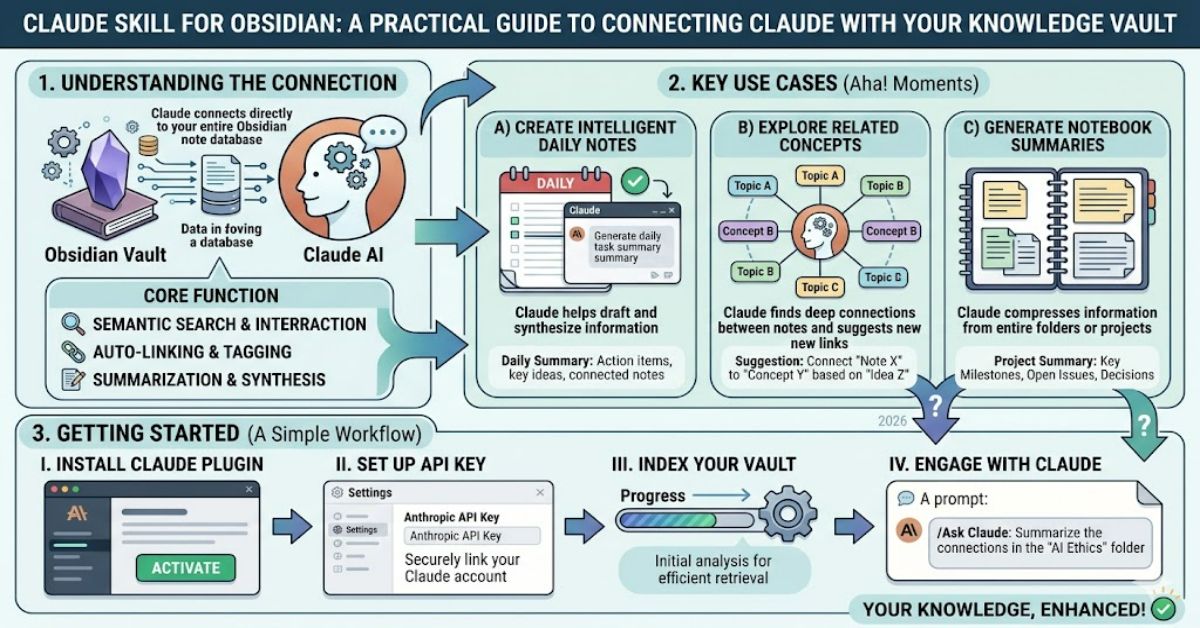
The rise of local AI workflows has created new interest in the concept of a claude skill for obsidian. Users increasingly want AI assistants that can work directly inside their personal knowledge systems without forcing them to migrate data into proprietary platforms.
Obsidian has become one of the most popular knowledge management tools because it stores information as local Markdown files. That architecture makes it uniquely compatible with AI systems that can read and manipulate structured text.
A Claude Skill acts as a specialised capability layer that teaches Claude how to interact with a particular environment or workflow. When applied to an Obsidian vault, these skills help Claude understand note relationships, metadata, backlinks, templates, and organisational patterns.
Rather than acting as a generic chatbot, Claude becomes a contextual assistant capable of helping users maintain large knowledge bases, research systems, project documentation, and content libraries.
The appeal is simple: users keep ownership of their data while gaining access to sophisticated AI-powered assistance.
Understanding How Claude Skills Work
Claude Skills are essentially reusable instruction frameworks that extend what Claude can do within a defined environment.
In an Obsidian workflow, a skill can help Claude:
- Read Markdown notes
- Interpret frontmatter metadata
- Understand vault hierarchies
- Generate linked notes
- Create summaries
- Maintain databases
- Build project documentation
- Analyse knowledge gaps
Because Obsidian stores information in plain text, AI systems can process content without requiring proprietary export formats.
This creates an unusually clean integration path compared with many traditional productivity tools.
Why Obsidian Is an Ideal Environment for Claude
Several characteristics make Obsidian particularly attractive for AI-assisted workflows.
Local-First Architecture
Users retain control over their data.
Unlike cloud-based note systems, Obsidian stores files locally. Claude can work with those files through approved workflows without requiring complete migration to a third-party platform.
Human-Readable Markdown
Markdown is predictable.
AI models generally perform better when working with structured text rather than complex proprietary document formats.
Knowledge Graph Structure
Obsidian’s linking system creates relationships between notes.
A properly configured Claude workflow can leverage these relationships to generate better summaries, identify missing information, and recommend useful connections.
Extensible Ecosystem
Obsidian’s plugin ecosystem allows advanced users to combine automation, scripting, databases, and AI-assisted workflows into a single environment.
Comparison: Standard Claude vs Claude with Obsidian Skills
| Capability | Standard Claude | Claude with Obsidian Skills |
| General writing | Excellent | Excellent |
| Understand vault structure | Limited | High |
| Navigate note relationships | Limited | Strong |
| Metadata awareness | Minimal | Advanced |
| Project documentation support | Moderate | High |
| Database note management | Limited | Advanced |
| Vault maintenance | Manual | Assisted |
| Research synthesis | Strong | Strong with vault context |
Real-World Use Cases
The most effective implementations focus on workflows rather than simple note editing.
Research Vaults
Researchers often accumulate hundreds or thousands of notes.
Claude can:
- Summarise literature
- Identify recurring themes
- Surface contradictory findings
- Suggest missing references
- Generate review drafts
Content Creation
Writers frequently struggle to reuse existing knowledge.
A well-configured Claude workflow can:
- Search prior notes
- Combine related ideas
- Create article outlines
- Generate first drafts
- Recommend internal links
Project Management
Teams and individuals use Obsidian for planning.
Claude can assist with:
- Meeting note summaries
- Action item extraction
- Documentation updates
- Knowledge transfer
- Progress tracking
Structured Insight Table: Where Users Gain the Most Value
| Workflow Area | Potential Impact | Complexity |
| Note summarisation | High | Low |
| Knowledge retrieval | High | Medium |
| Content drafting | High | Low |
| Vault organisation | Medium | Medium |
| Database maintenance | Medium | High |
| Research synthesis | High | Medium |
| Documentation generation | High | Medium |
Hidden Challenges Most Guides Ignore
Many articles focus exclusively on benefits.
The practical reality is more nuanced.
Context Window Limitations
Large vaults often contain tens of thousands of notes.
Even advanced AI systems cannot process unlimited information simultaneously.
Users must develop strategies such as:
- Folder segmentation
- Incremental retrieval
- Topic-focused workflows
- Structured note hierarchies
Inconsistent Metadata
Many Obsidian vaults evolve organically.
Tags, naming conventions, and frontmatter structures may become inconsistent over time.
Claude performs best when vault organisation follows predictable standards.
Permission Boundaries
Giving an AI write access to an entire vault introduces risk.
Many experienced users begin with read-only workflows before enabling automated note creation or editing.
Strategic Implications for Knowledge Management
The emergence of AI-enabled note systems changes how people think about knowledge storage.
Historically, knowledge management focused on collecting information.
Modern systems increasingly focus on retrieval and synthesis.
The real advantage of a claude skill for obsidian is not faster note-taking.
The advantage is reducing friction between stored knowledge and practical application.
Users spend less time searching and more time creating.
This shift becomes increasingly important as personal knowledge bases continue growing.
Three Important Insights Often Missed
Insight 1: Organisation Matters More Than Model Quality
Many users assume better AI models automatically produce better outcomes.
In practice, poorly structured vaults often generate poor results regardless of model quality.
Insight 2: Smaller Contexts Often Produce Better Results
Feeding Claude an entire vault is rarely optimal.
Focused note collections usually produce more accurate and actionable outputs.
Insight 3: Metadata Becomes Increasingly Valuable
As vaults expand, metadata transforms from an optional feature into critical infrastructure.
Tags, properties, and relationships become essential navigation tools for both humans and AI.
The Future of Claude Skill for Obsidian in 2027
Several trends suggest deeper integration between AI systems and personal knowledge management platforms.
By 2027, likely developments include:
- Better retrieval architectures
- Larger effective context windows
- Improved local AI processing
- More sophisticated graph analysis
- Automated knowledge maintenance
However, privacy concerns will remain central.
Users increasingly prefer systems that preserve ownership of personal data while still enabling advanced AI functionality.
Local-first applications such as Obsidian are well positioned to benefit from this trend.
The most successful solutions will likely combine local storage with selective AI augmentation rather than fully cloud-dependent architectures.
Key Takeaways
- Claude Skills can significantly improve Obsidian workflows when properly configured.
- Knowledge retrieval often provides more value than simple note generation.
- Vault organisation directly influences AI performance.
- Metadata becomes increasingly important as vaults grow.
- Read-only implementations offer a safer starting point.
- Research, writing, and documentation workflows benefit most from integration.
- The future points toward deeper AI-assisted knowledge management rather than complete automation.
Conclusion
A claude skill for obsidian represents a practical evolution in personal knowledge management. Instead of treating AI as a separate application, users can integrate intelligence directly into the systems where their information already lives.
The strongest implementations do not replace human thinking. They reduce repetitive work, improve retrieval, and help transform stored information into useful output.
Success depends less on the AI model itself and more on the quality of the underlying knowledge system. Well-organised vaults, consistent metadata, and thoughtful workflows consistently outperform chaotic collections of notes.
As AI capabilities continue to improve, the relationship between Obsidian and intelligent assistants will likely become more sophisticated. Yet the fundamental principle remains unchanged: the best results come when AI enhances human knowledge rather than attempting to replace it.
FAQ
What is a Claude Skill for Obsidian?
A Claude Skill is a specialised capability that helps Claude understand and interact with an Obsidian vault, including notes, metadata, links, and organisational structures.
Can Claude directly edit my Obsidian notes?
That depends on the implementation. Some workflows provide read-only access, while others permit controlled note creation and editing.
Is Obsidian a good platform for AI integration?
Yes. Its Markdown-based, local-first architecture makes it particularly suitable for AI-assisted knowledge management.
Does Claude understand backlinks and graph connections?
With appropriate configuration, Claude can analyse relationships between notes and use those connections to improve outputs.
Is my vault data private?
Privacy depends on how Claude is connected to the vault. Users should review permissions, storage methods, and data handling policies before granting access.
Do I need programming experience?
Basic workflows often require minimal technical knowledge, though advanced automation benefits from familiarity with scripting and configuration.
Who benefits most from this setup?
Researchers, writers, developers, consultants, students, and knowledge workers typically gain the most value from AI-assisted vault workflows.
Methodology
This article was developed using publicly documented information about Claude workflows, AI-assisted knowledge management, Markdown-based note systems, and Obsidian’s local-first architecture. The analysis focuses on documented capabilities, practical implementation patterns, and widely observed workflow practices.
Limitations include the rapidly changing nature of AI tooling and the fact that implementation methods vary between users, plugins, and custom integrations. Readers should validate technical setup details against current vendor documentation before deployment.
Balanced consideration was given to both benefits and limitations, including privacy concerns, context constraints, and organisational requirements.
Editorial Disclosure: This article was drafted with AI assistance and should be reviewed by a human editor before publication. All technical claims, references, and implementation details should be independently verified prior to publication.