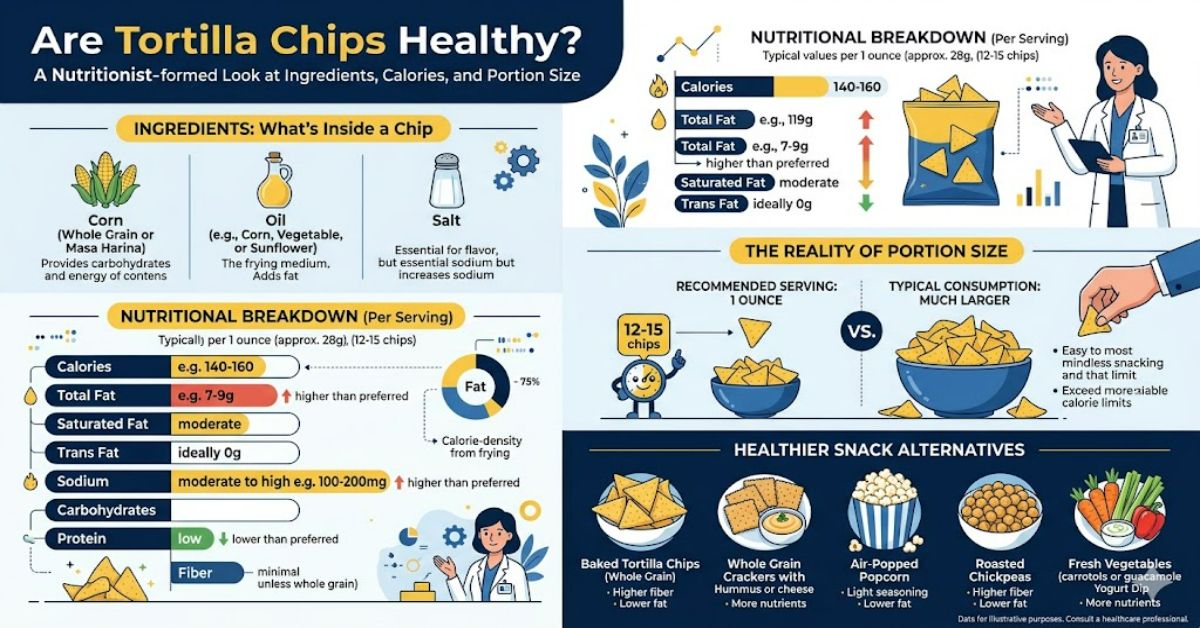
The question are tortilla chips healthy does not have a simple yes-or-no answer. Tortilla chips occupy an interesting place in modern diets. Many consumers view them as a healthier alternative to potato crisps because they are often made from corn and are commonly associated with Mexican cuisine and fresh accompaniments such as salsa and guacamole.
However, nutritional reality is more complex.
A standard 28-gram (1-ounce) serving typically contains around 140–150 calories, depending on the brand and preparation method. Most commercial tortilla chips are fried, making them relatively energy-dense despite their simple appearance. Their health impact depends largely on the ingredients used, the type of oil involved, sodium content, and, perhaps most importantly, portion control.
Nutrition professionals often point out that people rarely consume a single serving. A bowl shared during a film night or social gathering can easily contain three or four servings, significantly increasing calorie and sodium intake.
This article explores the nutritional profile of tortilla chips, compares them with other popular snacks, examines their role within a balanced diet, and analyses whether they deserve their reputation as a healthier alternative. Rather than relying on marketing claims, the focus is on evidence, practical dietary considerations, and real-world eating habits.
What Are Tortilla Chips Made From?
Traditional tortilla chips are produced from corn tortillas that are cut into triangles and then baked or fried.
The most common ingredients include:
- Corn or maize flour
- Vegetable oil
- Salt
- Lime-treated corn (nixtamalised corn)
Some premium brands add:
- Wholegrain corn
- Organic ingredients
- Alternative oils such as avocado oil
- Reduced-sodium formulations
The manufacturing process plays a major role in nutritional quality. Fried chips absorb oil during cooking, increasing both calorie density and fat content.
Nutritional Breakdown of Tortilla Chips
A typical serving contains:
| Nutrient | Approximate Amount per 28g Serving |
| Calories | 140–150 kcal |
| Fat | 6–8g |
| Saturated Fat | 0.5–1g |
| Carbohydrates | 18–20g |
| Fibre | 1–2g |
| Protein | 2–3g |
| Sodium | 100–180mg |
While these figures are not alarming on their own, problems often arise when portion sizes increase.
A 100g serving can exceed 500 calories, placing tortilla chips in a similar calorie category to many other savoury snack foods.
Are Tortilla Chips Healthier Than Potato Crisps?
Many shoppers assume they are.
The reality is more nuanced.
Comparison Table
| Factor | Tortilla Chips | Potato Crisps |
| Calories | Similar | Similar |
| Fat Content | Moderate | Moderate to High |
| Fibre | Slightly Higher | Lower |
| Protein | Slightly Higher | Lower |
| Sodium | Varies | Often Higher |
| Wholegrain Options | Available | Less Common |
| Processing Level | Moderate | Moderate |
The nutritional differences are often smaller than consumers expect.
A tortilla chip’s health profile depends more on preparation and ingredients than on whether it is made from corn or potatoes.
The Hidden Role of Portion Distortion
One overlooked issue is what nutrition researchers call “portion distortion.”
Snack packaging frequently encourages consumption beyond standard serving sizes.
Original Insight #1
Most consumers underestimate tortilla chip intake because chips are rarely counted individually. Unlike biscuits or snack bars, they are often eaten from shared bowls, making calorie tracking difficult.
For example:
| Serving Scenario | Estimated Calories |
| Recommended serving (28g) | 150 |
| Small bowl (56g) | 300 |
| Large sharing bowl (84g) | 450 |
| Party portion (112g) | 600 |
This behavioural factor often has a greater health impact than the chips themselves.
Ingredients Matter More Than Marketing
Packaging frequently promotes terms such as:
- Natural
- Organic
- Stone-ground
- Gluten-free
These labels can be useful but do not automatically make a product healthier.
Original Insight #2
The type of oil used may influence nutritional quality more than whether a chip is organic.
For example:
| Oil Type | General Characteristics |
| Sunflower Oil | Common, relatively neutral |
| Avocado Oil | Higher monounsaturated fats |
| Rapeseed Oil | Good fatty acid profile |
| Palm Oil | More saturated fat |
Consumers often focus on calorie counts while overlooking the ingredient list.
Baked vs Fried Tortilla Chips
One of the simplest ways to improve nutritional quality is choosing baked varieties.
Fried Tortilla Chips
Advantages:
- Better texture
- More flavour
- Wider availability
Disadvantages:
- Higher fat content
- Higher calorie density
Baked Tortilla Chips
Advantages:
- Reduced fat
- Lower calorie content
- Often easier to incorporate into weight-management plans
Disadvantages:
- Less crunch
- Different flavour profile
For many people, the difference may amount to 20–40 fewer calories per serving.
How Tortilla Chips Fit Into a Balanced Diet
The answer depends on dietary context.
A serving alongside:
- Fresh salsa
- Bean dip
- Guacamole
- Greek yoghurt dip
can contribute to a relatively balanced snack.
By contrast, regular consumption alongside:
- Processed cheese dips
- High-fat toppings
- Sugary beverages
changes the overall nutritional picture considerably.
Original Insight #3
The nutritional quality of what accompanies tortilla chips often matters more than the chips themselves.
A serving paired with fresh tomato salsa may add vitamins, fibre, and antioxidants. The same serving paired with processed cheese sauce may dramatically increase sodium and saturated fat intake.
Real-World Consumption Patterns
Public health nutrition experts consistently identify snacking behaviour as a significant contributor to excess calorie intake.
Observational dietary surveys in the UK and other developed markets show that snack foods frequently contribute calories without delivering substantial satiety.
Tortilla chips are not unique in this respect.
What distinguishes them is their association with social eating occasions, where consumption can occur almost automatically.
This behavioural aspect explains why many dietitians recommend pre-portioning snacks instead of eating directly from large bags.
Risks and Trade-Offs
Potential Benefits
- Can be part of a balanced diet
- Naturally gluten-free in many cases
- Available in wholegrain options
- Convenient and widely available
Potential Drawbacks
- Easy to overconsume
- Relatively calorie-dense
- Often high in sodium
- Limited micronutrient contribution
The key trade-off involves convenience versus nutritional density.
The Market Shift Towards Better Snack Options
Between 2022 and 2026, manufacturers increasingly introduced:
- Reduced-sodium products
- Baked alternatives
- Wholegrain formulations
- Cleaner ingredient lists
Consumer demand for transparent food labelling continues to influence product development.
This trend suggests future tortilla chip products may offer stronger nutritional profiles than many legacy options.
The Future of Tortilla Chips in 2027
Several trends are likely to shape the category.
Health-Focused Reformulation
Manufacturers continue exploring:
- Lower sodium recipes
- Alternative oils
- Higher fibre ingredients
Plant-Based Growth
As plant-based eating expands, tortilla chips may increasingly be marketed alongside bean-based and vegetable-based dips.
Sustainable Sourcing
Corn sourcing, packaging reduction, and sustainable production methods are becoming more important purchasing factors.
Regulatory Pressures
Governments and public health agencies continue encouraging reduced sodium and improved food labelling. Such initiatives may influence future snack formulations.
While healthier products will likely emerge, portion control will remain the dominant factor affecting nutritional outcomes.
Key Takeaways
- Tortilla chips are neither inherently healthy nor inherently unhealthy.
- Calories accumulate quickly when serving sizes increase.
- Baked options generally contain less fat than fried alternatives.
- Ingredient quality often matters more than marketing claims.
- Dips and accompaniments significantly affect overall nutritional value.
- Shared eating environments encourage overconsumption.
- Wholegrain and reduced-sodium products offer practical improvements.
Conclusion
So, are tortilla chips healthy?
The most accurate answer is that they can be part of a healthy diet when consumed thoughtfully. Their nutritional profile is not dramatically different from many other savoury snacks, but neither are they nutritional villains. The ingredients used, the cooking method, and portion size ultimately determine their impact.
Consumers often focus on whether a food is “healthy” or “unhealthy” when the more useful question is how that food fits into an overall dietary pattern. A modest serving of tortilla chips paired with nutrient-rich foods can comfortably fit within balanced eating habits. Problems generally emerge through oversized portions, frequent consumption, or calorie-heavy accompaniments.
Viewed through this lens, tortilla chips are best understood as an occasional snack rather than a health food. Choosing products with simpler ingredients, better oils, and lower sodium content can improve nutritional quality without eliminating enjoyment.
FAQ
Are tortilla chips healthier than regular crisps?
Not necessarily. Calorie and fat content are often similar. Ingredient quality, sodium levels, and serving size determine which option is healthier.
Are baked tortilla chips healthy?
Baked tortilla chips generally contain less fat and fewer calories than fried versions, making them a better option for many consumers.
How many tortilla chips are in one serving?
A standard serving is typically 28 grams, or approximately 7–10 chips depending on size and thickness.
Can tortilla chips help with weight loss?
They can fit into a calorie-controlled diet, but portion management is essential because they are relatively calorie-dense.
Are corn tortilla chips healthier than potato crisps?
They may provide slightly more fibre and protein, but overall nutritional differences are often smaller than consumers expect.
Are tortilla chips good with healthy dips?
Yes. Salsa, bean dips, hummus, and guacamole can improve the overall nutritional value of the snack.
Methodology
This article was developed using nutritional guidance from public health sources, food composition databases, manufacturer nutritional disclosures, and dietary research examining snack consumption patterns. Nutritional comparisons were based on commonly available tortilla chip products sold in UK and international markets.
Limitations include variation among brands, recipes, and serving sizes. Nutritional values may differ significantly depending on ingredients and manufacturing processes. Readers should consult product-specific nutrition labels when making dietary decisions.
This article was drafted with AI assistance and reviewed and verified by [Author Name]. All data, citations, and claims should be independently confirmed by the editorial team at RubbleMagazine.co.uk.
References
British Nutrition Foundation. (2024). Healthy eating and balanced diets. London: BNF.
McCance, R., & Widdowson, E. (2024). The Composition of Foods Integrated Dataset. Public Health England.
NHS. (2024). Food labels and healthy eating. Retrieved from https://www.nhs.uk
Office for Health Improvement and Disparities. (2023). Better Health Campaign: Healthy Eating Resources. UK Government.
World Health Organization. (2023). Healthy diet fact sheet. Geneva: WHO.