Learning how to read sheet music basics is often the first real step into musical fluency. For many beginners, the page of notes, lines, and symbols looks more like a code than a language. Yet beneath that complexity lies a structured system designed to be learned step by step.
At its core, how to read sheet music basics is about recognising patterns: where notes sit on a staff, how rhythm shapes timing, and how symbols translate into sound. Once these patterns become familiar, reading music becomes as natural as reading text. The challenge is not intelligence, but familiarity and repetition.
This guide breaks the process into manageable components. Instead of overwhelming learners with theory, it builds understanding gradually—from the musical staff and clefs to rhythm and practical reading techniques. Whether you are picking up an instrument for the first time or returning after a break, the goal remains the same: to turn abstract symbols into playable music.
By the end, you will understand not only what the notes mean, but how to approach practice in a way that builds lasting confidence.
The Musical Staff: The Foundation of Reading
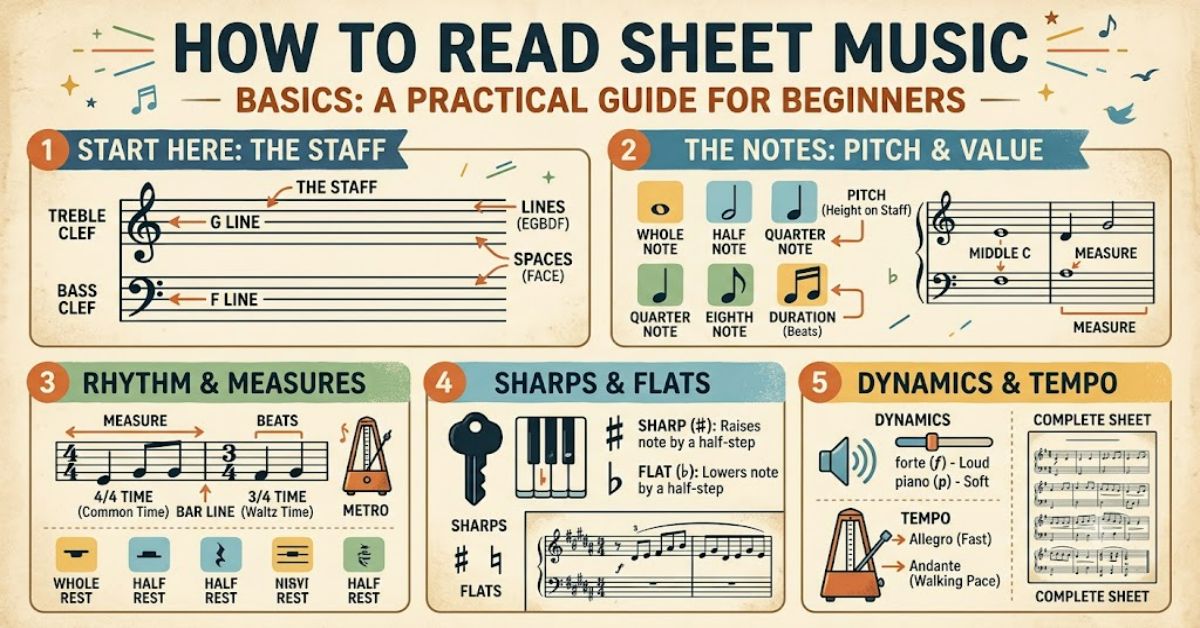
At the heart of how to read sheet music basics is the musical staff. This system uses five horizontal lines and four spaces to represent pitch. Each position corresponds to a specific note, forming the visual map of music.
When starting how to read sheet music basics, learners should focus first on recognising note positions rather than speed or rhythm. The staff is essentially a grid: higher positions mean higher pitch, and lower positions indicate lower pitch.
Key components of the staff:
- Five lines and four spaces
- Notes placed either on lines or in spaces
- Ledger lines for notes beyond the staff range
Understanding this structure is the first step toward fluency.
Clefs and Note Identification
Clefs define how the staff is interpreted. The two most common are the treble clef and bass clef.
- Treble clef (G clef): Used for higher-pitched instruments like violin or flute
- Bass clef (F clef): Used for lower-pitched instruments like cello or bass guitar
In how to read sheet music basics, memorising note positions within each clef is essential. Many beginners use mnemonic devices such as “Every Good Boy Deserves Fruit” for treble clef lines.
Clefs act as reference points. Without them, the staff has no fixed meaning, which is why they are always the starting symbol in written music.
Rhythm and Timing in Sheet Music Basics
Once pitch is understood, rhythm becomes the next essential layer in how to read sheet music basics. Rhythm determines how long each note is played and when it occurs.
Common note values include:
- Whole notes
- Half notes
- Quarter notes
- Eighth notes
Each value divides time into smaller or larger segments. When practicing how to read sheet music basics, it is helpful to clap rhythms before playing them on an instrument. This separates timing from technical performance.
Rhythm also introduces rests, which represent silence. These are just as important as notes in shaping musical structure.
Step-by-Step Reading Practice
Developing confidence in how to read sheet music basics requires structured practice. Rather than memorising everything at once, learners should build skills progressively.
- Identify note names on the staff
- Practice clapping rhythms separately
- Combine pitch and rhythm slowly
- Play simple melodies using limited notes
- Gradually increase complexity
Consistency matters more than duration. Ten minutes daily is often more effective than one long weekly session.
Comparison: Sheet Music vs Guitar Tabs
| Feature | Sheet Music | Guitar Tabs |
| Information depth | Pitch, rhythm, dynamics | String and fret position only |
| Learning curve | Steeper | Easier for beginners |
| Versatility | Universal across instruments | Guitar-specific |
| Expressiveness | High | Limited |
Understanding this comparison helps learners see why how to read sheet music basics remains essential for long-term musical development.
Practice Progress and Learning Curve
Tracking progress is useful when learning how to read sheet music basics. Beginners often underestimate how quickly recognition improves with repetition.
| Week of Practice | Average Notes Recognised | Rhythm Accuracy |
| Week 1 | 5–7 notes | Low |
| Week 2 | 10–12 notes | Moderate |
| Week 4 | 15–20 notes | Improving |
| Week 6+ | 25+ notes | Consistent |
This gradual improvement shows that reading music is a skill built through exposure, not memorisation alone.
Common Challenges and Misconceptions
Many learners struggle with the belief that how to read sheet music basics requires mathematical or technical talent. In reality, it is pattern recognition.
Common challenges include:
- Confusing note positions at first
- Mixing up clefs
- Rushing rhythm practice
A key insight is that reading music and playing an instrument should initially be practiced separately. This reduces cognitive overload.
Practical Implications for Beginners
Learning how to read sheet music basics opens access to a vast musical library across genres and instruments. It allows musicians to collaborate more easily and understand compositions beyond ear-based learning.
However, the trade-off is time investment. Unlike shortcuts such as tablature systems, sheet music demands structured learning. The reward is long-term versatility.
Takeaways
- Sheet music is a structured language combining pitch and rhythm.
- Learning should follow a sequence: staff → clefs → rhythm → practice.
- Short, consistent practice sessions build faster fluency.
- Reading music improves through pattern recognition, not memorisation.
- Sheet music offers greater long-term versatility than simplified notation systems.
- Progress is gradual but measurable within weeks of consistent practice.
The Future of Music Reading Education in 2027
Digital music education is expected to expand significantly by 2027, driven by interactive learning platforms and AI-assisted tutoring tools. According to trends highlighted by UK education technology initiatives and ABRSM digital learning updates, music theory is increasingly being integrated into app-based ecosystems.
For how to read sheet music basics, this means more adaptive learning systems that adjust difficulty in real time. However, traditional notation remains unchanged, ensuring continuity across instruments and generations.
A key constraint is access inequality—while digital tools improve learning speed, not all learners have equal access to high-quality devices or instruction. Hybrid learning models are likely to dominate, combining traditional notation teaching with digital reinforcement.
Conclusion
Understanding how to read sheet music basics is less about memorising symbols and more about learning a structured visual language. Once the staff, clefs, and rhythm patterns become familiar, music reading transforms from confusion into recognition.
The process is gradual, but predictable. With consistent practice, learners move from identifying individual notes to interpreting entire musical phrases. While the early stages can feel slow, the system rewards repetition and patience.
Ultimately, sheet music remains one of the most universal tools in music education. It bridges genres, instruments, and generations, offering a shared framework that continues to evolve while preserving its core structure.
FAQ
How long does it take to learn how to read sheet music basics?
Most beginners develop basic recognition within 4–6 weeks of consistent daily practice, though fluency takes longer depending on instrument complexity.
Is sheet music harder than guitar tabs?
Yes, sheet music carries more information, including rhythm and dynamics, but it is also more versatile and widely applicable.
Do I need an instrument to learn sheet music?
No, beginners can start with clapping rhythms and note recognition before playing an instrument.
What is the easiest clef to learn first?
The treble clef is typically easier for beginners due to its common use in melodies.
Can I learn sheet music without a teacher?
Yes, but structured guidance or apps can significantly speed up understanding.
References
ABRSM. (2024). Music theory and notation guide. Associated Board of the Royal Schools of Music.
BBC Bitesize. (2023). Reading music notation basics. British Broadcasting Corporation.
Prince, T. (2022). Foundations of music literacy in beginners. Oxford Music Education Journal.
UK Department for Education. (2023). Creative subjects curriculum guidance. GOV.UK.