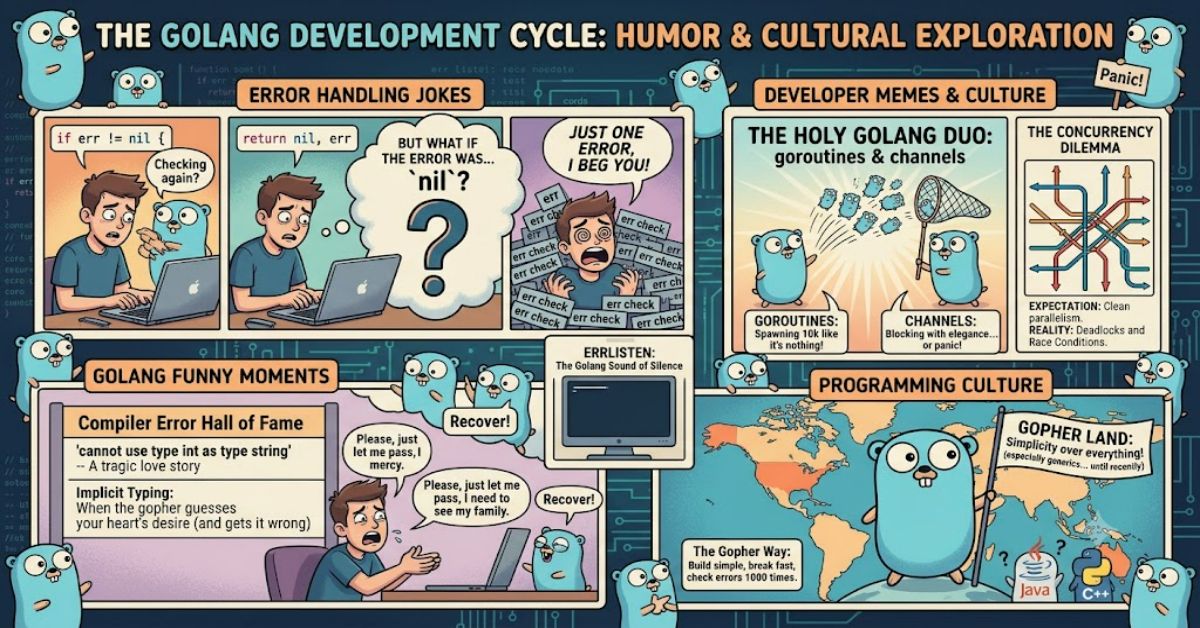
Programming languages develop personalities over time. Developers create memes, jokes, and shared experiences that reflect the strengths and frustrations of their tools. The world of golang funny moments is a perfect example of this culture, with Go developers regularly joking about repetitive code, error handling, and the language’s unusual design decisions.
Created at Google and publicly released in 2009, Go (often called Golang) was designed to make software development simpler, faster, and more reliable. However, some of those same design choices became the source of endless developer humour.
The most famous example is the repeated use of:
if err != nil {
return err
}
Many Go programmers joke that they spend half their working lives writing this small block of code. Yet behind the humour is a serious design principle: Go encourages developers to handle errors explicitly instead of hiding failures behind exceptions.
Why Go Developers Love Making Fun of Error Handling
The if err != nil pattern is perhaps the biggest inside joke in the Go community.
Unlike languages such as Java, Python, or JavaScript, Go does not rely on traditional exception-based error handling for everyday problems. Instead, functions commonly return an error value that developers must check.
This approach creates predictable code, but it also creates repetition.
| Go Feature | Developer Reaction |
| Explicit errors | “Another error check?” |
| Simple syntax | Easy to read but repetitive |
| Minimal language features | Fewer surprises |
| Strong tooling | Less configuration work |
The joke exists because developers recognise the routine. The repetition is real, but so is the benefit.
The Humour Behind Go’s Simplicity
Go was intentionally designed with fewer features than many modern programming languages.
The creators wanted a language that large teams could understand quickly. Features such as generics arrived much later, with official support introduced in Go 1.18 in March 2022.
This simplicity creates another common joke: Go developers often say the language has “less magic”.
The phrase refers to the idea that developers can usually understand what the compiler and runtime are doing without navigating complicated abstractions.
For experienced programmers coming from more complex ecosystems, this can feel refreshing. For beginners expecting advanced shortcuts, it can feel restrictive.
Common Golang Jokes Developers Recognise
The humour surrounding Go often comes from shared workplace experiences.
| Joke or Meme | Reality Behind It |
| Writing endless error checks | Explicit handling improves reliability |
| Missing advanced features | Simplicity is intentional |
| Gofmt jokes | Automatic formatting removes style debates |
| Tiny language design | Easier maintenance for teams |
These jokes are not usually criticism. They are often signs that developers understand and appreciate the language’s philosophy.
Go Formatting: The Joke That Solved a Real Problem
Another popular source of humour is gofmt, Go’s official formatting tool.
Many programming communities spend significant time debating style choices:
- Where braces should appear.
- How code should be spaced.
- Which formatting rules teams should follow.
Go removed much of this discussion by creating an official formatter.
The golang-funny joke is that Go developers no longer argue about formatting because the tool has already decided.
This small feature demonstrates an important software engineering principle: reducing unnecessary decisions can improve productivity.
The Cultural Impact of Go Developer Humour
Programming jokes like golang-funny often reveal how communities think.
The Go community’s humour reflects several values:
- Practicality over complexity.
- Reliability over cleverness.
- Maintainability over unnecessary abstraction.
Companies using Go for cloud infrastructure, networking systems, and backend services often value these qualities because large software systems require consistency.
The humour surrounding Go is therefore connected to professional experience, not just internet entertainment.
Hidden Lessons Behind Golang Funny Culture
Several deeper insights can be found beneath the jokes.
1. Repetition can be intentional design
Developers often criticise repeated code patterns, but repetition can sometimes make software easier to review and maintain.
2. Developer frustration can reveal priorities
The jokes about missing features show that Go intentionally chooses stability and simplicity over adding every possible programming capability.
3. Community humour strengthens technical identity
Shared jokes create belonging among developers, helping communities form around common experiences.
The Future of Golang Funny Culture in 2027
Go continues to be used in cloud computing, infrastructure tools, and high-performance backend systems. As adoption continues, its developer culture will likely keep producing new jokes around evolving features and changing workflows.
The future humour of Go will probably shift as the language grows. Features added after years of community requests may become new discussion points, while older jokes such as error handling repetition are likely to remain classics.
The important point is that programming humour often survives because it reflects genuine experiences. As long as developers write Go code, they will continue finding ways to laugh about it.
Key Takeaways
- Go humour comes from real developer experiences rather than random jokes.
- The if err != nil pattern is the language’s most famous running joke.
- Go’s simplicity creates both appreciation and playful criticism.
- Developer communities use humour to discuss technical choices.
- Many Go jokes reveal deeper software engineering principles.
Conclusion
Golang humour represents more than programming memes. It reflects the relationship between developers and the tools they use every day. The jokes about error handling, simplicity, and limited language features exist because Go makes deliberate choices that shape how programmers work.
The famous if err != nil pattern may appear repetitive, but it represents Go’s broader philosophy of clarity and explicit behaviour. Similarly, jokes about minimalism highlight the balance between simplicity and functionality.
The lasting appeal of Go community humour comes from recognition. Developers laugh because they have experienced the same situations themselves. These shared moments create a culture where technical discussions, frustrations, and appreciation can exist together.
FAQ
Why is if err != nil a common Go joke?
Because Go developers write this error-checking pattern frequently. Its repetition has become a defining part of the language’s culture.
What makes Golang humour different from other programming jokes?
Go jokes often focus on design philosophy, simplicity, and real development workflows rather than only syntax mistakes.
Is Go’s simple design a weakness?
Some developers see limitations, while others value the reduced complexity and easier maintenance.
Why do Go developers joke about missing features?
Because Go intentionally avoids adding features unless they provide clear practical benefits.
What is the funniest Go programming meme?
Many developers consider the endless if err != nil jokes the most recognisable example.
Methodology
This article was developed using publicly available information about Go’s design philosophy, official language documentation, and common developer community discussions. The analysis separates informal programming humour from technical facts and focuses on why these jokes became culturally significant among developers.
References
- Google. (2009). The Go Programming Language. Google Developers.
- The Go Authors. (2022). Go 1.18 Release Notes. The Go Programming Language Documentation.
- Donovan, A. A. A., & Kernighan, B. W. (2015). The Go Programming Language. Addison-Wesley Professional.
Editorial Disclosure:
This article was drafted with AI assistance and should be reviewed and verified by the RubbleMagazine.co.uk editorial team before publication.