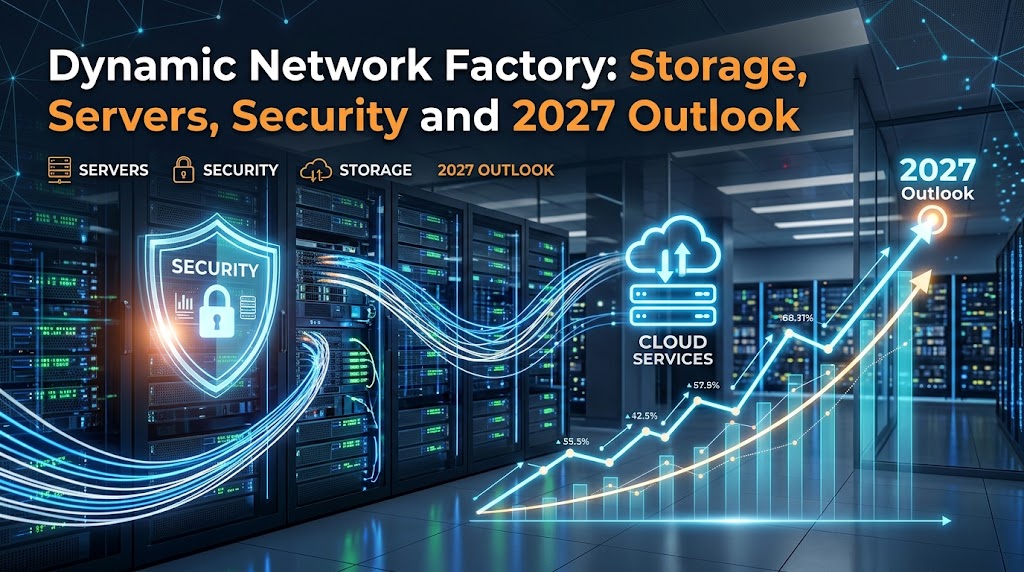
Dynamic Network Factory is a privately held technology company associated with enterprise storage, servers, security systems and IT infrastructure. Based in Hayward, California, DNF has a history stretching back to 1989, when it began as a US subsidiary of Japanese technology company CSK Electronics. It later became an independent private business in 1998, developing storage appliances and expanding into broader infrastructure services.
The company’s historical portfolio is notable because it spans several generations of enterprise infrastructure. DNF has worked with network-attached storage (NAS), storage area networks (SANs), RAID systems, iSCSI, direct-attached storage (DAS), servers, video-management systems and scalable IP storage. Its public company information also describes project management, IT consulting, analytics, business intelligence, ERP and lifecycle planning and staff augmentation.
That combination makes DNF more interesting than a conventional hardware manufacturer. Its business has repeatedly moved towards the point where storage becomes part of a larger operational system: servers process information, storage retains it, networking moves it and security controls how it is used.
The company’s history also contains a useful lesson for understanding infrastructure markets. Hardware specifications change quickly, but requirements such as availability, redundancy, capacity expansion, data protection and manageable operating costs remain remarkably consistent.
What Is Dynamic Network Factory?
DNF describes itself as a full-service storage, server and security enterprise solutions provider. Its LinkedIn company profile lists Hayward as its headquarters and identifies the company as privately held. The same profile says DNF works across sectors including healthcare, defence, high-tech manufacturing and education.
The company’s historical development can be divided into several stages.
| Period | Development | Strategic significance |
| 1989 | Established as a CSK Electronics subsidiary | Entered the US technology market |
| 1998 | Became an independent private company | Focus shifted towards storage |
| 2006 | Acquired StoneFly Networks | Added major iSCSI/IP SAN expertise |
| 2007 | Expanded professional services | Added storage, virtualisation, backup and disaster-recovery support |
| 2010s | Expanded security and surveillance solutions | Connected storage with video-management workloads |
| 2020s | Continued association with storage and security businesses | Infrastructure remains central to the company’s identity |
The 1998 transition is particularly important. DNF’s own historical material says the company refined its strategy around storage after becoming independent, while its 2006 acquisition of StoneFly added expertise in iSCSI and turnkey IP SAN systems.
DNF’s Core Technology Areas
Enterprise Storage
Storage has historically been DNF’s strongest area.
Its product history includes NAS, DAS, RAID and IP SAN systems. In 2007, for example, the company introduced the SASmaster family of RAID arrays, with models supporting hot-swappable drives and expansion to capacities of up to 64TB.
This older product history remains relevant because it demonstrates the engineering priorities DNF has consistently addressed: throughput, capacity, redundancy, expandability and compatibility.
A storage appliance is not simply a collection of disks. Enterprise deployments require decisions about RAID protection, controller redundancy, interfaces, workloads, backup, recovery, network connectivity and maintenance.
Servers and Infrastructure
DNF’s public profile also identifies server hardware, data-centre infrastructure, storage virtualisation and IT support among its specialisms.
The practical significance is that storage and compute cannot be evaluated independently. A high-capacity storage system is useful only when servers, network interfaces and applications can consume its resources efficiently.
This is particularly relevant to modern data infrastructure, where workloads may include virtual machines, databases, analytics, video, backup repositories and AI-related datasets.
Readers researching broader infrastructure concepts may also find our guide to data warehouse design useful because storage architecture is one component of a larger data-management system.
Security and Video Surveillance
DNF’s security business illustrates another important development: storage is increasingly part of the security system itself.
DNF Security, identified as a subsidiary of Dynamic Network Factory, describes its solutions as mission-critical video-surveillance systems incorporating storage protection, redundancy, high availability and scalability. Its portfolio has included video-management systems, video-management engines, mobile surveillance systems, viewing workstations and scalable IP storage.
This creates a distinctive infrastructure requirement. Security cameras continuously generate data, meaning storage capacity is closely connected to camera count, resolution, frame rate, retention periods and recording policies.
A surveillance deployment therefore cannot be evaluated only by asking how many cameras a system supports. The more meaningful questions concern retention, storage throughput, redundancy and recovery.
Documented Case Studies
DNF’s published case-study archive provides several concrete examples of its technology being applied in operational environments.
One case study concerns the Port of West Sacramento, which selected DNF Security’s Falcon and Seahawk systems for a surveillance upgrade. Another concerns the Vegas Valley deployment, where a Seahawk 1601 system provided 8TB of storage for video-retention requirements. The archive also documents a Pacifica Police Department deployment designed to address digital-video storage and centralised data-management challenges.
These examples provide stronger evidence than generic claims about scalability because they connect DNF’s technology with identifiable operational requirements.
They also reveal an important characteristic of surveillance infrastructure: storage requirements are determined by the behaviour of the system over time, not simply by its initial installation.
From Hardware to Professional Services
DNF’s expansion into professional services was another significant strategic move.
In 2007, the company announced a professional-services business unit focused on storage, server virtualisation, backup and disaster recovery for mid-market organisations. The stated objective was to provide specialist IT resources as storage environments became more complex.
This transition matters because hardware margins alone can be vulnerable to commoditisation. Consulting, implementation, support and lifecycle management allow an infrastructure company to participate in more stages of the technology lifecycle.
The model can therefore be understood as:
Hardware → Integration → Services → Support → Lifecycle management
That is a more durable business proposition than selling a server or storage array as an isolated product.
Comparison: DNF’s Infrastructure Model
| Capability | Traditional hardware vendor | DNF’s documented model | Practical implication |
| Storage hardware | Core offering | Core offering | Capacity and performance |
| Servers | Often separate product line | Integrated infrastructure focus | Closer system integration |
| Security | Frequently third-party | DNF Security subsidiary | Storage-security convergence |
| Consulting | Limited or partner-led | IT consulting and professional services | Implementation support |
| Backup and recovery | Often separate solutions | Documented professional-services focus | Broader lifecycle coverage |
| Video surveillance | Usually specialist market | Dedicated security business | Purpose-built storage workloads |
| Staff augmentation | Uncommon | Listed as a service | Additional technical capacity |
The distinction is important. DNF’s historical positioning has been closer to an infrastructure solutions provider than a simple component supplier.
What DNF’s History Reveals About Storage Engineering
Three broader insights emerge from the company’s documented development.
1. Storage has always been an availability problem
DNF’s historical products repeatedly emphasised redundant controllers, redundant power supplies, hot-swappable drives and RAID configurations. A 2007 Enterprise F12-HA system, for example, used active-active RAID controllers and redundant data paths to reduce single points of failure.
The lesson is straightforward: enterprise storage is not primarily about maximum capacity. It is about keeping valuable data accessible when individual components fail.
2. Security footage changes the economics of storage
Video surveillance creates continuous data streams rather than occasional file transfers. As resolution and camera counts increase, retention becomes a capacity-planning issue.
This explains why DNF’s movement into video security naturally complemented its storage expertise. The same infrastructure principles — capacity, redundancy, throughput and recovery — apply to both enterprise data and surveillance archives.
3. Services become more valuable as infrastructure becomes heterogeneous
DNF’s move into professional services recognised a structural problem that remains relevant today: organisations rarely operate a single technology stack.
Storage may need to work with virtualisation platforms, backup systems, servers, networks and security applications. Consulting and lifecycle support can therefore solve integration problems that hardware specifications alone cannot address.
Risks and Trade-Offs
DNF’s model also faces several industry-wide challenges.
Legacy technology risk: Storage interfaces and hardware platforms change quickly. Older systems can become difficult to maintain as components and expertise disappear from the market.
Vendor concentration: A customer relying heavily on one supplier can face migration costs if the vendor changes product direction.
Security exposure: Storage systems are increasingly connected to wider networks. Compromise of an infrastructure appliance can affect availability and confidentiality simultaneously.
Capacity planning: Buying excess capacity increases capital costs, while underestimating growth creates migration and downtime risks.
Energy consumption: Large infrastructure installations require power and cooling, making efficiency increasingly important.
The final issue is becoming harder to ignore. The International Energy Agency reported in April 2026 that global data-centre electricity demand increased by 17% in 2025 and expects data-centre electricity consumption to double by 2030.
That means infrastructure suppliers increasingly have to think beyond storage capacity. Power density, cooling, workload efficiency and hardware utilisation are becoming part of the infrastructure equation.
The Future of Dynamic Network Factory in 2027
The most important question for DNF heading into 2027 is not whether conventional storage hardware will disappear. It is how storage providers adapt to increasingly software-defined, energy-constrained and security-sensitive infrastructure.
The IEA’s 2026 analysis provides a useful backdrop. AI-focused data centres are placing growing pressure on electricity infrastructure, while advanced server racks are becoming substantially more power-dense. The agency says AI-server power density increased elevenfold between 2020 and 2025 and could increase another fourfold by 2027.
For companies operating in storage and server infrastructure, this creates several practical priorities:
| 2027 pressure | Likely infrastructure response |
| Higher data volumes | Greater storage density |
| AI workloads | Faster storage and higher throughput |
| Rising power demand | More energy-efficient hardware |
| Security threats | Stronger access and data-protection controls |
| Hybrid infrastructure | Better interoperability |
| Longer retention requirements | Tiering, archiving and lifecycle policies |
| Infrastructure complexity | Managed services and specialist support |
There is no evidence that DNF will pursue any particular 2027 strategy, so predictions about specific products would be premature. Its documented history does, however, show a pattern of moving towards adjacent infrastructure requirements when customer workloads change.
That makes storage, security integration and professional services more credible areas to watch than a simple return to standalone hardware.
Key Takeaways
- DNF’s history stretches back to 1989, with independence established in 1998.
- Enterprise storage has remained the foundation of its technology portfolio.
- The 2006 StoneFly acquisition strengthened its IP SAN and iSCSI capabilities.
- DNF Security connected storage expertise with video-surveillance infrastructure.
- Documented projects include deployments involving ports, police and surveillance environments.
- Professional services expanded the company beyond hardware into implementation and infrastructure support.
- Rising AI and data-centre energy requirements could make efficiency and infrastructure integration increasingly important by 2027.
Conclusion
Dynamic Network Factory represents a useful case study in how an infrastructure technology company can adapt as enterprise computing changes. Its roots are in storage, but its documented history extends through servers, RAID, NAS, SAN, iSCSI, professional services, security and video-management systems.
The company’s development from a CSK Electronics subsidiary in 1989 to an independent private business in 1998 established the foundation for its storage-focused strategy. The acquisition of StoneFly in 2006 subsequently strengthened its position in IP SAN and iSCSI technology.
Its security activities show why storage remains relevant even when the end product appears to be something else. Video surveillance, for example, depends heavily on reliable, scalable data retention.
Looking towards 2027, the wider infrastructure market faces rising data volumes, increasingly demanding AI workloads and greater pressure on energy efficiency. DNF’s historical emphasis on storage, availability, security and infrastructure services gives it a relevant foundation, although its future direction and commercial performance cannot be predicted from public information alone.
Frequently Asked Questions
What is Dynamic Network Factory?
Dynamic Network Factory is a privately held technology company associated with enterprise storage, servers, security systems, IT consulting and infrastructure services. Its headquarters are identified in Hayward, California.
What does Dynamic Network Factory specialise in?
Its documented specialisms include enterprise storage, data-centre infrastructure, NAS, SAN, RAID, iSCSI, server hardware, storage virtualisation, IT support, video surveillance, analytics and IT consulting.
When was Dynamic Network Factory founded?
DNF’s history traces back to 1989, when it was established as a US subsidiary of CSK Electronics. The company became an independent private firm in 1998.
What is DNF Security?
DNF Security is identified by its website as a subsidiary of Dynamic Network Factory. It focuses on video-surveillance and security infrastructure, including video-management systems and scalable IP storage.
Did Dynamic Network Factory acquire StoneFly?
Yes. DNF completed its acquisition of StoneFly Networks in 2006. StoneFly specialised in iSCSI and turnkey IP SAN solutions and became an important part of DNF’s storage technology portfolio.
Where is Dynamic Network Factory located?
Public company information identifies Hayward, California, as DNF’s headquarters. Its LinkedIn profile also lists locations in San Diego, California, and Secunderabad, India.
Is Dynamic Network Factory still relevant in 2027?
Its technology history remains relevant to the infrastructure market, but its future commercial performance cannot be established from available public information. The broader market is facing rising storage, AI, security and energy requirements, which could create opportunities for infrastructure specialists.
Methodology
This article was prepared using publicly available company information, DNF’s published materials, its DNF Security website, historical company announcements, documented case studies and independent technology sources.
The company history was cross-checked against DNF’s published historical material and its current public professional profile. Product and capability claims were supported where possible by DNF’s own historical announcements. Documented case studies were used as evidence of real-world deployments rather than presenting unverified claims as firsthand observations.
The article does not claim that the author personally tested DNF hardware or services. No independent benchmark, customer survey or technical laboratory evaluation was conducted.
A further limitation is that much of the detailed public evidence about DNF’s products comes from historical material. Current product availability, pricing, revenue, employee numbers, customer satisfaction and future commercial strategy should therefore be independently verified before publication.
The 2027 section is deliberately framed as industry analysis rather than a prediction of DNF’s specific business performance. Current data-centre energy trends from the International Energy Agency were used to establish the wider infrastructure context.
This article was drafted with AI assistance and requires human editorial review. All corporate claims, dates, product status and references should be independently confirmed before publication.
References
Dynamic Network Factory. (2006, 11 October). Dynamic Network Factory introduces entry-level direct-attached storage systems for affordable, scalable storage. DNF Security.
Dynamic Network Factory. (2007, 14 November). DNF launches professional services business unit. Network Computing.
Dynamic Network Factory. (2007, 11 September). DNF Storage intros SASmaster. Network Computing.
Dynamic Network Factory. (2007, 13 February). Dynamic Network Factory’s new high-performance Enterprise F12-HA RAID subsystem ensures fault tolerance. DNF Security.
Dynamic Network Factory. (n.d.). Company. DNF Security.
Dynamic Network Factory. (n.d.). Dynamic Network Factory. LinkedIn.
International Energy Agency. (2026, 16 April). Data centre electricity use surged in 2025, even with tightening bottlenecks driving a scramble for solutions. IEA.
International Energy Agency. (2026). Key questions on energy and AI. IEA.