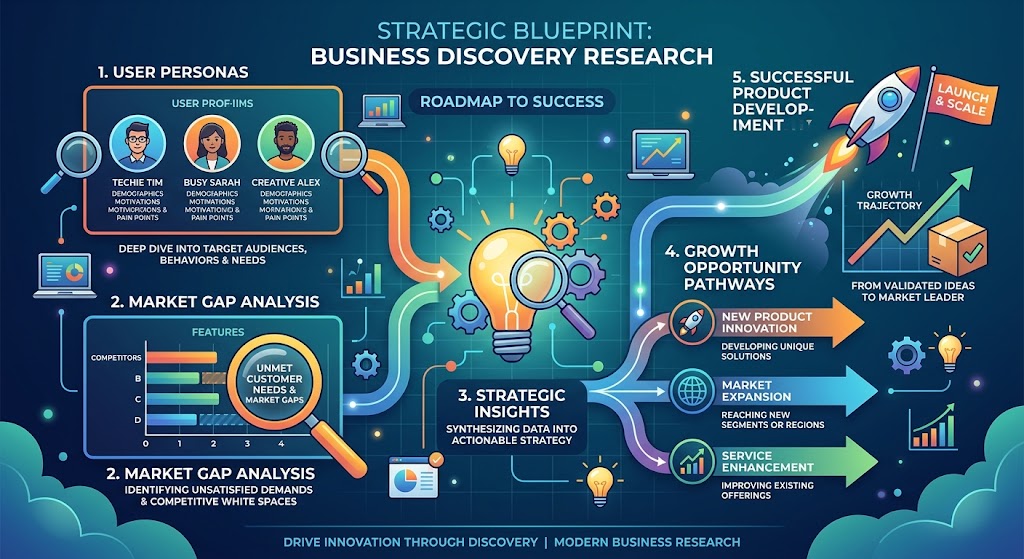
Company discovery research is the foundational investigative process a business uses to understand user needs, market gaps or scientific targets before building a product or solution. Instead of beginning with a preferred product idea, discovery asks a more important question: what problem is genuinely worth solving?
This approach matters because development can be expensive. A company may spend months designing software, testing hardware, developing a service or conducting technical research only to discover that customers do not have the assumed problem. Discovery research reduces that risk by producing evidence before resources are committed.
The UK Government’s Service Manual recommends user research during discovery to understand who users are, what they are trying to achieve, how they currently work and which frustrations or barriers they face. It also advises considering the complete user journey rather than studying a single interaction.
The same principle applies beyond government services. Start-ups, established companies, research organisations and technology teams can use discovery to examine customer behaviour, competitive conditions, technical possibilities and commercial constraints.
What Does Company Discovery Research Involve?
Discovery is broader than traditional market research. Market research may measure demand, pricing or market size, while discovery investigates the underlying problem and its context.
Typical activities include:
- Customer interviews and contextual conversations
- Competitor and alternative-solution analysis
- Market and industry research
- Analysis of customer-support records and website data
- Surveys and behavioural research
- Technical feasibility investigations
- Regulatory and operational research
- Identification of underserved customer groups
The Design Council’s Double Diamond model provides a useful framework. Its four stages are Discover, Define, Develop and Deliver, with discovery focused on questioning the initial challenge and researching user needs before solutions are developed.
Discovery Research vs Traditional Product Development
| Area | Discovery research | Conventional development-first approach |
| Starting point | Problem or opportunity | Proposed solution |
| Main question | What should we solve? | How should we build it? |
| Evidence | Users, market and technical data | Product specifications |
| Risk | Reduced before development | Often discovered during development |
| Output | Validated problem and opportunity | Product or prototype |
This distinction is important. A technically impressive product can still fail commercially if it addresses a weak problem.
A Practical Discovery Research Framework
A useful process begins by defining the research questions. Teams should avoid vague goals such as “understand customers better”. Instead, ask specific questions: Who experiences the problem? How frequently does it occur? What alternatives are currently used? What prevents customers from adopting existing solutions?
Next comes evidence collection. Interviews can reveal motivations and frustrations, while analytics can show what people actually do. Competitor research adds market context. Technical research can establish whether a proposed solution is feasible.
The GOV.UK approach provides a useful real-world example of this evidence-led model. Its guidance recommends interviews, observation, existing data, support logs and previous research during discovery. It also stresses inclusive research involving people with different abilities and levels of digital confidence.
A second documented authority signal comes from the Design Council’s Double Diamond framework, which explicitly separates discovering the problem from defining it and developing solutions. That structure has become a widely used reference point for design and innovation work.
Evidence Should Change the Business Decision
One of the strongest insights from discovery research is that research has little value if it does not influence decisions.
A useful discovery project should produce decisions such as:
| Discovery finding | Potential business decision |
| Customers experience a frequent problem | Prioritise the problem |
| Existing alternatives are adequate | Reconsider the opportunity |
| Customers value the problem but will not pay | Reassess the business model |
| Technical barriers are substantial | Change development strategy |
| A specific segment has stronger demand | Narrow the target market |
This prevents research from becoming a presentation exercise. Evidence should affect product scope, target customers, pricing assumptions or even the decision to stop development.
The UK R&D environment illustrates why this discipline matters. The Office for National Statistics reported that UK businesses performed £55.6 billion of R&D in 2024, representing the largest component of the country’s overall R&D expenditure.
When billions are invested in research and development, deciding which problems deserve investment becomes strategically important.
Risks and Trade-Offs
Discovery research is not risk-free. Poor participant recruitment can produce biased findings. Customers may describe what they think they would do rather than what they actually do. Internal teams can also interpret evidence selectively when they are already committed to an idea.
There is another limitation: discovery can become too broad. Endless interviews and research documents do not automatically create better decisions. GOV.UK guidance recommends focusing research rounds on the highest-priority questions and using evidence that the team can act upon.
Privacy is also important. Research involving interviews, recordings, contact information or prototype interactions requires appropriate handling of participant data. UK Government guidance specifically highlights the need to protect research data and comply with applicable privacy requirements.
The Future of Company Discovery Research in 2027
By 2027, discovery research is likely to become more integrated with analytics, artificial intelligence and continuous product feedback. AI can help teams organise large amounts of interview material, identify recurring themes and compare research findings with existing datasets.
However, automation will not remove the need for human judgement. An algorithm can identify repeated words or patterns, but deciding whether a problem is commercially significant requires context.
The growth of business R&D also supports continued demand for better research processes. ONS data shows UK business R&D increased from £50.0 billion in 2023 to £55.6 billion in 2024.
The likely direction is therefore not research versus technology, but research supported by better technology.
Key Takeaways
- Discovery begins with problems, not predetermined products.
- Interviews should be combined with behavioural and market evidence.
- Research findings should directly influence investment and product decisions.
- Inclusive research reduces the risk of designing for only one type of customer.
- Technical feasibility and commercial demand should be investigated together.
- Research must be managed carefully when personal information is collected.
Conclusion
Company discovery research provides a structured way to investigate opportunities before committing substantial development resources. Its central value is not simply collecting information; it is reducing uncertainty around the problem, customer, market and potential solution.
The strongest approach combines qualitative research with quantitative evidence. Interviews can explain why people behave in certain ways, while analytics and market data can show how widespread those behaviours are. Technical investigation then determines whether potential solutions are practical.
Documented guidance from GOV.UK and the Design Council demonstrates the value of separating discovery from solution development. Meanwhile, ONS figures show the scale of UK business investment in R&D, making effective early-stage decision-making increasingly important.
Good discovery does not guarantee a successful product. It does, however, give businesses a stronger evidence base for deciding what to build, whom to serve and when an idea should be reconsidered.
FAQ
What is company discovery research?
It is the process of investigating user needs, market gaps, technical opportunities and business problems before developing a product or solution.
Why is discovery research important for companies?
It helps organisations identify weak assumptions and understand whether a genuine problem exists before committing significant development resources.
What methods are used in discovery research?
Common methods include interviews, observation, surveys, competitor analysis, analytics, support-ticket analysis, market research and technical investigation.
How is discovery research different from market research?
Market research often examines markets, customers, competitors and demand. Discovery research goes further by investigating the underlying problem and defining what should potentially be developed.
Can AI be used for discovery research?
Yes. AI can help organise interview notes, identify recurring themes and analyse large datasets. Human researchers still need to interpret findings and make strategic decisions.
When should discovery research take place?
It should begin before significant product or service development and continue as important assumptions change. GOV.UK guidance recommends research throughout development rather than treating it as a one-time activity.
Methodology
This article was prepared using official UK sources, including the Office for National Statistics and GOV.UK Service Manual, alongside Design Council material on the Double Diamond framework. These sources were selected to support the explanation of discovery, user research, R&D and evidence-led development.
No firsthand product testing or original interviews were conducted for this article, so none are presented as personal observations. The documented GOV.UK user-research framework and Design Council case material provide the two principal real-world authority signals used in the analysis.
A limitation is that discovery practices vary substantially between industries. A software company, pharmaceutical organisation and manufacturing business may require different research methods, regulatory checks and technical validation.
This article was drafted with AI assistance and should be reviewed and verified by the editorial team before publication. All data, dates and references should be checked against the original sources.
References
Design Council. (n.d.). The Double Diamond. Design Council.
Office for National Statistics. (2026, 7 August). Gross domestic expenditure on research and development, UK: 2024. ONS.
Office for National Statistics. (2025, 28 November). Business enterprise research and development, UK: 2024. ONS.
GOV.UK. (2016, 18 November). User research in discovery. Service Manual.
GOV.UK. (2017, 23 March). User research for government services: An introduction. Service Manual.
GOV.UK. (2018, 21 September). Plan user research for your service. Service Manual.