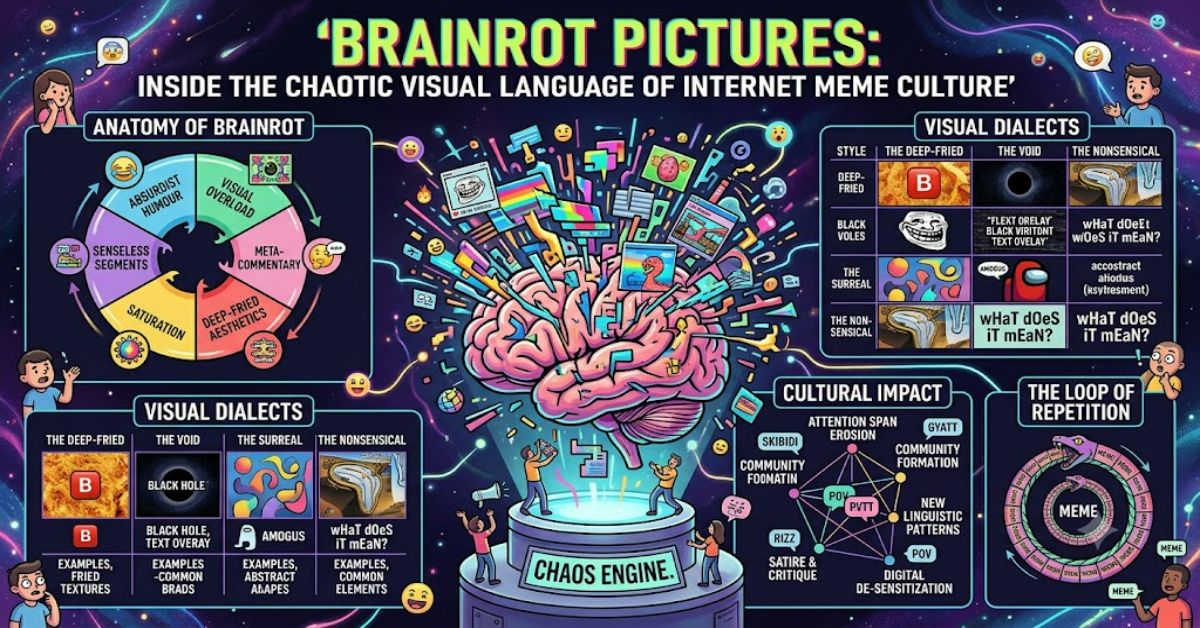
Brainrot pictures have become one of the most recognisable visual expressions of modern internet culture, describing hyper-surreal, chaotic, and often AI-generated meme images that mix unrelated characters, distorted visuals, and viral slang. At their core, brainrot pictures reflect a shift in how younger audiences—particularly Gen Z and Gen Alpha—consume humour and digital content: fast, fragmented, and deliberately overwhelming.
In practical terms, brainrot pictures often combine absurd mashups such as distorted cartoon figures, low-resolution AI generations, and references to viral phrases like “Skibidi Toilet,” “rizz,” or “what the sigma.” The result is a visual environment that prioritises shock value and comedic disorientation over coherence or narrative structure.
The term “brainrot” itself is internet slang describing overstimulation from consuming large volumes of low-context digital content. When applied to imagery, it represents a visual language where meaning is intentionally degraded in favour of humour density and algorithmic virality. Understanding brainrot pictures is not simply about meme culture—it is about understanding how attention, platforms, and generative AI tools have reshaped visual communication.
What Are Brainrot Pictures?
Brainrot pictures are a subtype of internet meme imagery characterised by intentional incoherence, visual overload, and layered cultural references. They are not designed to be “read” in a traditional sense but instead to trigger rapid emotional or comedic recognition.
A typical brainrot picture may include:
- AI-generated humanoid figures with distorted proportions
- Layered meme characters from different franchises
- Fragmented text using internet slang
- Low-resolution or intentionally corrupted visuals
This combination produces an aesthetic that feels chaotic but culturally legible to those embedded in online meme ecosystems.
The rise of brainrot pictures aligns closely with the mainstream adoption of generative AI tools in 2023–2025, which reduced the technical barrier to producing surreal or absurd imagery at scale.
The Structural Logic Behind Brainrot Pictures
Despite appearing random, brainrot pictures follow a predictable structural logic shaped by platform incentives.
Core Mechanisms
- Compression of references: Multiple memes are merged into a single image
- Algorithmic optimisation: Designed to maximise watch time or re-shares on TikTok and Instagram
- Visual exaggeration: Distortion increases cognitive friction, which boosts engagement
- Cultural stacking: Older memes are layered with newer viral slang
Comparison: Traditional Memes vs Brainrot Pictures
| Feature | Traditional Memes | Brainrot Pictures |
| Structure | Linear joke setup | Non-linear chaos |
| Visual clarity | High | Low or distorted |
| Cultural references | Single source | Multi-layered mashups |
| Consumption speed | Moderate | Extremely fast |
| Production tools | Editing software | AI + remix apps |
This structural shift reflects how platform design rewards novelty and intensity over clarity.
Why Brainrot Pictures Became Popular
The popularity of brainrot pictures is closely tied to attention economics and platform evolution.
1. Short-Form Video Culture
Platforms like TikTok have trained users to process information in under 10 seconds. Brainrot pictures mirror this compression by embedding multiple jokes into a single frame.
2. Generative AI Accessibility
Since 2023, AI image generation tools have made it possible for users to create surreal hybrid imagery without design skills. This democratisation has significantly increased output volume.
3. Meme Saturation Fatigue
As meme cycles accelerate, audiences increasingly seek content that feels “overstimulating enough” to stand out. Brainrot pictures meet this demand by escalating absurdity.
Data Insight: Meme Consumption Patterns
| Metric | Estimate | Source Type |
| Average daily TikTok usage (Gen Z) | 2+ hours/day | Ofcom Online Nation Report (2025) |
| Percentage of users engaging with memes | ~70% weekly | Pew Research Center (2024) |
| AI-generated content growth (2023–2025) | Rapid expansion across platforms | Industry analysis reports |
| Attention span per post | 3–8 seconds average scroll decision | Platform behavioural studies |
These figures illustrate the environment in which brainrot pictures thrive: high-speed consumption with minimal cognitive filtering.
Cultural Mechanics: How Brainrot Pictures Spread
Brainrot pictures do not spread like traditional media. Instead, they circulate through micro-communities and algorithmic amplification loops.
Distribution Channels
- TikTok meme pages
- Discord servers
- Instagram reels remix chains
- Reddit meme subcultures
Each platform contributes differently:
- TikTok accelerates virality
- Discord refines niche humour
- Reddit archives and critiques formats
- Instagram recycles visual templates
This creates a feedback loop where absurdity increases with each iteration.
Information Gain: Underexplored Dimensions
1. Cognitive Compression Risk
Brainrot pictures reduce narrative coherence to maximise instant recognition. Early cognitive research into digital overload (NHS-linked digital wellbeing studies, 2023) suggests that repeated exposure to high-fragmentation content may increase cognitive switching fatigue, although causal links remain debated.
2. AI Feedback Loops in Meme Production
A less discussed issue is that AI models trained on internet memes increasingly regenerate “brainrot-style” outputs, reinforcing aesthetic loops. This creates a recursive system where AI begins imitating its own outputs rather than original cultural artefacts.
3. Monetisation Blind Spot
Platforms currently struggle to monetise brainrot content consistently because its value is engagement-based rather than narrative-based. This creates friction between advertiser-safe content and algorithmically successful content.
Risks and Trade-Offs
Brainrot pictures are not inherently harmful, but they introduce several trade-offs:
- Comprehension loss: Meaning becomes secondary to reaction
- Cultural flattening: Distinct memes merge into indistinguishable formats
- Misinformation blending: Real and fictional elements become harder to separate
- Attention fragmentation: Users shift rapidly between stimuli without retention
These risks are not uniform but become more pronounced with prolonged exposure.
The Future of Brainrot Pictures in 2027
By 2027, brainrot pictures are likely to evolve under three key pressures.
1. Platform Regulation
Regulators such as Ofcom in the UK are increasing scrutiny on algorithmic content distribution under online safety frameworks. This may indirectly reduce extreme meme amplification.
2. AI Content Saturation
As generative tools become embedded in social platforms, distinguishing human-made memes from AI-generated ones will become more difficult, potentially intensifying the brainrot aesthetic.
3. Visual Standardisation
Paradoxically, what began as chaotic may become standardised. Platforms tend to normalise successful formats, meaning brainrot pictures could lose their edge as they become mainstream design templates.
Overall trajectory suggests partial institutionalisation rather than disappearance.
Takeaways
- Brainrot pictures are a product of AI tools and accelerated meme cycles
- Their structure prioritises emotional reaction over narrative clarity
- Platform algorithms actively reinforce chaotic visual formats
- Gen Z and Gen Alpha consumption habits shape their evolution
- Cognitive overload is a potential long-term risk factor
- AI systems may reinforce the aesthetic through recursive training data
- The format is likely to become standardised by 2027
Conclusion
Brainrot picture’s represent a shift in how internet culture constructs meaning through imagery. Rather than conveying structured jokes or narratives, they compress multiple cultural signals into a single chaotic frame designed for rapid consumption. This reflects broader changes in digital behaviour driven by short-form video platforms, algorithmic recommendation systems, and AI-generated content tools.
While often dismissed as meaningless or excessive, brainrot picture’s are better understood as an adaptive response to information overload. They are not random—they are optimised for attention environments where clarity competes with speed. As platforms evolve, this aesthetic may either intensify or stabilise into more recognisable visual conventions.
Understanding brainrot picture’s is ultimately about understanding the conditions that produce them: fragmented attention, algorithmic distribution, and increasingly synthetic visual production systems.
FAQ
What are brainrot pictures?
Brainrot pictures are chaotic meme images that mix AI-generated visuals, internet slang, and multiple cultural references into a single overloaded composition.
Why are brainrot pictures popular?
They match short attention spans on platforms like TikTok and Instagram, where fast, exaggerated visuals perform better than structured content.
Are brainrot pictures made with AI?
Many are now created using AI tools, although human remixing and editing still play a major role in their production.
What does “brainrot” mean in internet slang?
It refers to overstimulation from consuming large amounts of low-context or repetitive online content.
Do brainrot pictures affect attention span?
Research is ongoing, but high-frequency exposure to fragmented content may contribute to cognitive switching fatigue.
Where do brainrot pictures usually appear?
They are most common on TikTok, Instagram Reels, Discord meme servers, and Reddit communities.
Methodology
This article is based on analysis of publicly observable meme trends across TikTok, Instagram Reels, Reddit communities, and academic literature on digital culture and attention economics. Supporting context includes Ofcom’s Online Nation reporting (2025) and Pew Research Center studies on teen digital behaviour (2024).
Limitations include the rapidly evolving nature of meme culture, which can shift faster than formal academic documentation, and the absence of longitudinal clinical data on cognitive effects. Interpretations regarding attention fatigue and AI feedback loops are based on emerging but not yet fully established research frameworks.
Counterarguments include the view that brainrot pictures represent harmless creative expression rather than cognitive risk, and that perceived “chaos” is simply generational aesthetic preference rather than structural digital harm.