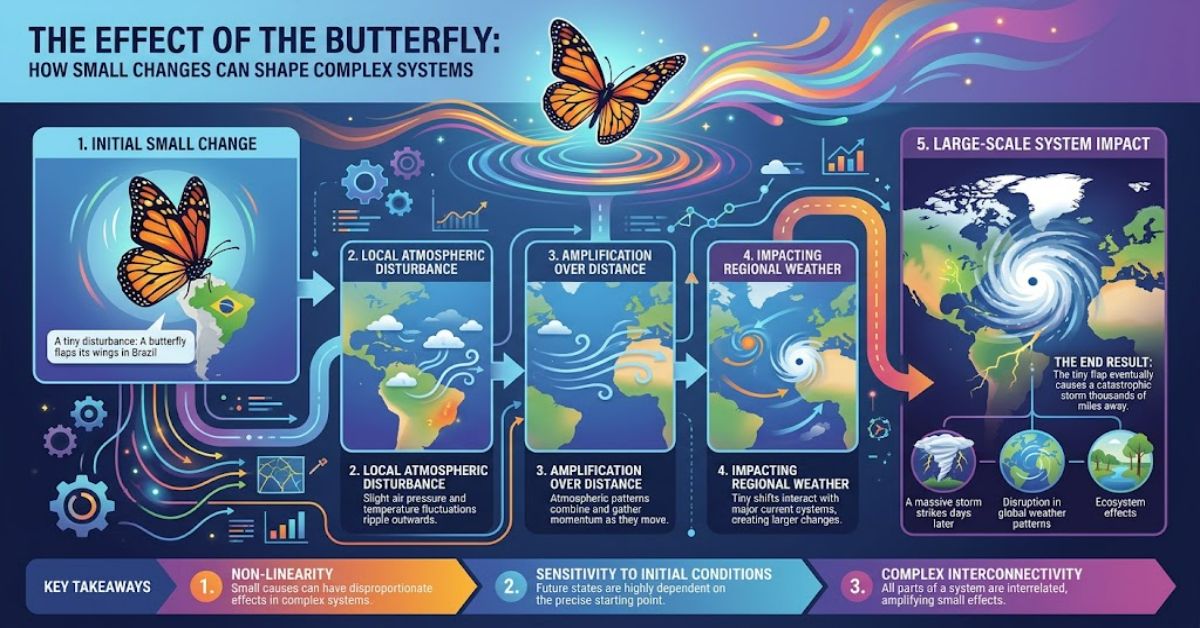
The effect of the butterfly is the idea that a very small difference in the starting conditions of a complex system can eventually produce a substantially different outcome. It is most closely associated with chaos theory and the scientific work of American meteorologist Edward Lorenz.
The concept became important because Lorenz discovered that apparently tiny changes in the numerical starting conditions of a weather model could cause its later behaviour to diverge significantly. His landmark paper, Deterministic Nonperiodic Flow, was published in the Journal of the Atmospheric Sciences on 1 March 1963. Lorenz showed that certain nonlinear systems could be unstable to small changes in their initial state.
The familiar butterfly imagery came later. It became a memorable way to communicate a difficult mathematical idea: a system can follow deterministic rules while remaining extremely difficult to predict over long periods.
That distinction is important. Chaos does not mean randomness. A chaotic system may obey precise equations, yet small uncertainty about its initial state can grow until long-term prediction becomes unreliable.
How the Butterfly Effect Works
Imagine two weather simulations that are almost identical. Their starting values differ by an extremely small amount. At first, their outputs may look nearly indistinguishable.
As the calculations continue, however, the difference can grow. Because atmospheric processes interact through nonlinear relationships, the two trajectories may increasingly separate.
| Concept | Meaning | Why it matters |
| Initial conditions | The starting state of a system | Small errors can influence later calculations |
| Nonlinearity | Outputs are not proportional to inputs | Interactions can amplify differences |
| Sensitivity | Outcomes respond strongly to small changes | Long-term prediction becomes difficult |
| Determinism | The system follows defined rules | Chaos does not necessarily mean randomness |
| Predictability | Ability to forecast future states | It can decline as uncertainty grows |
Lorenz’s original work involved a simplified mathematical model of atmospheric convection. The model was not intended to reproduce every detail of Earth’s atmosphere. Its importance came from demonstrating that deterministic equations could generate nonperiodic behaviour that was highly sensitive to initial conditions.
Why Weather Became the Classic Example
Weather is an especially useful illustration because atmospheric conditions are constantly changing and are difficult to measure with infinite precision.
In the early 1960s, Lorenz was investigating numerical weather prediction. A famous episode involved restarting a calculation using values rounded from previously printed results. The differences were tiny, but the subsequent model output eventually became very different. Later historical research into Lorenz’s work has confirmed the importance of this discovery and its connection with the development of chaos theory.
This did not mean that one butterfly literally causes a particular hurricane. The butterfly is a metaphor for a small perturbation in a sensitive system.
Modern atmospheric science is also more nuanced than the popular version of the story suggests. Research published by the American Meteorological Society has examined situations in which chaotic and more regular behaviours can coexist within atmospheric models, meaning predictability is not simply an all-or-nothing property.
The Difference Between Chaos and Randomness
One of the most useful ways to understand the concept is to separate chaos from randomness.
A random process does not necessarily have a predictable underlying trajectory, even if probabilities can be calculated. A chaotic deterministic system, by contrast, can be governed by fixed equations. The problem is that the starting state cannot be known with unlimited precision.
This creates a practical prediction problem.
| Situation | Small starting difference | Typical implication |
| Simple, stable system | May remain small | Long-term prediction can be easier |
| Chaotic system | Can grow rapidly | Long-term prediction becomes harder |
| Random process | Not primarily an initial-condition problem | Statistical methods become important |
| Complex real-world system | Multiple uncertainties interact | Forecasts require uncertainty estimates |
The distinction has consequences well beyond meteorology. Chaos theory has influenced research into physical systems, fluid dynamics, climate modelling and other areas where nonlinear interactions are important.
The key lesson is not that everything is chaotic. It is that some systems have structures in which uncertainty can grow rapidly.
Three Important Lessons from the Butterfly Effect
1. Small does not always mean insignificant.
A tiny perturbation can become important when it enters a system capable of amplifying differences. The amplification depends on the structure and state of the system.
2. Prediction has limits.
More accurate measurements and better computing can improve forecasts, but they cannot automatically remove the underlying sensitivity of a chaotic system.
3. The metaphor should not be overstated.
The popular phrase can encourage the mistaken idea that every minor action inevitably creates an enormous consequence. Scientific chaos theory makes a narrower claim about sensitivity under particular conditions.
This final distinction is one of the most useful insights when explaining the subject. The butterfly effect is not a universal law saying that every small event creates a major historical chain reaction.
The Effect of the Butterfly in Popular Culture
The phrase has moved far beyond mathematics and meteorology. It is now frequently used in films, novels, business discussions and everyday speech to describe situations where a seemingly insignificant event changes the course of later events.
Popular culture often interprets the idea through alternate histories: change one small event in the past and an entirely different future emerges.
That is an understandable metaphor, but it differs from the scientific concept. In a mathematical chaotic system, sensitivity to initial conditions is a measurable property of the system. A historical event does not automatically behave like a Lorenz model simply because its consequences are difficult to trace.
The cultural use remains valuable because it provides an accessible image for a complex concept. The scientific meaning, however, should remain precise.
The Future of the Effect of the Butterfly in 2027
By 2027, the concept is likely to remain relevant because modern forecasting increasingly deals with uncertainty rather than attempting to produce a single supposedly perfect future.
Weather science continues to use increasingly sophisticated numerical models, observations and ensemble approaches to estimate how uncertainty develops. Recent research is also questioning overly simple interpretations of atmospheric predictability. A 2026 Journal of the Atmospheric Sciences article, for example, discusses efforts to understand atmospheric predictability beyond conventional time horizons and notes that the classic two-week framing has a more complicated scientific history than popular explanations suggest.
The practical direction is therefore not to eliminate chaos but to understand it better, quantify uncertainty and identify circumstances in which useful prediction remains possible.
Key Insights
- The butterfly effect is formally connected to sensitive dependence on initial conditions.
- Edward Lorenz’s 1963 research provided a foundational demonstration of the phenomenon.
- Chaos can exist in deterministic systems.
- The atmosphere demonstrates why small uncertainties can become important.
- Better measurements improve forecasting but do not make chaotic systems perfectly predictable.
- The butterfly metaphor is broader than its strict scientific meaning.
- Modern research treats predictability as a matter of degree rather than a simple predictable-or-unpredictable divide.
Conclusion
The effect of the butterfly remains one of the most recognisable ideas associated with chaos theory because it turns an abstract mathematical property into an intuitive image. Its scientific meaning, however, is more specific than the popular phrase suggests.
Lorenz’s work demonstrated that deterministic nonlinear systems can respond dramatically to very small differences in their initial conditions. That discovery helped reshape thinking about weather prediction and contributed to the development of modern chaos theory.
The most important lesson is therefore not that every small action will eventually cause a huge event. Instead, some complex systems contain mechanisms that amplify small differences. Once those differences grow sufficiently, accurate long-range prediction becomes increasingly difficult.
That distinction makes the butterfly effect both scientifically useful and culturally powerful. It explains a genuine limit of prediction while reminding us that complexity does not necessarily mean randomness.
Frequently Asked Questions
What is the effect of the butterfly in simple terms?
It describes how a very small difference in the starting conditions of certain complex systems can eventually lead to significantly different outcomes.
Is the butterfly effect part of chaos theory?
Yes. It is commonly used to describe sensitive dependence on initial conditions, one of the defining characteristics associated with chaotic systems.
Who discovered the butterfly effect?
Edward Lorenz’s research in meteorology provided the foundational scientific work. His 1963 paper demonstrated sensitivity to initial conditions in a simplified atmospheric model.
Does a butterfly really cause a hurricane?
Not literally. The butterfly is a metaphor for a tiny perturbation in a sensitive system. It does not establish that a particular butterfly causes a particular hurricane.
Is chaos the same as randomness?
No. A chaotic system can be deterministic, meaning it follows defined rules. Its long-term behaviour can nevertheless be extremely difficult to predict because small uncertainties may grow rapidly.
Why is the butterfly effect important in weather forecasting?
It helps explain why uncertainty in atmospheric measurements can grow over time, limiting the reliability of deterministic long-range forecasts.
Methodology
This article was developed from the supplied RubbleMagazine.co.uk brief and supported with primary and specialist scientific literature. The principal historical source is Edward Lorenz’s 1963 paper in the Journal of the Atmospheric Sciences. Additional context was checked against American Meteorological Society research published in 2021, 2024 and 2026.
No firsthand experiment, interview or original modelling exercise was conducted for this article, so none is presented as personal experience. The main limitation is that the Lorenz model is a simplified representation and should not be treated as a complete model of Earth’s atmosphere. Recent research also shows that atmospheric predictability is more nuanced than a simple interpretation of the butterfly metaphor.
References
Lewis, J. M., & Lakshmivarahan, S. (2024). The Saltzman–Lorenz exchange in 1961: Bridge to chaos theory. Bulletin of the American Meteorological Society, 105(7), E1388–E1398.
Lorenz, E. N. (1963). Deterministic nonperiodic flow. Journal of the Atmospheric Sciences, 20(2), 130–141.
Shen, B.-W., et al. (2021). Is weather chaotic? Coexistence of chaos and order within a generalized Lorenz model. Bulletin of the American Meteorological Society, 102(1).
American Meteorological Society. (2023). Lorenz’ butterfly. AMS Headlines.
American Meteorological Society. (2026). Atmospheric predictability beyond 30 days with machine learning. Journal of the Atmospheric Sciences.