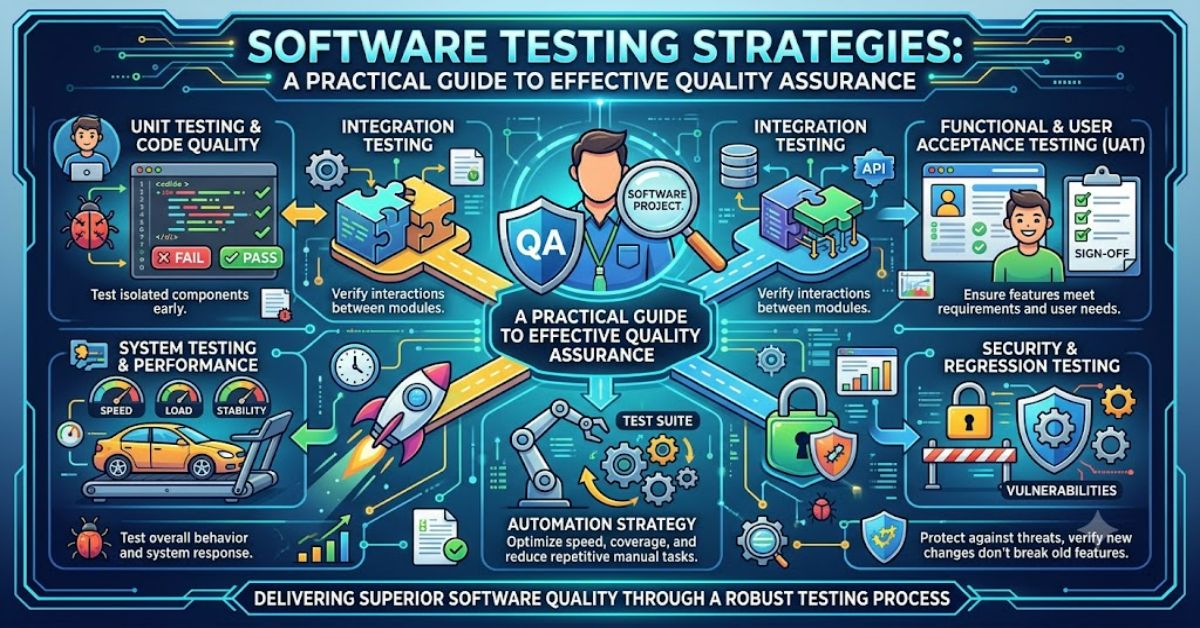
Software testing strategies are structured plans for deciding how software quality will be assessed throughout development and after release. A good strategy defines testing objectives, scope, risks, environments, responsibilities, techniques, tools and completion criteria. It acts as a practical roadmap for finding defects early while making sensible use of engineering and testing resources.
The International Software Testing Qualifications Board (ISTQB) describes testing strategy in terms of the general methodology used for testing, including how testing addresses product and project risks, test levels and high-level testing activities. Its current Foundation Level syllabus also covers test levels, test types, static testing, test techniques, risk management, defect management and automation.
The important point is that there is no universal strategy that works equally well for every application. A banking platform, mobile game, medical device interface and internal reporting tool have very different failure consequences. Their testing priorities should reflect those differences.
Modern development also changes the shape of testing. Agile delivery, continuous integration, cloud infrastructure, open-source dependencies and AI-enabled applications can create faster release cycles and new categories of risk. Testing therefore needs to be integrated into development rather than treated as a final inspection before launch.
The strongest approach is not simply to increase the number of automated tests. It is to build a layered system in which each testing activity answers a specific question about software quality.
What Is a Software Testing Strategy?
A software testing strategy is a high-level plan that explains how a development team will verify that an application meets its functional, technical, security and business requirements.
It normally answers several practical questions:
- What needs to be tested?
- What risks matter most?
- Which testing levels are required?
- Which tests should be automated?
- What should remain manual?
- Which environments and datasets are needed?
- Who owns testing activities?
- What constitutes acceptable quality?
- When can testing begin and finish?
- How will defects be tracked and addressed?
The strategy sits above individual test cases. A test case might check whether a customer can successfully reset a password. The strategy determines why password recovery matters, which test levels should cover it, whether the test should run on every build and which security risks require additional testing.
This distinction prevents a common mistake: treating a large collection of test cases as a complete testing strategy.
ISTQB’s current framework recognises that testing must be adapted to context and that test activities can be organised across different levels and types.
Why Testing Strategy Matters
Without a defined strategy, testing can become reactive. Teams may test the features that are easiest to check rather than those that carry the greatest business risk.
A structured approach creates several advantages.
Earlier defect detection
Testing can begin before a complete application exists. Requirements reviews, architecture assessments, static analysis and unit tests can identify problems before they reach system testing.
The UK’s National Cyber Security Centre recommends a clear process for testing software and updates before distribution. Its guidance also states that testing should cover individual components as well as the final software package.
Better resource allocation
Testing resources are limited. A risk-based strategy helps teams spend more time on payment processing, authentication, sensitive data handling or safety-critical functions than on low-impact cosmetic defects.
Faster feedback
A layered strategy can provide rapid feedback through automated unit and integration tests while reserving slower system, security and exploratory testing for appropriate stages.
Stronger release decisions
A strategy provides evidence for deciding whether software is ready. Instead of asking whether “everything has been tested”, teams can assess known risks, failed tests, unresolved defects, coverage and business acceptance.
Major Types of Software Testing
Different testing levels answer different questions. They should complement one another rather than operate as isolated activities.
| Testing approach | Main purpose | Typical timing | Automation potential |
| Unit testing | Verify individual functions or components | During development | High |
| Integration testing | Check interactions between components | During development and CI | High |
| System testing | Validate the complete application | Pre-release and throughout delivery | Medium to high |
| Acceptance testing | Confirm business and user requirements | Before release and during validation | Medium |
| Exploratory testing | Discover unexpected behaviour | Throughout development | Low to medium |
| Security testing | Identify vulnerabilities and weaknesses | Throughout SDLC | Medium to high |
| Performance testing | Assess speed, stability and capacity | Before major releases and changes | High |
| Regression testing | Detect unintended changes | After code changes | High |
| Usability testing | Assess user interaction and accessibility | During development | Low to medium |
This layered model reflects a central testing principle: no single testing technique can expose every category of defect.
Risk-Based Testing Should Drive Priorities
One of the most effective software testing strategies is risk-based testing.
Instead of assigning equal effort to every feature, the team evaluates the likelihood and impact of failure.
A simple risk model can be expressed as:
Risk = Probability of failure × Impact of failure
For example, an incorrect colour on a settings page may be inconvenient. An authentication defect could expose customer accounts. Both deserve testing, but they should not receive identical levels of attention.
ISTQB’s advanced Test Analyst framework specifically addresses risk analysis, risk control and selecting appropriate test techniques based on testing objectives.
A practical risk assessment can consider:
- Financial impact
- Security exposure
- Regulatory consequences
- Customer impact
- Safety implications
- Frequency of use
- Technical complexity
- Dependency on third-party services
- Difficulty of detecting failure
A useful risk-priority model
| Risk factor | Low priority | Medium priority | High priority |
| Customer impact | Minor inconvenience | Feature disruption | Major service failure |
| Security | Little sensitive data | Internal information | Credentials or personal data |
| Financial effect | Negligible | Moderate loss | Significant transaction impact |
| Complexity | Simple isolated code | Multiple dependencies | Distributed or highly coupled |
| Change frequency | Rarely changed | Periodic changes | Constantly modified |
This creates a more defensible testing plan than simply counting test cases.
The Role of Automation
Automation is central to modern testing, but it should not be treated as a replacement for human judgement.
NIST’s software verification guidance recommends automated testing alongside techniques such as threat modelling, static code scanning, black-box testing, structural testing, fuzzing and web application scanning.
Automation is particularly useful for repetitive, deterministic checks.
Good candidates include:
- Unit tests
- API tests
- Regression tests
- Build validation
- Static analysis
- Dependency checks
- Repeated security checks
- Performance baselines
- Data validation
Human testing remains valuable for areas involving judgement, ambiguity and unexpected behaviour.
Exploratory testing, for example, allows testers to investigate an application rather than following only predetermined scripts. This can reveal workflow problems that automated checks were never designed to find.
The practical lesson is simple: automate repetition, not judgement.
Shift-Left Testing and Continuous Feedback
Shift-left testing means moving appropriate verification activities earlier in the software development lifecycle.
Rather than waiting until the end of development, teams can review requirements, inspect architecture, analyse code and run automated tests during development.
OWASP’s current Web Security Testing Guide explicitly treats security testing as a lifecycle activity, with testing phases covering work before development, design, development, deployment and maintenance.
This approach changes the economics of defect management.
A defect found immediately after a developer writes a function can usually be investigated while the relevant code and context are still fresh. A similar defect discovered weeks later may require additional debugging, communication and regression work.
Shift-left does not mean “test everything as early as possible”. Some tests require a functioning environment or realistic integrations. The better principle is to move each test to the earliest stage where it can provide reliable information.
Security Testing Must Be Part of the Strategy
Security testing should not exist as an isolated exercise performed shortly before release.
The National Cyber Security Centre recommends integrating security testing with the development lifecycle and adapting testing methods to the speed of development. It also recommends converting appropriate security checks into automated tests that can help prevent regressions.
A comprehensive security testing strategy can include:
- Threat modelling
- Static application security testing
- Dynamic application security testing
- Dependency analysis
- Secret detection
- Authentication testing
- Authorisation testing
- Input validation
- Abuse-case testing
- Fuzzing
- Penetration testing
OWASP’s testing framework also emphasises the need for a balanced approach that combines different testing methods rather than relying on a single security assessment.
This produces an important practical insight: penetration testing is valuable, but it should not be used as evidence that the entire application has been adequately tested.
Performance and Reliability Testing
Functional correctness is only one part of software quality.
An application may return the correct result while still failing under realistic traffic. Performance testing therefore examines characteristics such as:
- Response time
- Throughput
- Concurrent users
- Resource consumption
- Scalability
- Stability
- Recovery behaviour
Performance testing should reflect expected usage patterns rather than arbitrary stress.
For example, a service that normally receives 1,000 requests per minute may need a different testing profile from one that experiences sharp traffic spikes during short periods.
Reliability testing should also consider failure. What happens when a database becomes unavailable? What happens when an external API times out? Can a partially completed transaction be safely recovered?
These questions often reveal weaknesses that ordinary functional testing misses.
Exploratory Testing and Human Judgement
Automation provides consistency, but software is used by people in ways that designers do not always predict.
Exploratory testing gives testers room to investigate behaviour dynamically. Instead of executing only predefined scripts, the tester forms hypotheses, interacts with the application and follows unexpected results.
It can be especially useful for:
- New features
- Complex workflows
- Usability problems
- Edge cases
- Poor error handling
- Unexpected state transitions
- Features with unclear requirements
This is one area where attempts to automate everything can create diminishing returns.
An automated script is excellent at repeating a known check. It is less effective at deciding that a workflow feels confusing or that two individually correct screens create an unintuitive user journey.
Testing in Agile and DevOps Environments
Agile and DevOps practices shorten the distance between development, testing and deployment.
ISTQB’s current Foundation Level certification explicitly covers testing across Waterfall, Agile, DevOps and Continuous Delivery approaches.
A testing strategy for these environments should therefore address:
- Pull-request validation
- Continuous integration
- Automated regression
- Test environment management
- Test data management
- Release gates
- Production monitoring
- Defect feedback
- Post-release verification
The strategy also needs clear ownership.
Developers should contribute to unit and integration testing. Test specialists can focus on complex functional, exploratory, performance and risk-based activities. Security specialists can address deeper security concerns. Product teams should validate business outcomes.
Quality becomes stronger when testing is treated as a shared responsibility rather than a final hand-off to a separate department.
Comparing Common Testing Strategies
| Strategy | Strength | Limitation | Best suited to |
| Risk-based | Concentrates effort on important failures | Requires reliable risk analysis | Business-critical systems |
| Automation-heavy | Fast and repeatable | Can miss unexpected behaviour | Stable regression suites |
| Exploratory | Finds unusual and usability issues | Difficult to measure consistently | Complex user workflows |
| Shift-left | Detects defects earlier | Some tests cannot run early | Agile and CI environments |
| Security-focused | Reduces vulnerability exposure | Requires specialist skills | Sensitive applications |
| Performance-focused | Exposes capacity and stability issues | Can require expensive environments | High-traffic systems |
| Balanced hybrid | Combines complementary methods | More planning required | Most mature software teams |
The hybrid model is generally the most adaptable because it recognises that different risks require different testing methods.
Common Mistakes in Testing Strategy
Several problems repeatedly weaken otherwise well-intentioned testing programmes.
Treating test coverage as quality
A high percentage of code coverage does not prove that an application meets user expectations.
Coverage measures what code was exercised. It does not automatically measure whether the right scenarios were tested.
Automating unstable tests
A test that frequently fails because of timing, data or environment issues can become test-suite noise. Teams may begin ignoring failures rather than investigating them.
Testing only the happy path
Successful transactions are usually easier to test than invalid inputs, interrupted processes and unexpected states. Yet many important defects appear in those less common paths.
Leaving security until the end
Late security testing can reveal architectural weaknesses when they are expensive to fix. Security requirements should influence design and implementation from the beginning.
Ignoring test data
Poor test data can create false confidence. Data should represent realistic boundary conditions, invalid states and privacy requirements without exposing unnecessary production information.
Measuring activity instead of outcomes
Counting executed tests, defects and automation scripts can be useful, but those numbers do not independently prove quality.
A stronger measurement framework considers escaped defects, risk coverage, defect severity, regression stability, time to feedback and release reliability.
Structured Testing Insights
| Insight | Why it matters | Practical response |
| More tests do not guarantee better coverage | Duplicate tests can consume resources without adding risk coverage | Review tests for unique value |
| Automation cannot replace exploratory judgement | Scripts execute known expectations | Reserve human effort for uncertainty |
| Code coverage is not risk coverage | Critical workflows may receive inadequate attention | Map tests to business risks |
| Security testing must continue after release | Vulnerabilities and dependencies change | Combine automated checks with periodic specialist testing |
| Test strategy should evolve with architecture | Microservices, APIs and AI introduce different failure modes | Review strategy after major technical changes |
These observations lead to three useful conclusions.
First, the unit of measurement should be risk rather than the raw number of tests.
Second, a stable automated suite is an engineering asset only when failures are trusted and acted upon.
Third, the strategy itself should be treated as a living document. Changes in architecture, regulations, user behaviour or deployment frequency can invalidate earlier assumptions.
The Future of Software Testing Strategies in 2027
By 2027, software testing is likely to become more tightly connected to continuous delivery, security engineering and AI-assisted development.
The direction is already visible. ISTQB has expanded its certification portfolio to cover areas including test automation, Agile testing, technical testing and AI-related testing needs.
AI systems introduce additional testing challenges because their behaviour can be probabilistic and difficult to evaluate using traditional deterministic assertions. OWASP released version 1 of its AI Testing Guide on 26 November 2025, describing a broader trustworthiness approach covering areas such as adversarial manipulation, bias and AI-specific risks.
This suggests that future strategies will need to distinguish between conventional software correctness and model behaviour.
Security will also remain integrated with development rather than being treated solely as a pre-release assessment. NIST guidance updated in 2024 continues to emphasise automated scanning, fuzzing, verification and software supply-chain controls.
However, automation will not remove the need for human testers. As software becomes more complex, the value of human judgement may shift from repetitive execution towards test design, risk analysis, investigation and interpretation.
The likely direction is therefore not fully automated testing, but increasingly intelligent combinations of automation and expert judgement.
Key Takeaways
- A testing strategy should begin with product risks rather than a list of test cases.
- Unit and integration testing provide fast feedback, while system and acceptance testing address broader behaviour.
- Security should be integrated throughout the software development lifecycle.
- Automation is most valuable for repeatable and deterministic verification.
- Exploratory testing remains important for unexpected behaviour and usability problems.
- Code coverage should not be confused with meaningful risk coverage.
- Testing strategies should be reviewed whenever architecture, deployment methods or product risks change.
Conclusion
Effective software testing strategies provide structure without turning quality assurance into a rigid checklist. Their purpose is to make testing purposeful: important risks receive appropriate attention, repeatable checks are automated, and human testers focus on areas where judgement adds the most value.
A strong strategy combines several layers. Unit testing can provide rapid feedback on individual components, integration testing can expose interface problems, system testing can examine complete workflows, and acceptance testing can confirm business expectations. Security, performance, usability and exploratory testing then address quality dimensions that functional checks alone cannot cover.
The most important shift is from measuring testing activity to evaluating testing effectiveness. A large test suite is not automatically a strong test strategy. What matters is whether the strategy identifies meaningful risks, provides trustworthy evidence and supports sensible release decisions.
As software delivery becomes faster and applications become more interconnected, testing must remain adaptable. The strongest teams will combine automation, risk analysis, security practices and human investigation rather than relying on any single method.
Frequently Asked Questions
What are software testing strategies?
Software testing strategies are high-level plans that define testing objectives, scope, risks, methods, resources, environments and completion criteria. They guide how a product will be evaluated throughout its development lifecycle.
What is the best software testing strategy?
There is no single best strategy for every product. A balanced risk-based approach is often the most adaptable because it combines automated regression, unit and integration testing with system, security, performance, acceptance and exploratory testing according to the application’s risks.
What are the main types of software testing?
Major types include unit, integration, system, acceptance, regression, performance, security, usability and exploratory testing. Static analysis and code review can also contribute to verification.
How does automation fit into a testing strategy?
Automation is best used for repeatable and deterministic checks such as unit tests, API tests, regression tests and build validation. It should complement rather than replace exploratory testing and professional judgement.
What is risk-based testing?
Risk-based testing prioritises testing according to the probability and impact of potential failures. Critical security, financial, safety or customer-facing functions generally receive more testing attention than low-impact features.
Why is security testing part of a testing strategy?
Security defects can expose data, disrupt services or create regulatory and financial consequences. Integrating security testing throughout development helps identify weaknesses earlier and reduces the risk of security regressions.
Should testing strategies change over time?
Yes. A strategy should be reviewed when software architecture, deployment frequency, user requirements, dependencies, regulations or major product risks change. A static strategy can quickly become unsuitable for a changing system.
Methodology
This article was prepared using established software testing guidance from ISTQB, NIST, the UK’s National Cyber Security Centre and OWASP. These sources were used to validate definitions, testing approaches, lifecycle principles, security practices and emerging developments.
The analysis distinguishes established testing concepts from editorial interpretation. No claim of personal software testing, hands-on benchmarking or direct practitioner interviewing is made. Documented frameworks and guidance are therefore used as the authority signals rather than fabricated firsthand experience.
The main limitation is that testing requirements vary substantially according to application type, architecture, regulatory exposure and organisational maturity. A strategy suitable for a consumer web application may be inadequate for safety-critical or highly regulated software.
The article also avoids treating automation as inherently superior to manual testing. Both approaches have different strengths, and the appropriate balance depends on risk and context.
Editorial Disclosure: This article was drafted with AI assistance and requires human editorial verification before publication. Named claims, dates and references should be checked against the original sources before publication.
References
Black, P. E., Okun, V., & Guttman, B. (2021). Guidelines on minimum standards for developer verification of software (NISTIR 8397). National Institute of Standards and Technology.
International Software Testing Qualifications Board. (2024). Certified Tester Foundation Level syllabus v4.0.1. ISTQB.
International Software Testing Qualifications Board. (2024). Certified Tester Advanced Level Test Analyst v4.0. ISTQB.
International Software Testing Qualifications Board. (2026). What we do. ISTQB.
National Cyber Security Centre. (2025). Theme 1: Secure design and development. Government Communications Headquarters.
National Cyber Security Centre. (2026). Continually test your security. Government Communications Headquarters.
National Institute of Standards and Technology. (2024). Software security in supply chains: Software verification. U.S. Department of Commerce.
OWASP Foundation. (2025). Web Security Testing Guide. OWASP.
OWASP Foundation. (2025). OWASP AI Testing Guide v1. OWASP.