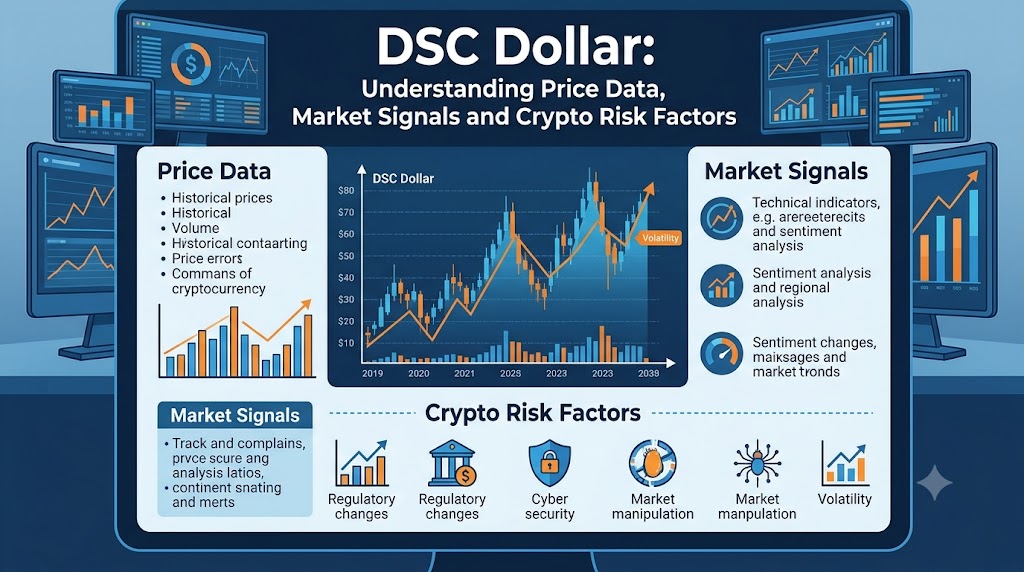
The term dsc dollar is commonly associated with checking the price relationship between a DSC cryptocurrency token and the US dollar. Investors searching for DSC/USD data typically want to understand current market value, price movements, trading activity, and whether the asset has meaningful market support.
Cryptocurrency prices can change quickly because digital assets are influenced by liquidity, exchange listings, market sentiment, token supply, and broader economic conditions. Unlike traditional currencies issued by central banks, crypto assets often depend heavily on community adoption, technology development, and investor confidence.
Platforms such as CoinGecko and CoinMarketCap provide market tracking tools where users can review available price information, historical charts, trading volume, and market capitalisation. However, price data alone does not provide a complete investment picture.
A responsible evaluation requires examining factors such as tokenomics, liquidity depth, wallet distribution, project transparency, and regulatory exposure.
This article explains how to interpret DSC Dollar market information, what signals matter most, and how cryptocurrency investors can avoid common evaluation mistakes.
What Does DSC Dollar Represent in Crypto Markets?
In cryptocurrency terminology, a dollar pairing shows how much one token is worth compared with the US dollar. A DSC/USD chart displays the relationship between the DSC token price and USD valuation.
For example, if a token trades at $0.10, this means one unit of that cryptocurrency is valued at ten cents at that specific market moment.
However, the displayed price is only one part of the market picture.
Important metrics include:
| Metric | Why It Matters |
| Market capitalisation | Shows overall project valuation |
| Trading volume | Indicates market activity and liquidity |
| Circulating supply | Shows available token quantity |
| Maximum supply | Helps assess potential inflation pressure |
| Exchange availability | Determines accessibility for buyers |
A low-priced token is not automatically cheaper than a higher-priced one. Investors often misunderstand price per token without considering total supply.
A cryptocurrency with billions of tokens may have a low individual price but still represent a significant valuation.
How Investors Analyse DSC Price Information
Market tracking websites provide useful information, but interpreting that information requires context.
Price Movement
Short-term price changes can be influenced by:
- Market sentiment
- Exchange activity
- News announcements
- Trading volume changes
- Broader cryptocurrency trends
A sudden increase in price without stronger trading volume may indicate temporary speculation rather than sustainable demand.
Liquidity Assessment
Liquidity determines how easily a token can be bought or sold without significantly affecting its price.
A market with limited liquidity can create challenges:
- Large orders may cause major price movement
- Selling may become difficult during volatility
- Price charts may not represent real market depth
This is particularly important for smaller cryptocurrency projects.
Comparing DSC Market Evaluation With Major Cryptocurrency Assets
Different digital assets have different levels of maturity and market infrastructure.
| Asset Type | Market Characteristics | Investor Consideration |
| Established cryptocurrencies | High liquidity and broad exchange support | Lower market friction |
| Mid-sized tokens | Developing ecosystems and growing adoption | Requires deeper research |
| Smaller tokens such as DSC-type assets | Limited data and higher volatility risk | Greater due diligence required |
The main difference is not simply price. It is the strength of the surrounding ecosystem.
A cryptocurrency supported by active developers, transparent communication, and practical applications may have stronger long-term foundations than an asset driven only by speculation.
Tokenomics: The Foundation Behind Cryptocurrency Value
Tokenomics refers to the economic design of a cryptocurrency.
Key elements include:
Supply Structure
The total number of tokens affects scarcity. Projects with large future unlocks may experience selling pressure when additional supply enters the market.
Distribution
Wallet concentration is another important factor. If a small number of wallets control a large percentage of tokens, market manipulation risks may increase.
Utility
A token’s purpose influences long-term demand. Projects connected to payments, applications, communities, or blockchain services may have different value drivers compared with purely speculative assets.
A practical evaluation of DSC Dollar market data should therefore include more than a price chart.
Risks and Trade-Offs When Tracking DSC Dollar
Cryptocurrency markets provide opportunities but also introduce significant risks.
Volatility Risk
Digital assets can experience large price movements within short periods. Smaller tokens are generally more vulnerable because fewer buyers and sellers participate.
Liquidity Risk
A token may appear valuable based on its listed price, but limited trading activity can make buying or selling difficult.
Regulatory Risk
Cryptocurrency regulation continues developing worldwide. Authorities such as the UK Financial Conduct Authority (FCA) monitor crypto-related activities and provide consumer guidance regarding digital asset risks.
Information Quality Risk
Not all online price information is equally reliable. Investors should verify data through recognised market platforms and official project channels.
Market Impact of Smaller Cryptocurrency Assets
Smaller cryptocurrencies contribute to innovation across blockchain markets by experimenting with new applications and economic models.
However, market participation has changed significantly since the early cryptocurrency period. Investors increasingly examine:
- Developer activity
- Security practices
- Compliance approach
- Real-world utility
- Community sustainability
The growth of institutional digital asset research has also increased demand for transparent market information.
Data Insights: What DSC Price Tracking Can Reveal
| Observation | Possible Interpretation |
| Rising volume with stable price | Growing market participation |
| Price increase without volume support | Possible speculative activity |
| Declining liquidity | Higher trading difficulty |
| Increased exchange availability | Improved accessibility |
One important insight is that price charts alone can hide market weakness. A token may rise temporarily while underlying liquidity remains limited.
Another consideration is that exchange listings can influence visibility significantly. A project receiving additional trading access may experience increased attention, but listing alone does not guarantee long-term success.
The Future of DSC Dollar in 2027
By 2027, cryptocurrency evaluation is likely to become more data-driven. Investors are expected to rely less on price speculation and more on measurable indicators such as network activity, transparency, and regulatory alignment.
Several trends may influence smaller crypto assets:
Improved Regulatory Standards
Regulatory frameworks in regions including the UK and European Union are likely to place greater emphasis on consumer protection, disclosure requirements, and operational standards.
Better Market Analytics
Advanced blockchain analytics tools may provide deeper insights into wallet behaviour, liquidity patterns, and transaction activity.
Greater Focus on Utility
Projects without clear use cases may struggle to maintain attention as investors become more selective.
The future of DSC-related assets will depend on whether they develop sustainable ecosystems rather than relying only on market speculation.
Key Takeaways
- DSC Dollar searches generally relate to monitoring DSC cryptocurrency value against the US dollar.
- Price alone does not determine whether a token has strong market potential.
- Liquidity, tokenomics, supply distribution, and utility are essential evaluation factors.
- Smaller cryptocurrencies usually carry higher volatility and market risks.
- Reliable market data sources are important when analysing digital assets.
- Regulatory developments will increasingly influence cryptocurrency markets.
Conclusion
Understanding DSC Dollar requires more than checking a live price chart. Cryptocurrency valuation depends on multiple factors, including liquidity, token economics, market participation, and regulatory conditions.
For investors and researchers, the most valuable approach is combining market data with fundamental analysis. Price movements can provide useful signals, but they do not explain the complete story behind a digital asset.
As cryptocurrency markets mature, transparency and practical utility are likely to become increasingly important. Whether DSC develops meaningful market relevance will depend on ecosystem growth, adoption, and the ability to maintain trust among users and investors.
FAQ
What is DSC Dollar?
DSC Dollar generally refers to tracking the value of a DSC cryptocurrency token against the US dollar. Exact details depend on the specific DSC asset being referenced.
Where can I check DSC/USD price information?
Cryptocurrency tracking platforms such as CoinGecko and CoinMarketCap provide market charts, price history, and trading information when data is available.
Is DSC Dollar a stablecoin?
Not necessarily. The name does not automatically indicate a stablecoin. Investors should verify the specific token’s design and price mechanism.
Why does DSC price change frequently?
Crypto prices change due to supply and demand, trading activity, market sentiment, liquidity, and broader digital asset trends.
What should I check before buying DSC?
Important factors include token supply, exchange availability, liquidity, project documentation, security practices, and regulatory considerations.
Are smaller cryptocurrencies riskier?
Generally, smaller digital assets can experience greater volatility because they often have lower liquidity and less established market infrastructure.
Methodology
This article was prepared using publicly available cryptocurrency market concepts, regulatory guidance, and established digital asset research practices. Information about cryptocurrency evaluation methods was assessed through recognised industry sources and public market documentation.
Limitations include the possibility that multiple cryptocurrency projects may use similar DSC naming. Specific price data should always be verified through current market platforms before making decisions.
This article was drafted with AI assistance and requires human editorial review before publication. All market claims, references, and regulatory statements should be independently verified.
References
Financial Conduct Authority. (2023). Cryptoasset consumer research and guidance.
CoinGecko. (2024). Cryptocurrency market data and digital asset tracking methodology.
CoinMarketCap. (2024). Cryptocurrency price tracking and market capitalisation data.
Bank for International Settlements. (2023). Annual Economic Report: Digital assets and financial innovation.