Many people search for cuddlefish, believing it refers to a unique sea creature. In reality, the correct name is cuttlefish. Despite the spelling difference, the search reflects genuine curiosity about one of the world’s most remarkable marine animals.
Cuttlefish belong to the class Cephalopoda, making them close relatives of octopuses and squid. They inhabit coastal waters across Europe, Africa, Asia, and Australia, where they rely on extraordinary camouflage and intelligence to hunt and avoid predators.
Scientists continue studying these animals because they demonstrate complex behaviours once thought to exist only in vertebrates. Their ability to instantly alter skin colour, recognise patterns, and solve simple problems has made them important subjects in marine biology.
What Is a Cuttlefish?
Although commonly searched as cuddlefish, the animal’s scientific identity is well established. More than 120 species of cuttlefish have been identified worldwide.
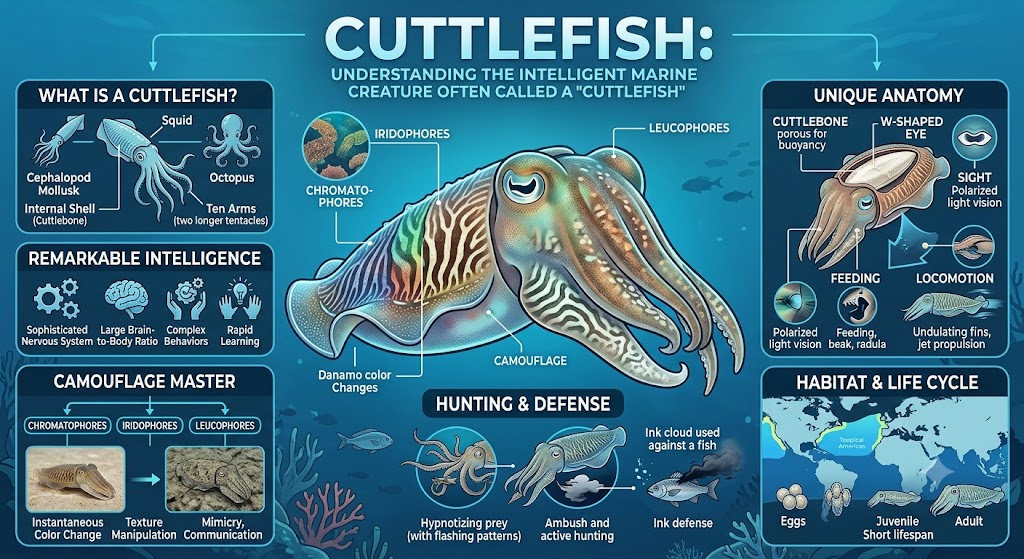
Unlike fish, they are molluscs with soft bodies protected internally by a hard structure called the cuttlebone, which helps regulate buoyancy.
Key Characteristics
| Feature | Description |
| Classification | Marine cephalopod mollusc |
| Closest relatives | Squid and octopus |
| Habitat | Coastal and shallow marine waters |
| Lifespan | 1–2 years for most species |
| Defence | Camouflage, ink release, rapid escape |
Masters of Instant Camouflage
The feature that makes cuttlefish famous is their extraordinary ability to change colour almost instantly.
Their skin contains specialised pigment cells known as chromatophores, supported by iridophores and leucophores that reflect and scatter light. Working together, these cells allow the animal to create complex colours, stripes, and moving patterns within fractions of a second.
Camouflage serves several purposes:
- Avoiding predators
- Hunting prey
- Communicating with other cuttlefish
- Courtship displays
- Territorial behaviour
Unlike a chameleon, which changes colour primarily through hormones, cuttlefish control these changes directly through their nervous system, making the process significantly faster.
Intelligence Beyond Expectations
Marine biologists consider cuttlefish among the smartest invertebrates.
Laboratory studies have shown they can:
- Learn from experience
- Recognise visual patterns
- Navigate unfamiliar environments
- Adapt hunting techniques
- Remember previous food locations
Their relatively large brain, compared with body size, supports these advanced behaviours.
Researchers have even observed cuttlefish delaying immediate rewards to obtain better food later—a behaviour associated with self-control and higher cognitive function.
Hunting and Feeding Behaviour
Cuttlefish are active predators.
They mainly feed on:
- Small fish
- Crabs
- Shrimp
- Marine worms
- Small molluscs
Instead of chasing prey over long distances, they rely on patience and camouflage. Remaining nearly invisible, they slowly approach before extending two specialised feeding tentacles with remarkable speed.
This ambush strategy conserves energy while increasing hunting success.
Ecological Importance
Cuttlefish play an essential role in marine ecosystems.
As predators, they help regulate populations of smaller marine animals. At the same time, they serve as prey for dolphins, sharks, seals, and larger fish.
| Ecological Role | Importance |
| Predator | Controls populations of crustaceans and fish |
| Prey | Supports larger marine predators |
| Research species | Advances neuroscience and camouflage studies |
| Economic value | Supports sustainable fisheries in several countries |
Threats Facing Cuttlefish
Although many species remain widespread, cuttlefish face growing environmental pressures.
Key threats include:
- Climate change
- Ocean warming
- Habitat degradation
- Coastal pollution
- Unsustainable fishing practices
Because many species complete their life cycle within one or two years, changes in breeding habitats can quickly affect local populations.
Marine conservation programmes increasingly monitor cephalopod populations as indicators of changing ocean conditions.
The Future of Cuddlefish in 2027
By 2027, research into cuttlefish is expected to expand further, particularly in biomimicry and robotics.
Scientists are already studying chromatophores to develop adaptive materials capable of changing colour for medical devices, military camouflage, and underwater technology.
Artificial intelligence combined with marine imaging may also improve monitoring of wild populations without disturbing natural behaviour.
However, the future of many species will depend on healthier coastal ecosystems and continued conservation efforts to protect breeding grounds.
Key Takeaways
- “Cuddlefish” is a common misspelling of cuttlefish.
- Cuttlefish belong to the cephalopod family alongside squid and octopuses.
- Chromatophores allow them to change colour within milliseconds.
- They display advanced intelligence and problem-solving abilities.
- Healthy marine ecosystems remain essential for their survival.
- Scientific research continues revealing new insights into their remarkable biology.
Conclusion
Whether someone searches for cuddlefish or cuttlefish, they are discovering one of the ocean’s most extraordinary creatures. These intelligent molluscs combine rapid camouflage, sophisticated communication, and advanced hunting strategies unlike almost any other marine animal.
Beyond their biological fascination, cuttlefish contribute significantly to marine ecosystems while inspiring innovations in science, engineering, and material design. Their colour-changing skin has already influenced research into adaptive technologies, and ongoing studies continue to reshape our understanding of animal intelligence.
Protecting coastal habitats will ensure future generations can continue learning from these remarkable cephalopods. Their story demonstrates how even seemingly unfamiliar marine species can transform scientific knowledge and deepen our appreciation of ocean biodiversity.
Frequently Asked Questions
Is cuddlefish the correct name?
No. “Cuddlefish” is a common misspelling. The correct name is cuttlefish.
Are cuttlefish fish?
No. They are marine molluscs belonging to the cephalopod family, closely related to octopuses and squid.
Why do cuttlefish change colour?
They use chromatophores and other specialised skin cells to camouflage themselves, communicate, hunt, and attract mates.
Are cuttlefish intelligent?
Yes. Studies have shown they possess advanced learning abilities, memory, and problem-solving skills uncommon among invertebrates.
Where do cuttlefish live?
They inhabit temperate and tropical coastal waters throughout Europe, Africa, Asia, and Australia.
Methodology
This article was prepared using established marine biology research, cephalopod studies, and information from recognised scientific organisations. Biological characteristics and behavioural descriptions were based on current scientific understanding. Readers should note that ongoing marine research continues to improve knowledge of cuttlefish behaviour and ecology.
Editorial Disclosure: This article was drafted with AI assistance and should be reviewed by a human editor, with all scientific references and factual claims verified before publication.