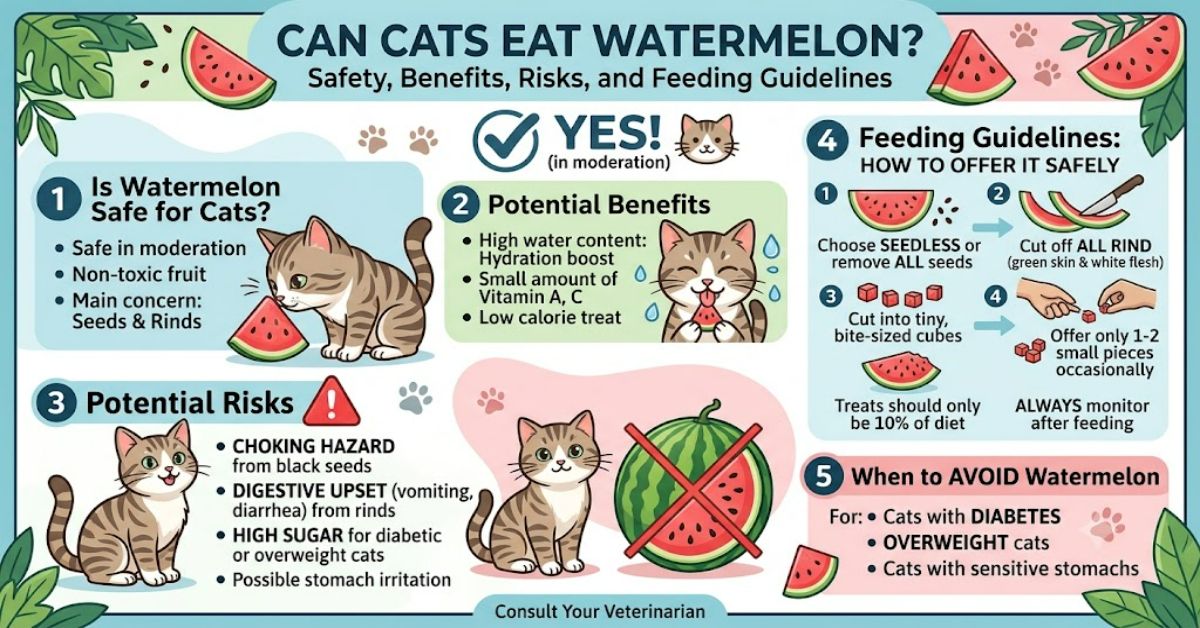
Many pet owners wonder, can cats eat watermelon when their feline companion shows interest in a sweet slice during warm weather. The answer is yes, healthy cats can safely eat a small amount of raw, seedless watermelon flesh as an occasional treat. However, watermelon should never replace a balanced cat diet because cats are obligate carnivores and rely on nutrients found in animal-based foods.
Unlike humans, cats do not need fruit for vitamins, hydration, or fibre. Their digestive systems are designed primarily for processing meat, meaning most plant-based foods provide limited nutritional benefit.
Watermelon is mostly water, making it potentially refreshing during hot days, but careless feeding can create problems. Seeds should be removed because they contain compounds that may be harmful if consumed in large amounts, while the tough rind can be difficult to digest and may increase the risk of gastrointestinal blockage.
Understanding how cats process food helps owners make safer decisions. A small cube of prepared watermelon may be harmless for some cats, but every pet has different dietary needs, allergies, and health conditions.
Why Some Cats Show Interest in Watermelon
Cats are not naturally attracted to sweet flavours because they lack functional taste receptors for sweetness. Unlike humans, they do not experience sugar in the same way.
Their interest in watermelon often comes from:
- The fruit’s high moisture content
- Curiosity about new smells and textures
- Attraction to human food habits
- Cooling sensations from chilled fruit
A cat licking watermelon does not necessarily mean it needs the fruit. Often, curiosity drives the behaviour rather than nutritional demand.
Nutritional Profile of Watermelon for Cats
Watermelon contains several nutrients beneficial to humans, but cats have different dietary requirements.
| Nutrient | Role in Humans | Importance for Cats |
| Water | Supports hydration | Useful in small amounts |
| Vitamin A compounds | Supports vision and immunity | Cats require animal-derived vitamin A |
| Fibre | Helps digestion | Limited need compared with humans |
| Natural sugars | Provides energy | Not required in a feline diet |
The main advantage of watermelon for cats is hydration rather than nutrition. Since the fruit contains a high percentage of water, it may contribute a small amount of additional fluid intake.
However, a cat’s primary hydration source should come from fresh water and moisture-rich cat food designed for feline biology.
How to Safely Prepare Watermelon for Cats
If an owner decides to offer watermelon, preparation is the most important safety step.
Safe Preparation Method
Follow these steps:
- Wash the watermelon thoroughly.
- Remove all seeds.
- Remove the outer rind completely.
- Cut the flesh into small bite-sized pieces.
- Offer only a small amount.
The safest option is plain raw watermelon without added ingredients. Cats should never receive watermelon mixed with sugar, syrup, artificial sweeteners, or dairy products.
Watermelon Risks for Cats
Although small amounts of watermelon are generally safe for healthy cats, there are several risks to consider.
| Risk | Why It Matters |
| Seeds | May contain harmful compounds and create choking risks |
| Rind | Difficult to digest and may cause intestinal issues |
| Excess quantity | Can contribute to stomach upset |
| Sugar content | Too much may affect cats with certain health conditions |
A common mistake is assuming that because a food is healthy for humans, it is automatically suitable for pets. Cats have specialised nutritional needs that differ significantly from people.
Comparison: Watermelon and Other Common Cat Treats
| Food | Cat Safety | Nutritional Value | Feeding Advice |
| Watermelon flesh | Generally safe | Low feline nutritional benefit | Occasional small pieces |
| Cooked chicken | Safe | High-quality animal protein | Suitable regular treat |
| Tuna | Safe in moderation | Protein source but not complete alone | Avoid excessive feeding |
| Grapes | Unsafe | No nutritional need | Avoid completely |
This comparison highlights an important point: treats should support, not replace, a complete feline diet.
Practical Feeding Guidelines
Veterinary professionals generally recommend that treats make up only a small proportion of a cat’s daily calorie intake.
Before introducing watermelon, owners should consider:
- The cat’s age
- Existing health conditions
- Weight management needs
- Digestive sensitivity
Cats with diabetes, obesity, or gastrointestinal problems may require additional caution because even natural sugars can affect dietary management.
A useful approach is introducing a tiny piece first and monitoring for signs such as vomiting, diarrhoea, or changes in appetite.
Three Important Insights About Cats and Fruit
1. Hydration Is the Main Benefit, Not Nutrition
Many discussions focus on watermelon’s vitamins, but hydration is the more relevant benefit for cats. The fruit’s high water content is useful only as a minor supplement.
2. Individual Response Matters More Than General Safety
A food may be considered safe overall but still cause digestive problems in individual cats. Pet owners should monitor reactions rather than assuming every cat will tolerate the same treat.
3. Treat Choices Reflect Changing Pet Culture
Modern pet owners increasingly look for natural foods and enrichment options. However, “natural” does not always mean appropriate for every species. Species-specific nutrition remains the priority.
The Future of Can Cats Eat Watermelon in 2027
By 2027, pet nutrition is expected to become increasingly personalised. Advances in veterinary research, personalised feeding plans, and improved pet health monitoring may influence how owners select treats.
The pet food industry is also expanding its focus on functional ingredients, although experts continue to emphasise that cats require diets based around animal proteins and essential nutrients.
Future discussions around feline treats are likely to focus less on whether individual foods are trendy and more on whether they support long-term health outcomes.
Watermelon is unlikely to become a major part of feline nutrition, but it may continue as an occasional enrichment food for cats that enjoy it safely.
Key Takeaways
- Cats can eat small amounts of seedless watermelon flesh.
- Watermelon should only be an occasional treat.
- Seeds and rind must always be removed.
- Cats gain limited nutritional value from fruit.
- A balanced meat-based diet remains essential.
- Individual cats may react differently to new foods.
Conclusion
Watermelon can be a safe occasional treat for many healthy cats when prepared correctly. Removing seeds and rind, limiting portion size, and observing the cat’s reaction are essential steps for responsible feeding.
Although the fruit provides hydration, it does not offer the nutrients cats need for survival. As obligate carnivores, cats depend on carefully balanced diets containing animal-based proteins and essential compounds.
The best approach is to view watermelon as a small enrichment opportunity rather than a dietary requirement. A tiny piece shared safely may be enjoyable for some cats, but it should always remain secondary to proper feline nutrition and veterinary guidance.
Frequently Asked Questions
Can cats eat watermelon seeds?
No. Cats should not eat watermelon seeds. Seeds may create choking risks and contain compounds that can be harmful if consumed.
Can kittens eat watermelon?
Kittens have developing digestive systems and should mainly eat specially formulated kitten food. Watermelon is generally unnecessary for young cats.
How much watermelon can a cat eat?
A few small pieces are usually enough. Treats should remain a very small part of a cat’s overall diet.
Can cats eat watermelon rind?
No. The rind is tough and difficult for cats to digest, increasing the risk of stomach problems.
Is watermelon good for cats?
Watermelon can provide extra moisture but offers little nutritional benefit because cats require animal-based nutrients.
Methodology
This article was prepared using veterinary nutrition guidance, animal health resources, and established research on feline dietary requirements. Information was reviewed with attention to feline biology, digestive systems, and common pet safety recommendations.
The article does not suggest watermelon as a nutritional requirement for cats. Individual health conditions vary, so veterinary advice remains important for cats with medical concerns.
References (APA Style)
American Society for the Prevention of Cruelty to Animals. (2024). People foods to avoid feeding your pets. ASPCA.
Cornell University College of Veterinary Medicine. (2024). Feline nutrition and dietary requirements. Cornell Feline Health Center.
World Small Animal Veterinary Association. (2023). Global nutrition guidelines for companion animals. WSAVA.
Association of American Feed Control Officials. (2024). Official publication: Pet food standards and regulations. AAFCO.