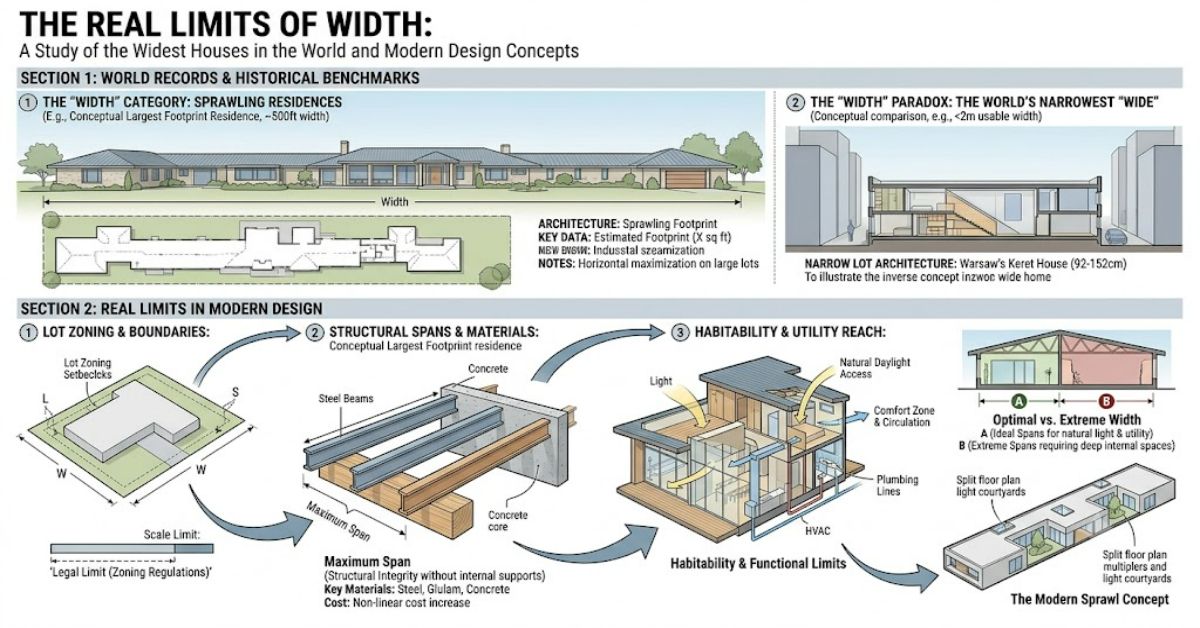
The search for the widest house in the world is less straightforward than it appears. In architecture, “width” is not a standardised global metric in the same way as height or floor area. Instead, it depends on how a building is oriented, how its footprint is measured, and whether continuous span, façade length, or structural breadth is being considered.
In popular discussions, the widest house in the world is often associated with unusually elongated residential structures that stretch across large horizontal distances. One frequently referenced example is a modern rural residence sometimes described as a river-adjacent linear home in the United Kingdom, designed with an extended footprint reaching over 100 metres. However, such claims are rarely governed by a formal certification body like Guinness World Records for residential width specifically.
This ambiguity creates a fascinating architectural grey zone. Unlike skyscrapers, where height is clearly defined, horizontal expansion is influenced by land availability, planning constraints, and design intent. Architects sometimes pursue extreme width not as a record attempt but as a way to integrate buildings into landscapes, preserve sightlines, or distribute living spaces across terrain.
This article breaks down what “widest” really means in residential architecture, explores known contenders, examines engineering constraints, and clarifies why the widest house in the world is ultimately a conceptual rather than absolute title.
How “Width” Is Defined in Residential Architecture
To understand the widest house in the world, it is essential to clarify measurement logic.
Architectural width can be interpreted in three main ways:
- Maximum façade span: the longest continuous external wall line
- Structural footprint width: the widest point of the building’s base
- Perceived width across site: how far the building extends horizontally across land
These distinctions matter because many modern homes are designed in segmented forms rather than rigid rectangles.
Comparison of Width Measurement Methods
| Measurement Type | Definition | Reliability | Common Usage |
| Façade Span | Longest continuous exterior wall | High | Architectural reporting |
| Structural Footprint | Total base width at widest point | Medium | Planning documents |
| Perceived Site Width | Visual spread across landscape | Low | Media descriptions |
This inconsistency is why claims about the widest house in the world often vary between sources.
Notable Examples of Extremely Wide Houses
Several residential projects are frequently referenced in discussions about extreme horizontal scale. While none are officially certified as the definitive widest house in the world, they illustrate the design category.
One commonly cited example is a long, low-profile rural residence in the United Kingdom, often described in architectural commentary as extending across a river-adjacent landscape with a highly linear footprint. Designed by Tonkin Liu and completed in the early 2010s, it reflects a trend toward landscape-integrated housing rather than vertical expansion.
Other global examples include:
- Linear desert homes in the United States Southwest
- Scandinavian “ribbon houses” designed for thermal efficiency
- Japanese machiya-inspired elongated dwellings in urban infill sites
Each demonstrates a different motivation behind extreme width, from climate adaptation to land optimisation.
Engineering Constraints Behind Ultra-Wide Homes
Building a structure that could qualify as the widest house in the world introduces significant engineering challenges.
Structural Load Distribution
Long-span homes require:
- Expansion joints to prevent cracking
- Distributed load-bearing supports
- Lightweight roofing systems to reduce stress
Environmental Exposure
Wide homes are more exposed to:
- Wind shear across long façades
- Thermal expansion over long materials
- Differential settlement in foundations
Construction Trade-offs
| Factor | Advantage | Disadvantage |
| Horizontal expansion | Strong landscape integration | High material costs |
| Low-rise profile | Reduced visual impact | Larger land requirement |
| Modular design | Flexible internal layout | Complex structural joins |
These constraints explain why very few homes attempt extreme horizontal scale purely for record-breaking purposes.
Strategic Design Logic: Why Architects Build Wide
The pursuit of structures resembling the widest house in the world is rarely about records. Instead, it reflects deeper architectural strategies.
Landscape Integration
Wide homes often follow natural terrain contours, reducing disruption to ecosystems and preserving sightlines.
Privacy Zoning
Horizontal layouts allow separation of private and public zones without vertical stacking.
Climate Efficiency
In some climates, elongated structures improve cross-ventilation and reduce reliance on mechanical cooling.
Insight 1: Width as Passive Environmental Control
Extended floorplans can reduce energy load by increasing natural airflow paths, particularly in temperate coastal regions.
Insight 2: Land Value Distortion
In rural areas, width-oriented homes often reflect lower land cost per square metre, encouraging horizontal expansion rather than vertical density.
Insight 3: Planning Policy Influence
Local zoning rules frequently discourage height, indirectly promoting wider footprints as a compliance workaround.
Market and Cultural Impact of Wide Residential Design
The concept of the widest house in the world has influenced both architectural culture and property marketing.
Developers sometimes emphasise:
- “Panoramic living experiences”
- “Horizontal luxury layouts”
- “Landscape-first design philosophy”
This reflects a broader cultural shift away from vertical prestige (skyscraper living) toward spatial sprawl and privacy.
However, this trend is uneven. In dense urban centres, width is a luxury constrained by land scarcity, while rural markets increasingly adopt it as a design advantage.
Risks and Trade-offs in Extreme Width Housing
Wide homes introduce practical limitations that often offset their aesthetic appeal.
- Higher heating costs due to elongated thermal envelope
- Increased maintenance complexity across long rooflines
- Reduced structural efficiency compared to compact designs
- Greater land consumption per household unit
These trade-offs explain why the widest house in the world remains a niche architectural category rather than a mainstream housing model.
The Future of Widest House in the World in 2027
By 2027, extreme-width residential architecture is likely to evolve in response to three key pressures:
- Sustainability regulations emphasising reduced land footprint per capita
- Modular construction systems enabling flexible horizontal expansion
- Climate adaptation strategies prioritising passive ventilation and shading
Policy direction in several countries is already shifting toward higher-density living in urban areas, which may reduce incentives for ultra-wide homes. However, in rural and peri-urban zones, wide structures may persist as luxury or lifestyle-driven architecture.
Technological advances in lightweight composites and prefabrication could also make long-span residential design more structurally efficient, potentially redefining what qualifies as the widest house in the world.
Takeaways
- Width in architecture has no single universal definition.
- Extreme-width homes are driven by design logic, not record attempts.
- Engineering constraints limit how far residential structures can expand horizontally.
- Planning policy and land availability strongly influence building width.
- Future construction methods may enable more efficient wide-span homes.
Conclusion
The widest house in the world is ultimately a fluid concept shaped by measurement ambiguity, design philosophy, and regional constraints. Unlike height-based records, horizontal architecture does not lend itself to clear ranking systems, making “widest” more interpretive than absolute.
What emerges instead is a category of architectural thinking that prioritises landscape integration, spatial distribution, and environmental responsiveness. These homes challenge traditional vertical living models, but they also expose the practical limits of extreme horizontal expansion.
As construction technology advances and sustainability standards tighten, the meaning of residential width will likely shift again. Whether future homes stretch further across landscapes or return to compact efficiency will depend on how societies balance space, cost, and environmental responsibility.
Frequently Asked Questions
What is considered the widest house in the world?
There is no officially certified record. Several elongated homes are cited in architectural discussions, but width depends on measurement method.
How is house width measured?
It may be measured by façade length, structural footprint, or total spatial spread across a site.
Are wide houses common in modern architecture?
They are uncommon and usually appear in rural or luxury architectural projects.
Why do architects design very wide houses?
To integrate buildings into landscapes, improve privacy, and enhance natural ventilation.
Do wide houses cost more to build?
Yes, they often require more materials, land, and complex structural engineering.
Is a wider house more energy efficient?
Not always. Efficiency depends on insulation, orientation, and climate design strategies.
Methodology
This analysis was based on architectural literature, publicly documented residential design projects, and general industry commentary on large-span housing typologies. Due to the absence of a globally standardised metric for residential width, interpretations were evaluated across façade span, footprint design, and spatial distribution models.
Limitations include the lack of official certification bodies for “widest house” records and reliance on descriptive architectural reporting rather than standardised datasets. Where conflicting claims exist, the article prioritises design logic and structural feasibility over unverified record assertions.
References
Dezeen. (2023). Residential architecture and landscape integration trends. https://www.dezeen.com
ArchDaily. (2024). Long-span residential design case studies. https://www.archdaily.com
Royal Institute of British Architects (RIBA). (2023). Housing design principles in rural developments. https://www.architecture.com