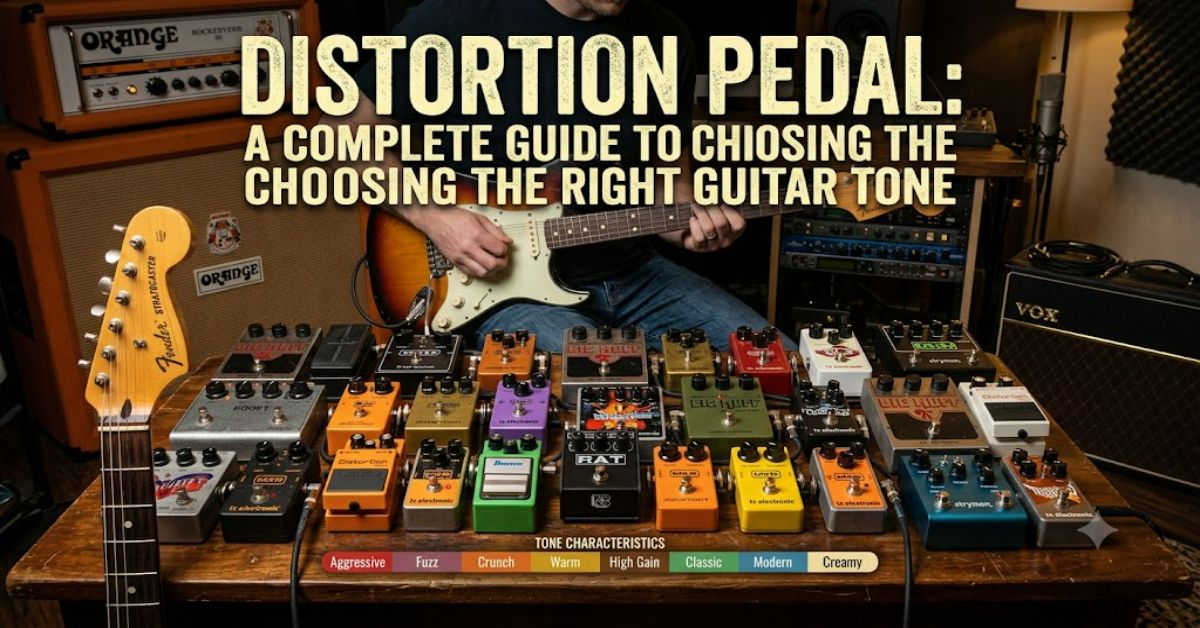
A distortion pedal is one of the most influential effects in modern guitar playing. Whether you enjoy classic rock, punk, hard rock or heavy metal, this small device can dramatically transform your sound by increasing gain and clipping the audio signal. The result is a richer, more saturated tone with greater sustain and harmonic complexity.
Although distortion has existed since the 1960s, today’s pedals offer far greater flexibility than early designs. Modern models allow players to fine-tune gain, bass, mids, treble and output volume, making them suitable for everything from blues-inspired crunch to high-gain metal.
Choosing the right pedal, however, involves more than selecting the model with the highest distortion level. Your amplifier, pickups, playing style and preferred music genre all influence which pedal will sound best. Understanding these factors will help you build a rig that complements your playing rather than fighting against it.
This guide explains how distortion pedals work, compares them with similar effects, highlights key buying considerations and explores future developments shaping guitar effects.
What Is a Distortion Pedal?
A distortion pedal is an effects unit that intentionally alters the guitar’s signal by increasing gain until the waveform becomes clipped. Unlike a clean signal, clipped waves create additional harmonics that produce the familiar gritty and sustained sound associated with rock music.
While every manufacturer uses slightly different circuitry, most pedals contain three fundamental sections:
- Input stage
- Gain or clipping circuit
- Tone-shaping output stage
As the signal passes through the clipping circuit, its peaks are compressed and limited. This creates additional harmonic content, giving notes more body, sustain and perceived power.
How Distortion Creates Its Characteristic Sound
At lower gain levels, only a small amount of clipping occurs, producing a crunchy rhythm tone. As gain increases, clipping becomes more pronounced, creating heavier saturation and longer sustain.
Most pedals include controls such as:
| Control | Purpose |
| Gain | Determines the amount of distortion |
| Level | Controls output volume |
| Tone | Adjusts overall brightness |
| Bass | Shapes low frequencies |
| Mid | Adds body and presence |
| Treble | Controls high-end clarity |
These controls allow players to tailor the pedal to different amplifiers and guitars without replacing their entire setup.
Distortion vs Overdrive vs Fuzz
Although many players use these terms interchangeably, they produce noticeably different sounds.
| Feature | Overdrive | Distortion | Fuzz |
| Gain | Low to Medium | Medium to High | Very High |
| Clipping | Soft | Hard | Extreme |
| Dynamic Response | Excellent | Moderate | Compressed |
| Typical Genres | Blues, Country | Rock, Punk, Metal | Psychedelic, Garage Rock |
| Sustain | Moderate | High | Very High |
Overdrive mimics the natural breakup of a valve amplifier, while distortion creates a more aggressive, compressed sound. Fuzz pushes clipping even further, producing a thick, almost synthesiser-like character.
Choosing the Right Distortion Pedal
Before purchasing a pedal, consider the following factors.
Your Musical Style
Different genres benefit from different gain structures.
- Classic rock often requires moderate gain with warm mids.
- Punk favours tight, punchy distortion.
- Heavy metal typically uses high-gain circuits with excellent note definition.
- Alternative rock often combines distortion with modulation effects for texture.
Your Amplifier
A distortion pedal should complement your amplifier rather than compensate for it.
A clean amplifier usually provides the greatest flexibility because the pedal supplies most of the gain. High-gain amplifiers, on the other hand, may only require a pedal to tighten the low end or add sustain for solos.
Guitar Pickups
Single-coil pickups produce brighter tones with greater clarity, while humbuckers naturally deliver more output and thicker distortion.
Matching the pedal to your pickups often has a greater impact than spending more money on premium equipment.
Essential Features to Consider
When comparing pedals, prioritise these characteristics.
| Feature | Why It Matters |
| Multiple EQ controls | Better tone shaping |
| True bypass | Preserves clean signal |
| Metal enclosure | Greater durability |
| Low noise floor | Cleaner performance at high gain |
| Standard 9V power | Easier compatibility |
| Compact footprint | Saves pedalboard space |
Rather than chasing maximum gain, look for a pedal that remains articulate even with complex chords.
Common Mistakes When Buying
Many first-time buyers assume more distortion automatically means better tone. In reality, excessive gain often reduces clarity and increases unwanted noise.
Other common mistakes include:
- Ignoring amplifier compatibility
- Overlooking power requirements
- Buying based solely on artist endorsements
- Using excessive bass settings
- Forgetting that speaker quality affects tone as much as the pedal itself
A balanced setup usually produces better results than simply increasing distortion.
Practical Tips for Better Tone
Small adjustments can dramatically improve your sound.
- Reduce gain slightly when playing rhythm parts.
- Increase mids instead of bass to cut through a live mix.
- Stack an overdrive before distortion for tighter response.
- Use a quality isolated power supply to minimise electrical noise.
- Experiment with your guitar’s volume control before adjusting pedal settings.
Professional guitarists frequently achieve heavier tones through careful EQ rather than maximum distortion.
The Future of Distortion Pedals in 2027
Digital modelling continues to improve rapidly, allowing compact pedals to emulate dozens of classic analogue circuits with impressive accuracy. At the same time, boutique analogue manufacturers remain popular among players who value unique circuit designs and tactile controls.
Hybrid pedals combining analogue clipping with digital impulse responses are becoming more common, giving guitarists studio-quality cabinet simulation without carrying large amplifiers.
Artificial intelligence may also influence future products by automatically suggesting EQ settings based on the connected guitar, amplifier and musical style. However, analogue distortion is unlikely to disappear, as many musicians continue to prefer its simplicity and distinctive response.
Key Takeaways
- Distortion pedals generate clipped signals that create sustain and harmonic richness.
- The best pedal depends on your guitar, amplifier and playing style.
- High gain does not always produce better tone.
- Good EQ controls are often more valuable than additional distortion.
- Matching pickups and amplifier characteristics improves overall performance.
- Future pedals will likely blend analogue circuitry with digital technology.
Conclusion
A distortion pedal remains one of the most effective ways to shape an electric guitar’s personality. From subtle classic rock crunch to modern high-gain saturation, the right pedal allows musicians to develop a signature sound without replacing their amplifier.
Understanding how clipping works, recognising the differences between distortion, overdrive and fuzz, and choosing features that match your equipment will lead to better purchasing decisions and better performances. Rather than focusing solely on gain, players should prioritise clarity, responsiveness and tonal balance.
As technology advances, guitarists will have more options than ever before, yet the core purpose of a distortion pedal remains unchanged: transforming a clean guitar signal into an expressive, powerful voice that suits the music.
Frequently Asked Questions
What does a distortion pedal do?
A distortion pedal clips the guitar signal to create a heavier, more sustained tone commonly used in rock and metal.
Is distortion the same as overdrive?
No. Overdrive produces softer clipping and responds more naturally to playing dynamics, while distortion delivers higher gain and greater compression.
Can beginners use a distortion pedal?
Yes. Most pedals are straightforward to operate, making them suitable for players at every experience level.
Do distortion pedals work with any amplifier?
Generally yes, although clean amplifiers provide the greatest flexibility for shaping tone.
Is an expensive distortion pedal always better?
Not necessarily. Many affordable pedals offer excellent sound quality. Proper matching with your guitar and amplifier is usually more important than price.
Methodology
This article was prepared by reviewing manufacturer documentation, educational resources on guitar effects, and current industry discussions surrounding analogue and digital guitar pedals. The content focuses on widely accepted principles of audio signal processing rather than brand-specific marketing claims.
Limitations include the subjective nature of tone, which varies according to the player’s technique, guitar, amplifier and speaker configuration.
References
- Electro-Harmonix. (2024). Understanding guitar effects and signal chains.
- Guitar World. (2024). How distortion pedals shape electric guitar tone.
- MusicRadar. (2024). Beginner’s guide to guitar pedals and effects.
- Sweetwater. (2024). Distortion, overdrive and fuzz explained.
Editorial Disclosure
This article was drafted with AI assistance and should be reviewed by a human editor before publication. Verify all references, statistics, internal links and technical claims prior to publishing on RubbleMagazine.co.uk.