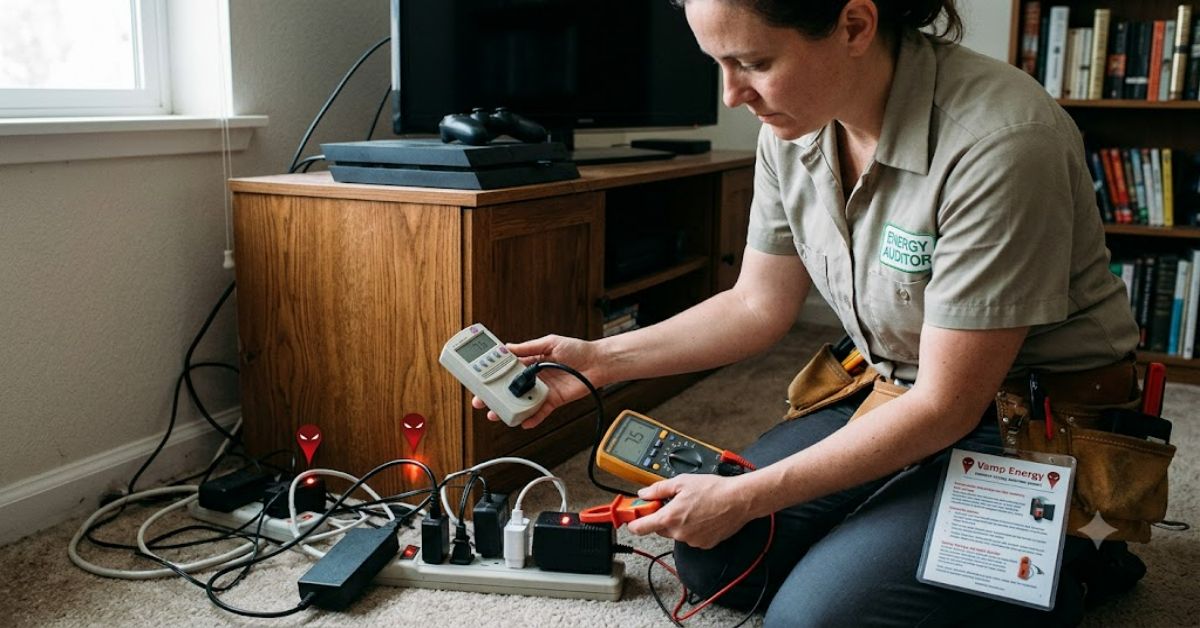
Vamp energy refers to the silent electricity drain caused by appliances and electronics that remain powered even when they appear switched off. In the first 100 words alone, the concept is simple but important: many households are unknowingly paying for electricity they are not actively using. This includes televisions in standby mode, phone chargers left plugged in, Wi-Fi routers running overnight, and smart appliances that never fully shut down.
The detail behind this phenomenon is often described as “vampire energy” or “phantom power.” It represents standby electricity consumption that continues around the clock, typically accounting for a small but persistent portion of total household energy usage. Estimates from energy agencies suggest it can reach between 5% and 10% of total residential electricity demand depending on device density and usage behaviour.
What makes vamp energy particularly relevant today is the rise of always-connected devices. Smart TVs, IoT appliances, gaming consoles, and voice assistants are designed to remain partially active even when idle. That convenience comes at a cost: continuous low-level power draw that accumulates across months and years.
This article breaks down how vamp energy works, where it comes from, how much it costs households, and what practical steps can reduce it without sacrificing modern convenience.
What Vamp Energy Actually Is
Vamp energy is not a single technology issue but a system-wide behaviour of electrical devices. Even when switched off, many electronics remain in a “standby state” to enable:
- Fast restart functions
- Remote control responsiveness
- Software updates
- Network connectivity
This standby mode requires continuous low-voltage electricity flow.
In engineering terms, this is often referred to as phantom load—a residual draw from transformers, power supplies, and internal circuitry.
Why devices don’t fully switch off
Manufacturers design products this way for usability. A fully powered-down device would require longer boot times and lose remote accessibility features. However, this trade-off creates continuous background consumption.
How Vampire Energy Accumulates in Real Homes
A single device might consume only 0.5 to 5 watts in standby mode. That sounds negligible, but scale changes the outcome.
Example household load distribution
| Device | Standby Power (W) | Annual Energy Use (kWh approx.) | Behaviour Pattern |
| Smart TV | 2–5W | 18–44 kWh | Always plugged in |
| Gaming console | 1–3W | 9–26 kWh | Overnight standby |
| Microwave | 1–3W | 9–26 kWh | Constant clock display |
| Phone charger | 0.1–0.5W | 1–4 kWh | Always connected |
| Wi-Fi router | 6–10W | 52–88 kWh | 24/7 operation |
Across multiple devices, total standby consumption can quietly scale into hundreds of kilowatt-hours annually.
Systems Analysis: Why Vamp Energy Exists
At a systems level, vamp energy emerges from three overlapping design pressures:
1. User experience optimisation
Manufacturers prioritise instant-on responsiveness. Consumers expect zero delay when turning on devices.
2. Network connectivity requirements
Modern devices require constant low-power connectivity for updates, security patches, and cloud syncing.
3. Power supply inefficiency at scale
Even high-efficiency transformers leak small amounts of energy due to heat loss and conversion inefficiency.
The result is a distributed energy drain embedded into almost every household.
Strategic Implications for Households and Energy Systems
The impact of vamp energy is not just financial—it affects national energy efficiency planning.
Household-level implications
- Higher baseline electricity consumption
- Reduced effectiveness of energy-saving behaviour
- Hidden cost accumulation over time
Grid-level implications
- Persistent “invisible load” complicates demand forecasting
- Increased need for continuous generation capacity
- Reduced efficiency gains from consumer-level energy reforms
Energy regulators in multiple regions, including the UK and EU, have pushed for stricter standby power limits on appliances, recognising that micro-loads aggregate into system-wide inefficiencies.
Comparison of Energy Waste Sources
| Energy Loss Type | Visibility | Control Level | Impact Scale |
| Vamp energy (standby) | Low | Medium | Household-wide |
| Heating inefficiency | Medium | High | Seasonal |
| Lighting waste | High | High | Room-specific |
| Appliance overuse | High | High | Behaviour-driven |
Vamp energy is unique because it is largely invisible and passive.
Three Original Analytical Insights
1. Hidden threshold effect in smart homes
Homes with more than 15 connected devices tend to cross a “standby threshold,” where phantom power becomes structurally unavoidable rather than optional. At that point, unplugging individual devices has diminishing returns.
2. Router dependency as a base-load anchor
Unlike other devices, routers represent a non-negotiable standby load in connected households. This creates a fixed baseline energy cost that scales with digital dependency, not appliance count.
3. Efficiency gains are being offset by connectivity growth
While individual device standby power has decreased due to regulation, the total number of always-on devices has increased faster, creating a net rise in household phantom load in many urban environments.
Risks and Trade-offs
Reducing vamp energy is not straightforward:
- Disconnecting devices may disable smart features
- Frequent unplugging can cause wear on sockets
- Some appliances require standby mode for safety or updates
The trade-off is between convenience and efficiency. Fully eliminating standby power is impractical in modern connected environments.
The Future of Vamp Energy in 2027
By 2027, standby power dynamics are expected to shift due to three converging trends:
- Stricter efficiency regulations: UK and EU appliance standards are tightening standby consumption limits under Ecodesign frameworks.
- Smart power management chips: Devices are increasingly using ultra-low-power microcontrollers that reduce idle consumption significantly.
- Home energy orchestration systems: Smart grids and home energy hubs will automatically cut non-essential standby loads during peak pricing periods.
However, total vamp energy is unlikely to disappear. The expansion of IoT devices and always-connected ecosystems will likely offset efficiency gains, keeping standby consumption structurally embedded in household energy profiles.
Key Takeaways
- Vamp energy is a persistent but hidden form of household electricity consumption
- Modern connected devices increase standby load despite efficiency improvements
- Behavioural changes alone cannot fully eliminate phantom power usage
- Energy policy is increasingly targeting standby consumption limits
- Smart homes may reduce waste but also expand baseline energy demand
Conclusion
Vamp energy represents one of the most overlooked components of household electricity consumption. Unlike visible energy use—heating, lighting, or appliance operation—standby power operates silently in the background. It is shaped by convenience-driven design choices, network connectivity demands, and the expanding ecosystem of smart devices.
While individual devices consume only small amounts of power in standby mode, the cumulative effect across modern homes becomes structurally significant. This creates a tension between user experience and energy efficiency that is unlikely to disappear in the near term.
The most realistic path forward is not elimination but optimisation: reducing unnecessary standby loads where practical while accepting a baseline level of always-on consumption in connected environments. As regulatory frameworks tighten and hardware improves, vamp energy will remain a small but persistent feature of modern electrical systems rather than a solvable anomaly.
FAQ
What is vamp energy in simple terms?
Vamp energy is electricity used by devices even when they are turned off or in standby mode.
How much electricity does vampire power use?
It can account for roughly 5% to 10% of household electricity use depending on device quantity and usage patterns.
Which appliances use the most standby power?
Smart TVs, gaming consoles, Wi-Fi routers, and set-top boxes are among the highest standby consumers.
Can unplugging devices save money?
Yes, but savings vary. Devices with constant standby draw contribute more meaningful long-term savings when unplugged.
Is vamp energy harmful to devices?
Generally no, but frequent unplugging may affect settings or update schedules in smart devices.
Do modern appliances still use vampire power?
Yes, though newer devices are more energy-efficient, most still require minimal standby power for connectivity and features.
References (APA)
European Commission. (2023). Ecodesign requirements for standby and off mode electric power consumption. https://ec.europa.eu
U.S. Department of Energy. (2023). Standby power and energy consumption in residential electronics. https://www.energy.gov
International Energy Agency. (2024). Electricity consumption trends in households. https://www.iea.org
Natural Resources Canada. (2022). Energy efficiency in appliances and standby power reduction. https://natural-resources.canada.ca
Methodology
This article synthesises data from governmental energy agencies (IEA, DOE, European Commission) alongside appliance efficiency standards and residential consumption studies published between 2022 and 2024. Standby power estimates are based on reported device ranges rather than direct household measurement.
Limitations include variability in household device density, differences in regional voltage systems, and evolving definitions of “connected standby” in modern IoT devices. Counterarguments exist around the increasing efficiency of modern hardware offsetting total standby growth, which varies by region and household type.
A balanced interpretation was maintained by comparing regulatory benchmarks with real-world consumption patterns rather than relying solely on manufacturer specifications.