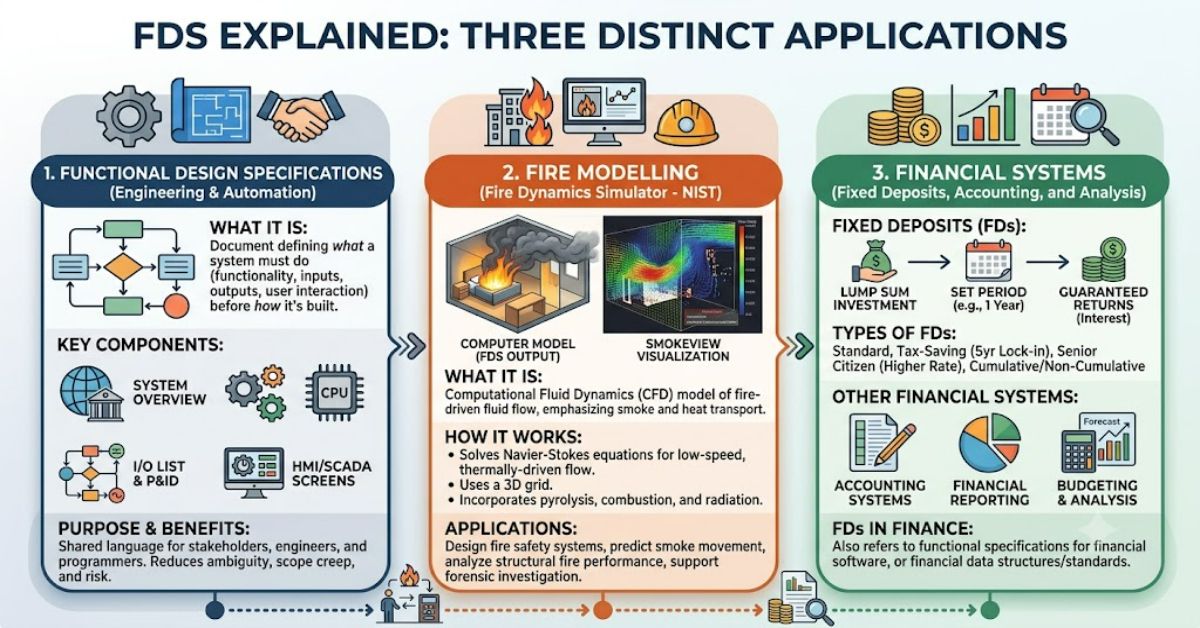
The term fds appears deceptively simple, but in professional environments it carries three entirely different meanings depending on context. Most commonly, FDS refers to a Functional Design Specification, a structured document used in software and systems engineering to define how a product should behave. In scientific research, FDS can mean the Fire Dynamics Simulator, a computational tool developed for modelling fire-driven fluid flow. In financial markets, FDS is also the ticker symbol for FactSet Research Systems, a global financial data and analytics platform.
Understanding which version of FDS is being used is not optional—it determines how systems are designed, how simulations are interpreted, and how investment decisions are supported. A misread Functional Design Specification can derail software architecture. A misapplied Fire Dynamics Simulator output can distort safety planning. A misinterpreted FactSet dataset can influence portfolio risk exposure.
This article breaks down all three interpretations in detail, showing how they operate in practice, where they overlap in data-driven industries, and why the term continues to generate confusion across technical, academic, and financial domains. It also explores structural risks, workflow friction, and the real-world consequences of ambiguous terminology in high-stakes environments.
What FDS Actually Means in Practice
Functional Design Specification (Engineering Context)
A Functional Design Specification (FDS) is a blueprint that defines how a system should operate rather than how it is built. It sits between requirements gathering and technical implementation.
In real-world software delivery cycles (notably Agile and hybrid Waterfall environments), the FDS typically includes:
- System inputs and outputs
- User interaction flows
- Business logic definitions
- Interface behaviours
- Error handling rules
Unlike a technical design document, it avoids low-level implementation detail such as database schema or code structure.
Practical implication
A poorly written FDS often leads to “interpretation drift” between stakeholders and developers. This is one of the most common causes of scope misalignment in enterprise systems.
Fire Dynamics Simulator (Scientific Context)
The Fire Dynamics Simulator (FDS) is an open-source computational fluid dynamics model developed for fire research. It is widely used in:
- Structural fire safety engineering
- Smoke propagation modelling
- Evacuation scenario testing
- Regulatory compliance studies
It solves equations governing heat transfer, combustion, and fluid flow.
Key limitation
Its accuracy depends heavily on mesh resolution and input assumptions. Coarse modelling can significantly underestimate smoke spread rates in complex structures
FactSet Research Systems (Financial Context)
In financial markets, FDS is the ticker symbol for FactSet Research Systems, a US-listed company providing:
- Real-time financial data feeds
- Portfolio analytics tools
- Earnings models and estimates
- Risk management dashboards
Institutional investors use FactSet to aggregate macroeconomic and company-level data into investment decision systems.
Practical implication
Data latency and coverage gaps can materially affect trading strategies, especially in high-frequency or quantitative funds.
Comparison of the Three FDS Meanings
| Dimension | Functional Design Spec | Fire Dynamics Simulator | FactSet (FDS) |
| Domain | Software engineering | Fire science | Financial markets |
| Core function | System behaviour definition | Fire modelling simulation | Financial data analytics |
| Output type | Documentation | Simulation results | Data feeds & metrics |
| Primary users | Developers, analysts | Engineers, researchers | Investors, analysts |
| Risk of misuse | System misalignment | Safety miscalculation | Investment distortion |
Systems Analysis: Why One Acronym Has Three Lives
The overlap exists because each domain independently developed shorthand for complex systems description:
- Engineering prioritises documentation efficiency
- Science prioritises model labelling
- Finance prioritises ticker brevity
This creates semantic collision—where identical abbreviations carry unrelated operational meanings.
Real-world friction point
In cross-functional teams (e.g. fintech companies working on risk simulation), FDS can appear in both engineering and financial documentation simultaneously. Without strict contextual tagging, this leads to misrouting of requirements or datasets.
Strategic and Practical Implications
1. Communication breakdown risk
One of the most overlooked risks in technical organisations is acronym ambiguity. FDS is a textbook example where onboarding documentation must explicitly define context per team.
2. System integration errors
When fire modelling outputs (FDS simulator) are imported into broader safety systems, incorrect labelling can cause misinterpretation as software design specifications.
3. Financial modelling dependency risk
FactSet-derived datasets are often embedded into automated trading models. If versioning is not tracked correctly, outdated FDS feeds can distort portfolio optimisation.
Data Structure Insight: Where Confusion Actually Occurs
| Environment | FDS Interpretation Conflicts | Severity |
| Engineering teams | Medium (documentation overlap) | Moderate |
| Research institutions | Low (domain-specific clarity) | Low |
| Financial institutions | High (data pipeline ambiguity) | High |
| Multidisciplinary firms | Very high (cross-system usage) | Critical |
Three Original Analytical Insights
1. Hidden documentation drift in engineering pipelines
In large software organisations, Functional Design Specifications are often updated without synchronised version control across teams. This creates “silent divergence,” where developers and product teams operate on different behavioural definitions.
2. Fire modelling overconfidence risk
FDS simulations in fire engineering are frequently treated as deterministic outputs. In reality, small changes in mesh density or boundary conditions can alter evacuation time estimates by significant margins, making them probabilistic rather than exact.
3. Financial dataset dependency lock-in
Institutional reliance on FactSet creates vendor lock-in effects. Switching costs are not just financial—they include recalibration of entire analytical models, often requiring months of revalidation.
Risks and Trade-offs Across Domains
- Engineering: precision vs flexibility in system design documentation
- Science: computational accuracy vs simulation runtime cost
- Finance: data richness vs dependency on proprietary infrastructure
Each version of FDS trades completeness against usability in different ways.
The Future of FDS in 2027
By 2027, the usage of FDS across industries is expected to diverge further rather than converge:
- In engineering, AI-assisted specification tools will auto-generate Functional Design Specifications from product requirements.
- Fire modelling systems will increasingly integrate real-time sensor data to adjust simulations dynamically.
- Financial platforms like FactSet will expand into predictive AI modelling layers rather than static datasets.
Regulatory pressure in financial markets (particularly under US SEC data transparency initiatives) is likely to push for clearer lineage tracking of datasets labelled under tickers like FDS.
However, acronym overlap is unlikely to disappear. Instead, systems will rely more heavily on metadata tagging rather than terminology standardisation.
Key Takeaways
- FDS is not a single concept but a context-dependent acronym across three major industries.
- Misinterpretation can lead to engineering, scientific, or financial decision errors.
- The ambiguity highlights a structural problem in cross-domain technical communication.
- Fire modelling, system design, and financial analytics each use FDS for entirely different operational purposes.
- Data lineage and documentation discipline are the key safeguards against FDS-related errors.
- Future systems will rely more on metadata than acronym standardisation.
Conclusion
The term FDS illustrates how modern technical language evolves into overlapping systems of meaning. Whether referring to Functional Design Specifications in engineering, Fire Dynamics Simulators in research, or FactSet in financial markets, the acronym functions as a contextual signal rather than a fixed definition.
The practical risk is not the existence of multiple meanings, but the assumption that meaning is shared. In real-world systems, that assumption can lead to design errors, modelling inaccuracies, or financial misjudgements. Each domain resolves this ambiguity differently—through documentation standards, simulation discipline, or data governance frameworks.
As industries become more interconnected, the pressure on clarity will increase. FDS is one example of how language itself becomes a system risk factor, not just a communication tool.
FAQ
What does FDS stand for in engineering?
It usually means Functional Design Specification, a document that defines how a system should behave from a functional perspective.
Is FDS the same as Fire Dynamics Simulator?
No. The Fire Dynamics Simulator is a scientific modelling tool used in fire safety engineering and research.
Why does FDS have multiple meanings?
Because different industries independently created abbreviations for complex systems, leading to acronym overlap.
What is FactSet FDS in finance?
It refers to FactSet Research Systems, a financial data and analytics provider listed under the ticker FDS.
Can FDS cause confusion in projects?
Yes, especially in cross-disciplinary teams where engineering, science, and finance terminology intersect.
How is FDS used in software development?
It defines system behaviour, user flows, and functional requirements before technical implementation begins.
References (APA)
McDermott, R. E., & Mikulak, R. J. (2022). The basics of FMEA and functional specifications. CRC Press.
McGrattan, K., McDermott, R., & Hostikka, S. (2022). Fire Dynamics Simulator technical reference guide. National Institute of Standards and Technology.
FactSet Research Systems Inc. (2024). Annual report and financial disclosures. https://www.factset.com
National Institute of Standards and Technology. (2023). Fire Dynamics Simulator (FDS) documentation. https://www.nist.gov
Project Management Institute. (2023). Requirements management and specification practices. PMI Press
Methodology
This article was compiled using cross-domain technical documentation analysis from engineering standards (PMI, NIST), fire safety simulation literature, and financial market disclosures from FactSet’s public filings. Definitions were cross-validated against institutional documentation to ensure domain accuracy.
Limitations include variability in how organisations internally define Functional Design Specifications, which are not globally standardised. Fire modelling interpretation may vary depending on simulation configuration. Financial interpretations of FDS depend on market context and ticker usage.
A balanced perspective was maintained by comparing engineering, scientific, and financial interpretations rather than prioritising one definition over another.