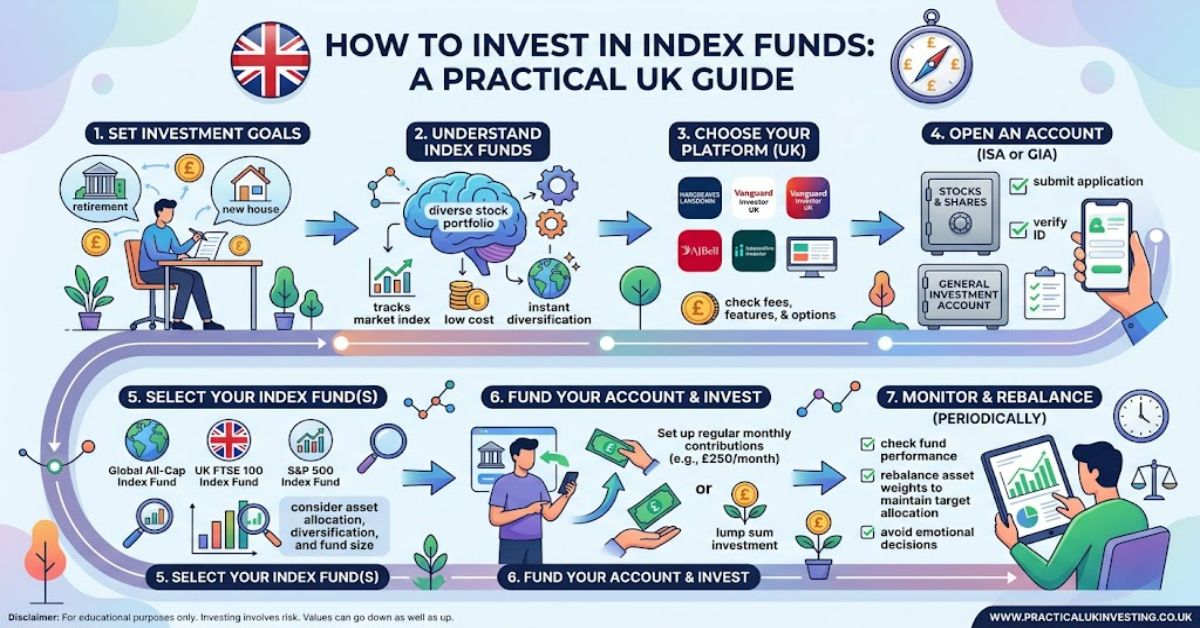
If you want to learn how to invest in index funds, the basic process is relatively simple: open an appropriate investment account, choose a low-cost fund that tracks an index, invest an amount you can afford and review your plan periodically.
The difficult part is not placing the first order. It is deciding what you are actually buying and whether it fits your financial circumstances.
An index fund is a collective investment designed to follow the performance of a particular market index. Rather than relying on a manager to select a small group of shares, a passive fund generally attempts to replicate an index’s holdings or performance. MoneyHelper explains that passive funds track a specific market or index and usually have lower fees than active funds, although lower fees do not guarantee better returns.
For UK investors, the choice also involves account structure. A Stocks and Shares ISA can shelter investment income and capital gains from tax, subject to ISA rules and allowances. For the 2026/27 tax year, the overall ISA subscription limit is £20,000.
Step 1: Decide What You Want the Fund to Track
The first decision is not which provider to use. It is which market you want exposure to.
An index might represent large UK companies, US shares, global companies, emerging markets or another defined investment universe. A fund tracking the FTSE 100, for example, is very different from one tracking the S&P 500 or a global equity index.
This matters because diversification is determined partly by the index itself. Owning an index fund does not automatically mean owning a balanced portfolio.
| Index approach | Typical exposure | Main consideration |
| FTSE 100 | Large UK-listed companies | Concentrated in one market |
| S&P 500 | Large US companies | Strong US exposure and currency risk for UK investors |
| Global equity index | Companies across multiple countries | Wider geographical diversification |
| Emerging markets index | Developing economies | Greater country and market risk |
| Bond index | Government or corporate bonds | Different risk and return characteristics from shares |
A useful distinction is between fund diversification and portfolio diversification. A fund can hold hundreds or thousands of securities while still concentrating heavily in one country, sector or asset class.
For example, Vanguard’s U.S. Equity Index Fund seeks to track the S&P Total Market Index and had exposure to 3,445 stocks at 31 July 2026. That is broad within US equities, but it is not the same as owning a globally diversified portfolio.
Step 2: Choose the Right Investment Account
Once you know what you want to own, consider where you will hold it.
For many UK investors, the main choices include a Stocks and Shares ISA, a pension arrangement or a taxable investment account. Each has different rules, accessibility and tax implications.
A Stocks and Shares ISA allows qualifying investments to grow without UK income tax or capital gains tax being charged within the ISA. The current overall annual allowance is £20,000.
There is also an important upcoming change. From 6 April 2027, the Cash ISA subscription limit for people under 65 is scheduled to become £12,000, while the overall ISA limit remains £20,000. Stocks and Shares ISA limits remain within that overall framework.
The account should therefore be considered alongside the investment itself. The same index fund can have a different practical outcome depending on fees, tax treatment and the account used.
Step 3: Compare Fund Costs
Low cost is one of the attractions of passive investing, but investors should not look only at a headline management fee.
MoneyHelper highlights the importance of the Ongoing Charges Figure, or OCF, which represents the annual operating costs of a fund. Platform charges, dealing costs and other expenses can also affect the total cost.
The FCA’s current cost-disclosure rules distinguish between one-off costs, ongoing costs and transaction costs.
| Cost to check | What it can represent | Why it matters |
| OCF | Ongoing fund expenses | Reduces returns over time |
| Platform fee | Account or service charge | Adds to the investment’s total cost |
| Trading charge | Cost of buying or selling | Matters particularly with frequent purchases |
| Transaction costs | Costs generated by portfolio trading | Can differ between funds |
| Currency costs | Costs associated with foreign-currency exposure | Relevant to overseas investments |
The practical lesson is simple: compare the total cost of ownership, not just the fund’s advertised annual charge.
Step 4: Decide Between Income and Accumulation
Many index funds are available as either income or accumulation versions.
An income fund distributes dividends or interest to investors. An accumulation fund reinvests qualifying income within the fund.
For someone building long-term wealth and not needing regular income, automatic reinvestment can make the process simpler. However, tax treatment depends on the account used, so the distinction should not be considered in isolation.
The fund’s documentation should clearly state which share class you are buying and how distributions are handled.
Step 5: Invest Consistently
After selecting an account and fund, the next question is how much and how often to invest.
A regular monthly contribution can create a simple process. Instead of trying to identify the perfect entry point, an investor contributes according to a predetermined schedule.
For example, an investor might decide to invest £200 on the same date each month. When prices are higher, the contribution buys fewer units. When prices are lower, it buys more.
This does not eliminate investment risk and does not guarantee a profit. It simply reduces the need to make repeated timing decisions.
The larger risk is behavioural. Investors may abandon a long-term strategy after a sharp market decline. An index fund can fall considerably because its underlying assets can fall.
Risks and Trade-Offs
Index investing is not risk-free.
Equity index funds can experience substantial declines. International funds can introduce currency movements, while narrowly focused indices can create concentration risk.
There is also tracking difference: a fund may not perfectly match its benchmark because of fees, trading costs, tax, cash holdings and the way the index is replicated.
Another consideration is that passive investing follows the rules of an index. If an index has a heavy exposure to particular companies or sectors, the fund inherits that exposure rather than independently deciding that it has become too concentrated.
These limitations are important because the simplicity of an index fund can hide complexity underneath it.
The Future of How to Invest in Index Funds in 2027
Passive investment products are likely to remain an important part of retail investing, but product choice may become increasingly sophisticated.
The FCA announced in July 2026 that it was proposing changes to investment-cost disclosures to make charges easier for consumers to understand and compare. The regulator said 30% of non-advised platform users surveyed did not know how much they were charged for investing.
That development matters because comparison is becoming less about headline fund fees and more about the complete cost of investing.
The 2027 ISA reforms will also change the context for UK savers. The overall £20,000 ISA limit remains, while the Cash ISA limit for under-65s is scheduled to fall to £12,000.
Key Insights
- The index determines the portfolio’s basic exposure; the label “index fund” alone says little about diversification.
- A very broad fund can still leave an investor concentrated in one asset class.
- The platform and fund together determine much of the investor’s ongoing cost.
- Accumulation and income share classes suit different cash-flow requirements.
- Regular investing can simplify behaviour but cannot remove market risk.
- Tax wrappers can be as important as fund selection for UK investors.
- Charges should be assessed collectively rather than by focusing only on the OCF.
Conclusion
Learning how to invest in index funds is less about finding a perfect fund and more about constructing a process that is understandable, affordable and appropriate for the investor’s circumstances.
The basic sequence is straightforward: identify the market exposure required, select a suitable account, compare funds and total charges, understand the fund’s distribution policy, then invest according to a consistent plan.
For UK investors, tax wrappers such as Stocks and Shares ISAs can materially affect the practical outcome, while changes scheduled for 2027 make understanding ISA rules particularly relevant.
Index funds also have limitations. They remain exposed to market movements, can be concentrated in particular regions or sectors, and may not perfectly track their benchmarks. A passive strategy therefore reduces some investment decisions but does not remove the need for informed decision-making.
This article is general information, not personalised financial advice. Individual circumstances, objectives, tax position and tolerance for investment losses should be considered before investing.
FAQ
How do I start investing in index funds?
Open an appropriate investment account, choose the market index you want exposure to, compare suitable funds and their total charges, then purchase fund units. A regular contribution schedule can help create a consistent process.
Can beginners invest in index funds?
Yes. Index funds are often used by investors seeking a relatively straightforward way to gain exposure to a market. However, beginners still need to understand volatility, diversification, charges and the possibility of losing money.
Are index funds tax-free in the UK?
Index funds themselves are not automatically tax-free. Investments held within a Stocks and Shares ISA can benefit from the ISA tax rules. Outside an ISA or pension, different tax considerations can apply.
What is the difference between an index fund and an ETF?
An index fund describes an investment strategy that tracks an index. An ETF is a fund structure that trades on an exchange. An ETF can be passive and track an index, but not every ETF follows an index.
Is it better to invest monthly or as a lump sum?
Both approaches have different characteristics. Regular investing spreads purchases over time, while investing a lump sum gives immediate market exposure. The appropriate approach depends on circumstances and risk tolerance.
What should I check before buying an index fund?
Check the index tracked, geographical and sector exposure, OCF, transaction costs, platform charges, fund structure, accumulation or income status, currency exposure and the level of investment risk.
Methodology
This article how to invest in index funds uses current UK regulatory and consumer-finance information from the Financial Conduct Authority, MoneyHelper and GOV.UK, alongside current fund information from Vanguard. Regulatory details were checked against sources available in 2026, including the FCA’s current cost-disclosure framework and HMRC’s 2026 ISA guidance.
No firsthand investment testing or personal portfolio performance has been claimed. Fund examples illustrate how index products differ and should not be interpreted as recommendations. Investment returns, tax outcomes and product availability can change.
Editorial disclosure: This article how to invest in index funds was drafted with AI assistance and should be reviewed and independently verified by the RubbleMagazine.co.uk editorial team before publication.
References
Financial Conduct Authority. (2026). Costs and charges information. FCA Handbook.
Financial Conduct Authority. (2026). Financial regulator to simplify investment disclosure regime. Financial Conduct Authority.
Financial Conduct Authority. (2022). Is it the right investment for you? FCA InvestSmart.
HM Revenue & Customs. (2026). Individual Savings Accounts: Overview. GOV.UK.
HM Revenue & Customs. (2026). Tax-free savings newsletter 23 — September 2026. GOV.UK.
MoneyHelper. (2026). Types of investments. MoneyHelper.
MoneyHelper. (2026). Pension investment options: An overview. MoneyHelper.
Vanguard Asset Management, Ltd. (2026). U.S. Equity Index Fund GBP Acc. Vanguard UK.