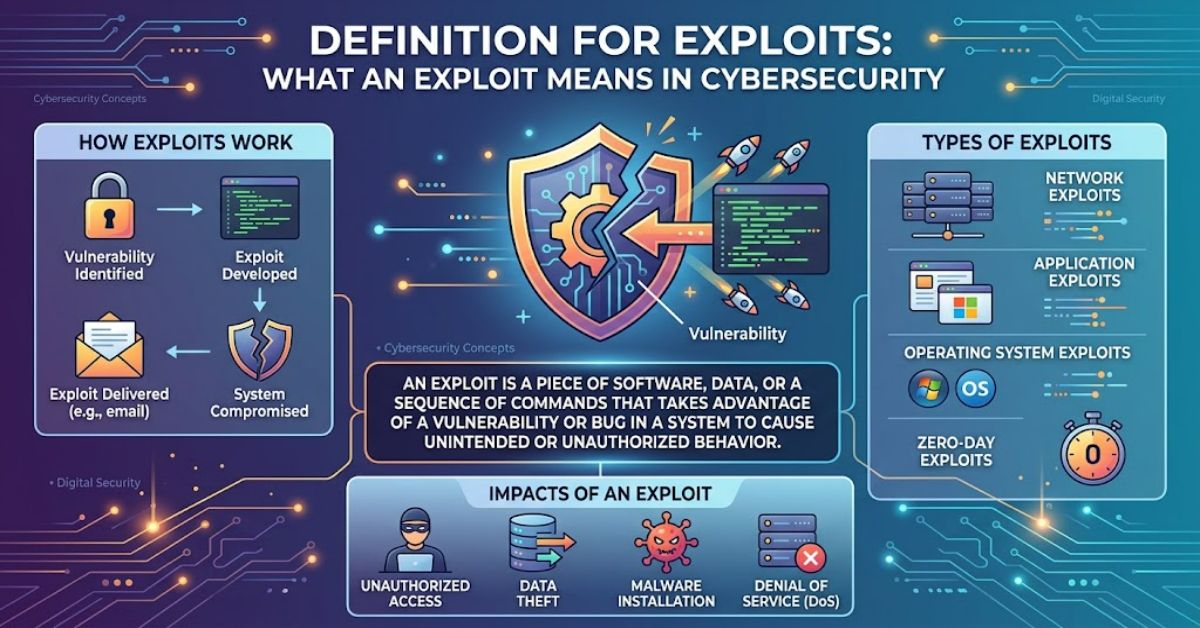
The definition for exploits depends on context. In ordinary English, exploit can mean using a resource or opportunity to gain an advantage. It can also describe treating another person unfairly for personal benefit.
In cybersecurity, however, an exploit has a more specific meaning. It refers to code, software, data or a sequence of actions designed to take advantage of a weakness in software, hardware or a wider computing environment. Cisco describes an exploit as code designed to find and take advantage of a security flaw or vulnerability, while NIST defines a vulnerability as a weakness that can be exploited or triggered by a threat source.
That distinction matters. A vulnerability may exist for months or years without being exploited. An exploit is what turns that weakness into a practical attack pathway.
Exploit vs Vulnerability: What Is the Difference?
The simplest way to understand the relationship is to think of a vulnerability as the weakness and an exploit as the mechanism used against it.
For example, imagine a web application contains a programming error that allows an attacker to perform an action they should not be authorised to perform. The programming error represents the vulnerability. Code or carefully constructed input that takes advantage of that error represents the exploit.
NIST’s security research also separates related concepts such as bugs, weaknesses, vulnerabilities, exploit vectors and security failures. An exploit vector describes the pathway through which exploitation can occur.
| Term | Meaning | Example |
| Bug | Error or defect in software or design | Incorrect input handling |
| Vulnerability | Weakness that could be exploited | Unauthorised access condition |
| Exploit | Method used to abuse the weakness | Specially crafted input or code |
| Attack | Malicious activity using a technique or exploit | Attempt to access protected data |
| Security failure | Harm caused by successful exploitation | Data exposure or service disruption |
This distinction is one of the most useful parts of the definition for exploits because it prevents several cybersecurity terms from being treated as synonyms.
How Do Exploits Work?
An exploit generally depends on a specific condition. The attacker must identify a weakness and determine how it can be triggered.
The process can vary significantly. Some vulnerabilities involve malformed input. Others concern authentication, memory handling, permissions, insecure configurations or exposed services. NIST notes that vulnerabilities can arise from system design, implementation, security procedures and internal controls.
An exploit may produce different outcomes depending on the weakness involved. These can include unauthorised access, privilege escalation, information disclosure, modification of data or disruption of availability.
The exploit itself is also not necessarily malware. Cisco explicitly distinguishes exploits from malware: an exploit can provide the route through which malicious software or another harmful action is delivered.
Known Exploits and Zero-Day Exploits
A known exploit targets a vulnerability that has already been identified. Once a vendor understands the weakness, it may release a security update or mitigation.
A zero-day exploit is associated with a vulnerability for which defenders may have little or no advance warning. This creates a difficult security situation because organisations can be exposed before a conventional patch is available.
The important practical point is that disclosure does not automatically remove risk. Once information about a vulnerability becomes public, attackers may attempt to reproduce the conditions necessary to exploit it.
Why Exploits Matter to Organisations
Modern organisations rarely operate a single application on a single computer. Their technical estates can include cloud services, laptops, mobile devices, websites, databases, APIs, network equipment and third-party software.
That complexity creates a larger attack surface.
The UK’s National Cyber Security Centre states that effective vulnerability management requires organisations to understand which systems and software they operate, identify vulnerabilities, prioritise remediation and regularly verify their processes.
| Security priority | Why it matters |
| Asset visibility | Unknown systems cannot be reliably protected |
| Patching | Removes known software weaknesses |
| Prioritisation | Directs resources towards higher-risk issues |
| Monitoring | Helps identify suspicious exploitation |
| Verification | Confirms that remediation actually worked |
One important insight follows from this: security is partly an inventory problem. An organisation may have excellent patching procedures but still leave serious exposure if it does not know that a vulnerable system exists.
A second insight is that severity alone does not determine practical risk. The NCSC recommends considering factors such as whether a service is internet-facing and what the impact would be if exploitation succeeded.
A third insight is that fixing a vulnerability is not always the end of the process. Organisations may need to investigate whether exploitation already occurred, particularly when attackers are actively targeting the weakness. NCSC guidance recommends checking for evidence of compromise alongside remediation in such circumstances.
Risks and Trade-Offs in Exploit Management
Patching sounds straightforward, but organisations often face operational constraints. An update can affect compatibility, availability or business-critical systems.
This creates a trade-off between reducing security exposure and maintaining reliable services.
The NCSC recommends updating by default while recognising that some systems require controlled deployment and testing. Its current guidance also states that internet-facing services should have particularly short update windows, while actively exploited vulnerabilities require faster action.
This is why mature vulnerability management is not simply a race to install every update immediately. It involves asset identification, risk assessment, testing, deployment, monitoring and verification.
The Future of Definition for Exploits in 2027
By 2027, the practical meaning of exploits is likely to remain tied to the same basic principle: attackers seeking ways to turn weaknesses into real-world consequences.
What is changing is the environment around that process. Cloud infrastructure, APIs, software dependencies and continuously changing digital estates make asset visibility increasingly important.
The NCSC’s guidance, reviewed in May 2026, emphasises continuous review because organisational estates and threats change over time. It also recommends using manual testing alongside automated vulnerability scanning to identify weaknesses that automated tools may miss.
The likely direction is therefore not simply more automated patching. It is greater emphasis on continuous exposure management, faster identification of affected assets and better verification after remediation.
Key Insights
- An exploit is the mechanism used to take advantage of a vulnerability.
- A vulnerability can exist without being actively exploited.
- Exploitation can affect confidentiality, integrity or availability.
- Internet-facing systems generally require particular attention because attackers can reach them remotely.
- Asset visibility is fundamental to effective vulnerability management.
- Patching should be supported by monitoring and verification.
- Active exploitation changes the urgency and response process.
Conclusion
The definition for exploits becomes clearer when it is separated from the broader concept of a vulnerability. A vulnerability is a weakness; an exploit is a method for taking advantage of that weakness. The resulting attack may have consequences ranging from unauthorised access and data exposure to service disruption.
For organisations, the distinction is more than terminology. It shapes how security teams identify weaknesses, prioritise remediation and investigate potential compromise. Current UK guidance emphasises asset visibility, timely updates, risk-based prioritisation and verification rather than relying on a single defensive measure.
Understanding exploits therefore provides a useful foundation for understanding modern cybersecurity. It explains how a technical defect can become a security incident and why reducing exposure requires continuous attention rather than a one-off security exercise.
FAQ
What is an exploit in simple terms?
An exploit is a technique, code sequence or method that takes advantage of a weakness in a computer system, application or device.
What is the difference between an exploit and a vulnerability?
A vulnerability is the weakness. An exploit is the method used to take advantage of that weakness.
Is an exploit always malware?
No. An exploit is not necessarily malware. It can be a method used to trigger a vulnerability and may then enable another malicious action.
What is a zero-day exploit?
A zero-day exploit targets a vulnerability before defenders have had the opportunity to develop and widely deploy an effective fix.
How can organisations reduce exploit risk?
They can maintain accurate asset inventories, apply security updates, prioritise exposed vulnerabilities, monitor systems and verify that remediation has worked.
Can an old vulnerability still be exploited?
Yes. A vulnerability can remain exploitable on systems that have not been updated or properly mitigated, even after a security fix has become available.
Methodology
This article Definition for exploits was researched using authoritative cybersecurity terminology and guidance from NIST, the UK’s National Cyber Security Centre and Cisco. Definitions were compared across primary institutional sources to distinguish vulnerabilities, exploits, attack methods and security failures.
The analysis does not claim firsthand penetration testing or original security measurements. Examples are explanatory rather than reports of testing conducted by the author. The main limitation is that exploit behaviour varies substantially between vulnerabilities, technologies and threat actors, so no single workflow applies to every incident.
Editorial disclosure: This article Definition for exploits was drafted with AI assistance and should be reviewed and independently verified by the RubbleMagazine.co.uk editorial team before publication.
References
Bojanova, I., & Cardoso Galhardo, C. E. (2023). Bug, fault, error, or weakness: Demystifying software security vulnerabilities. IEEE IT Professional, 25(1).
Cisco. (2026). What is an exploit? Cisco Security.
National Cyber Security Centre. (2026). Vulnerability management. UK Government.
National Cyber Security Centre. (2026). Responding to active exploitation of vulnerabilities. UK Government.
National Cyber Security Centre. (2026). Understanding vulnerabilities. UK Government.
National Institute of Standards and Technology. (2025). Vulnerabilities. Computer Security Resource Center.
National Institute of Standards and Technology. (2023). Bug, fault, error, or weakness: Demystifying software security vulnerabilities. U.S. Department of Commerce.