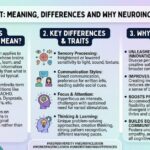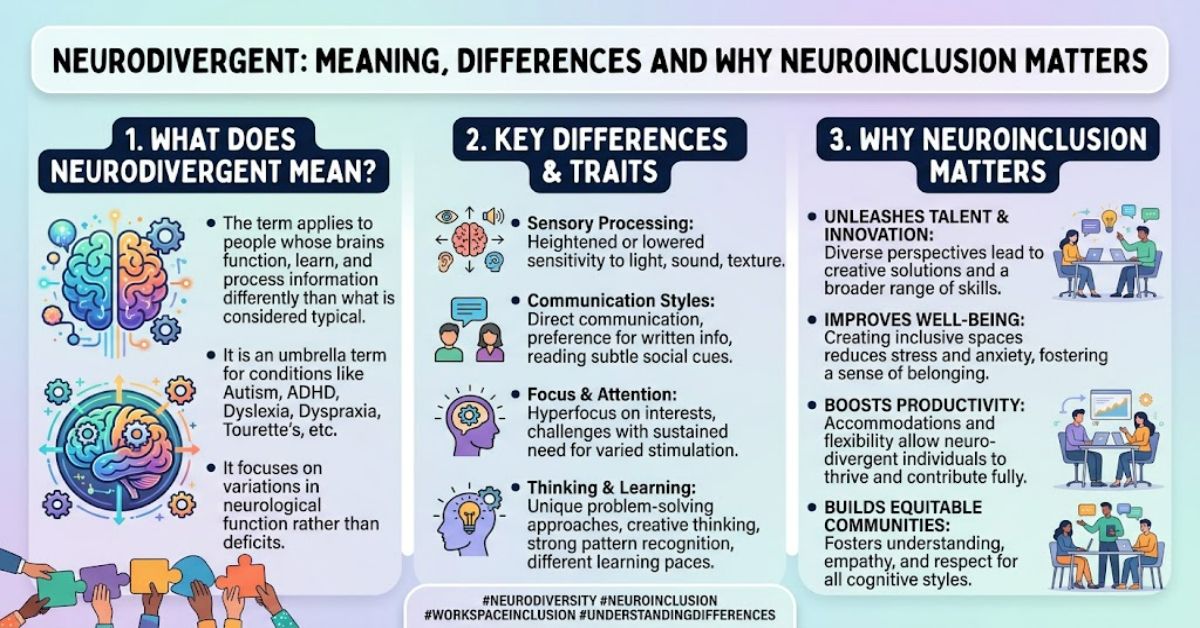
The term neurodivergent describes an individual whose brain processes, learns, communicates or responds to the world differently from what society commonly regards as typical. It is closely related to the broader concept of neurodiversity, which refers to natural variation in human brains and cognitive functioning.
The term is not itself a medical diagnosis. Instead, it is an umbrella description that may be used by people with conditions or neurological differences including autism, ADHD, dyslexia, dyspraxia and Tourette syndrome. The precise boundaries of neurodivergence are debated, so the word should not be treated as a fixed clinical category.
This distinction matters because two people with the same diagnosis can have very different experiences. One person may find certain sensory environments particularly difficult, while another may be more affected by organisation, communication or attention demands.
The NHS describes autism as a difference in how the brain develops and notes that it can affect communication, learning, attention and responses to sensory experiences. It also describes autism as a form of neurodivergence.
Neurodiversity and Neurotypicality
Neurodiversity describes variation across human brains rather than a single accepted model of how people should think or behave. In this framework, neurotypical is commonly used to describe people whose neurological functioning broadly aligns with prevailing expectations.
This does not mean that every neurodivergent person has unusual abilities or that every difficulty is caused by society. Both biological differences and environmental factors can shape someone’s experience.
A useful way to understand the distinction is to separate the person from the environment. A task may be straightforward in one setting but difficult in another because of noise, unclear instructions, rigid schedules, social expectations or excessive sensory stimulation.
| Term | General meaning |
| Neurodiversity | Variation in how human brains function and process information |
| Neurodivergent | A person whose neurological functioning differs from prevailing norms |
| Neurotypical | A person whose neurological functioning broadly aligns with prevailing norms |
| Neuroinclusive | An environment designed to reduce unnecessary barriers for different neurological needs |
These definitions are broad rather than diagnostic. Personal preference and identity also influence which terminology someone uses.
Common Forms of Neurodivergence
Neurodivergence can involve differences in attention, communication, learning, sensory processing, movement or social interaction.
Autism, for example, can influence communication and social understanding as well as responses to sounds, smells, tastes, light and touch. ADHD can involve differences relating to attention, activity and impulse control. Dyslexia is associated with particular difficulties involving reading and written language, while dyspraxia can affect coordination and movement.
These descriptions should not become assumptions about an individual. A diagnosis or identity does not provide a complete picture of someone’s strengths, difficulties or personality.
The National Autistic Society’s employment material similarly describes neurodivergence as differences in thinking, communication or sensory experience and emphasises that neurodiversity encompasses variation across the whole population.
Why Neuroinclusion Matters
The workplace provides a practical example of how environmental design can affect neurodivergent people.
Traditional recruitment and management processes may depend heavily on interviews, unspoken social rules, open-plan environments, multitasking or rapidly changing priorities. Those approaches can create barriers even when the actual job does not require them.
CIPD research published in February 2024 found that 53% of surveyed employees said their organisation had an open and supportive climate for discussing neurodiversity. Its research also found that only 60% of employers surveyed said neuroinclusion was a focus for their organisation.
A particularly important insight is that support can fail through its delivery. In a 2026 CIPD discussion of neurodivergent workers, employees described lengthy forms, repeated explanations and delays in obtaining workplace adjustments. This suggests that an adjustment policy can exist on paper while the process of accessing it still creates a barrier.
| Workplace area | Possible barrier | More flexible approach |
| Recruitment | Unstructured interviews | Clear questions and transparent criteria |
| Communication | Verbal-only instructions | Written instructions alongside meetings |
| Workspace | High sensory stimulation | Quiet or lower-stimulation alternatives |
| Scheduling | Unexpected changes | Advance notice where practical |
| Technology | Inaccessible interfaces | Assistive and configurable tools |
The important point is not that every neurodivergent employee requires these measures. Adjustments should reflect individual needs rather than stereotypes.
Legal and Practical Context in the UK
Neurodivergence can intersect with disability law, but being neurodivergent and being legally disabled are not automatically identical concepts.
Under the Equality Act 2010, disability is defined around a physical or mental impairment that has a substantial and long-term adverse effect on a person’s ability to carry out normal day-to-day activities. GOV.UK guidance updated in November 2025 explains the definition and provides employers with information on recruiting and supporting disabled people and people with long-term health conditions.
For employers, this makes individual assessment important. A blanket policy may look inclusive but still overlook what a particular worker actually needs.
The Future of Neurodivergent Inclusion in 2027
The direction of workplace policy suggests that neuroinclusion is likely to remain part of broader employment and equality discussions in 2027. In January 2025, the UK Department for Work and Pensions announced an independent expert panel focused on improving employment prospects for neurodivergent people.
Technology may also play a role through assistive software, flexible communication tools and configurable working environments. However, technology alone cannot solve structural problems. If an employee must repeatedly justify an adjustment or navigate complicated procedures, the process itself can remain exclusionary.
The more durable approach is likely to combine accessible systems with individual choice, clear communication and meaningful employee involvement.
Key Insights
- Neurodivergent is an umbrella term, not a single medical diagnosis.
- Neurodiversity describes variation across the population rather than one alternative neurological type.
- A diagnosis does not predict an individual’s abilities, preferences or workplace needs.
- Environmental design can either reduce or increase barriers.
- Workplace adjustments work best when they respond to individual circumstances.
- Support systems themselves can create barriers when they are overly complicated.
- UK employment policy increasingly recognises the importance of supporting neurodivergent people.
Frequently Asked Questions
What does neurodivergent mean?
It generally describes someone whose neurological functioning differs from what is considered typical, particularly in areas such as thinking, learning, communication, attention or sensory processing.
Is neurodivergent a medical diagnosis?
No. Neurodivergent is an umbrella term rather than a standalone clinical diagnosis. People may use it to describe experiences associated with conditions such as autism, ADHD or dyslexia.
What conditions are considered neurodivergent?
Usage varies, but autism, ADHD, dyslexia, dyspraxia and Tourette syndrome are commonly discussed within the broader concept of neurodivergence.
Can someone be neurodivergent without a diagnosis?
Some people use the term for themselves without having received a formal diagnosis. Terminology and personal identification vary, so assumptions should be avoided.
What is neuroinclusion?
Neuroinclusion means designing environments, systems and practices that allow people with different neurological characteristics to participate fairly and effectively.
Does neurodivergence mean someone has a disability?
Not automatically. Some neurodivergent people may meet the legal definition of disability under the Equality Act 2010, depending on the effect of their impairment.
Methodology
This article was developed from the supplied RubbleMagazine.co.uk production brief and checked against current UK institutional and professional sources, including the NHS, GOV.UK, CIPD and National Autistic Society materials. The terminology is intentionally presented as an umbrella concept because definitions and boundaries of neurodivergence vary.
The article does not claim firsthand testing, interviews or personal experience. Workplace findings cited above come from published CIPD research rather than original RubbleMagazine.co.uk research. Legal information is a general summary and should not be treated as individual legal advice.
References
Chartered Institute of Personnel and Development. (2024). Neuroinclusion at work report 2024. CIPD.
Chartered Institute of Personnel and Development. (2024). Neuroinclusion at work. CIPD.
Chartered Institute of Personnel and Development. (2026). What neurodivergent workers are telling us – and what managers need to understand. CIPD.
Department for Work and Pensions. (2025). Employing disabled people and people with health conditions. GOV.UK.
Department for Work and Pensions. (2025). Employment prospects for neurodiverse people set to be boosted with launch of new expert panel. GOV.UK.
National Autistic Society. (2026). What is neurodiversity? Employment Toolkit.
NHS. (2026). What is autism? NHS.