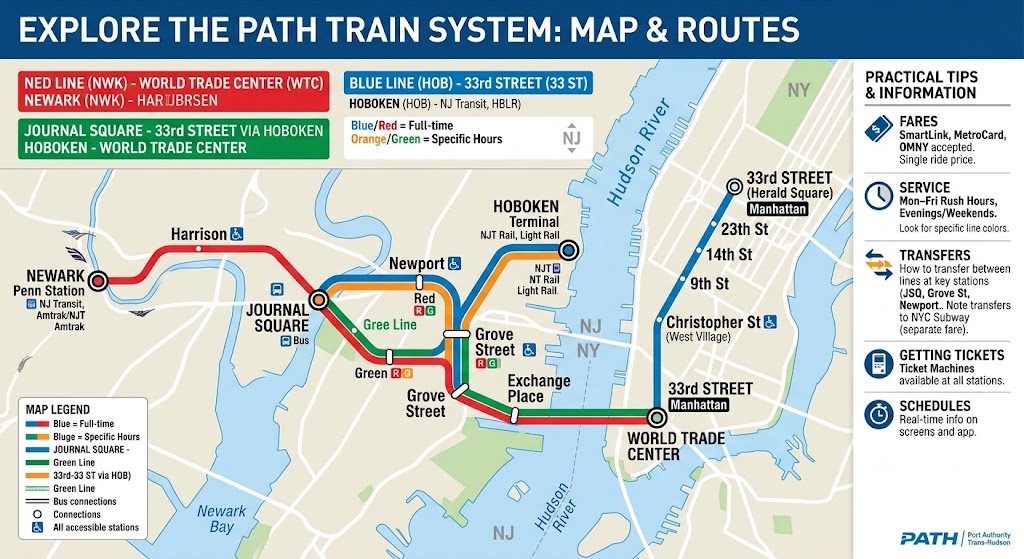
The path train map is a useful reference for anyone travelling between New Jersey and New York City. PATH, short for Port Authority Trans-Hudson, is a rapid-transit railway operated by the Port Authority of New York and New Jersey. It connects communities in northeastern New Jersey with several important Manhattan destinations.
Unlike a large city subway network with dozens of unrelated lines, PATH has a relatively compact structure. Its routes overlap, which means the same tracks and stations can serve different services depending on the time and destination. This makes the map look more complicated than the underlying system really is.
The network is built around several major terminals, including Newark, Hoboken, Journal Square and 33rd Street. World Trade Center is another crucial destination, particularly for passengers travelling into Lower Manhattan. Understanding these locations is the key to reading the system.
For visitors, commuters and occasional passengers, the most important question is usually not simply which station is closest. It is which PATH service reaches the right terminal with the fewest unnecessary changes. The distinction matters because two trains travelling through part of the same corridor can eventually head towards different destinations.
The system has also developed alongside the wider transport network of the New York metropolitan area. Connections with New York City Subway services, New Jersey Transit and other transport modes make PATH more significant than its relatively small geographical footprint suggests.
How the PATH Network Is Structured
The PATH system operates as a cross-river network linking New Jersey and Manhattan. Its tracks pass beneath the Hudson River, creating a direct rail connection between the two states.
A useful way to understand the map is to divide the network into its major terminals and corridors.
| PATH Service | Main Terminals | Key Areas Served |
| Newark–World Trade Center | Newark / World Trade Center | Newark, Harrison, Jersey City, Lower Manhattan |
| Hoboken–World Trade Center | Hoboken / World Trade Center | Hoboken, Jersey City, Lower Manhattan |
| Journal Square–33rd Street | Journal Square / 33rd Street | Jersey City, Lower Manhattan transfer areas, Midtown |
| Hoboken–33rd Street | Hoboken / 33rd Street | Hoboken, Jersey City, Midtown Manhattan |
This structure creates an important distinction between Lower Manhattan and Midtown Manhattan.
World Trade Center is the principal Manhattan destination for services travelling to the southern end of the network. The 33rd Street terminal serves Midtown, making it particularly useful for passengers heading towards the Empire State Building area, Herald Square and nearby commercial districts.
Reading the PATH Train Map
The easiest way to read the map is to identify your starting station, your final destination and the relevant terminal.
For example, a passenger travelling from Hoboken to Midtown Manhattan can use the Hoboken–33rd Street service directly. A passenger travelling from Hoboken to World Trade Center has a different direct service.
Journal Square is particularly important because it acts as a major interchange point. Passengers using services through Jersey City need to pay attention to the displayed destination rather than assuming every train follows the same route.
This is one of the most useful insights when planning a journey: PATH route names are often more important than the physical appearance of the map. Two lines may share several stations, but their terminals determine where the train ultimately goes.
Major Stations and Their Importance
Several stations deserve special attention because of their location or connections.
Newark
Newark is the westernmost major terminal in the PATH network. It provides access to New Jersey’s largest city and offers connections with other regional rail services.
Harrison
Harrison is notable for its proximity to the Red Bull Arena and its role in the growing urban area around the station. It is also one of the key intermediate stations between Newark and Jersey City.
Journal Square
Journal Square is one of the most important transfer locations in Jersey City. It connects multiple PATH service patterns and serves a dense commercial and residential district.
Grove Street
Located in downtown Jersey City, Grove Street is useful for passengers travelling to the city’s business, residential and entertainment areas.
Exchange Place
Exchange Place provides access to Jersey City’s waterfront business district. The station is also valuable for connections with other local transport services.
World Trade Center
World Trade Center is the principal PATH destination in Lower Manhattan. The station’s location places passengers close to the World Trade Center complex, Financial District and several subway connections.
33rd Street
The 33rd Street terminal is located in Midtown Manhattan near Herald Square and major shopping, office and tourist destinations.
Why Route Direction Matters
One of the easiest mistakes for occasional passengers is boarding a train because the station name appears correct without checking the final destination.
PATH services can share stations, so the direction displayed on the train matters. A passenger travelling from Jersey City towards Manhattan should confirm whether the train is bound for World Trade Center or 33rd Street.
| Journey Planning Factor | Why It Matters |
| Starting station | Determines which services are available |
| Destination terminal | Identifies the correct train direction |
| Intermediate station | Helps confirm you are on the expected route |
| Transfer point | May reduce travel time |
| Time of travel | Service patterns can vary |
| Connecting transport | Subway and regional rail connections affect the best route |
This is a practical difference between PATH and many simpler point-to-point railway systems. The network rewards passengers who check the destination displayed on the platform.
PATH and the Wider New York Transport Network
The value of PATH is partly explained by its connections. A PATH journey rarely exists in isolation. Many passengers use it as the first or final part of a larger trip involving the New York City Subway, New Jersey Transit, buses, ferries or walking.
The World Trade Center area, for example, is connected to a substantial network of subway services. Likewise, 33rd Street places passengers close to several Midtown subway stations.
For commuters, this creates a network effect. The usefulness of a PATH station depends not only on where the station itself is located, but also on what passengers can reach after leaving the platform.
That makes interchange design an important part of the system’s practical value.
Three Insights Travellers Often Miss
The shortest-looking route is not always the simplest. A route involving one additional transfer can sometimes provide a more convenient final destination, particularly when the passenger’s actual destination is several blocks from a terminal.
Shared stations can hide different service patterns. Seeing a station on the map does not necessarily mean every PATH train serves it in the same direction or at every period.
The terminal is a planning tool. Thinking in terms of World Trade Center, 33rd Street, Hoboken, Newark and Journal Square makes the network much easier to understand than memorising every segment.
The Future of Path Train Map in 2027
The PATH network’s future will be shaped by demand, infrastructure investment and the wider development of the New York–New Jersey metropolitan region. Population growth and major redevelopment projects around stations can increase pressure on existing services.
A major consideration is capacity. Cross-Hudson transport is strategically important because the Hudson River creates a significant physical barrier between New Jersey and Manhattan. Expanding rail capacity is therefore a long-term infrastructure issue rather than simply a question of adding more trains.
By 2027, passengers should also expect journey planning to become increasingly digital. Real-time service information, mobile ticketing and integrated travel-planning tools can make a relatively complex network easier to navigate. However, digital information does not remove the value of understanding the physical network. During disruptions, passengers still benefit from knowing alternative terminals and connections.
Key Takeaways
- PATH is a cross-Hudson railway linking New Jersey with Manhattan.
- The four principal service patterns revolve around Newark, Hoboken, Journal Square, World Trade Center and 33rd Street.
- World Trade Center and 33rd Street serve different parts of Manhattan.
- Journal Square is an important Jersey City interchange.
- Checking the train’s destination is essential because routes share sections of track.
- Subway and regional transport connections expand PATH’s practical reach.
- The map is easiest to understand as a network of terminals and corridors rather than isolated lines.
Conclusion
The path train map becomes much easier to understand once its basic structure is clear. Rather than treating every route as an entirely separate line, passengers should focus on the network’s major terminals, shared corridors and transfer points.
Newark and Hoboken anchor the New Jersey side, while World Trade Center and 33rd Street serve two distinct parts of Manhattan. Journal Square and other Jersey City stations provide important links within the network. This structure explains why checking the destination shown on an approaching train is often more useful than simply looking for a familiar station name.
PATH also demonstrates how urban transport systems gain value through connections. Its stations link with subway, regional rail, bus and pedestrian networks, allowing a comparatively compact railway to support journeys across a much larger metropolitan area.
For visitors, the most practical approach is simple: identify the destination terminal first, confirm the service direction, and then check any onward connection. Once those habits become familiar, the network is considerably less intimidating.
Frequently Asked Questions
What is the PATH train map?
It is a visual representation of the Port Authority Trans-Hudson railway network connecting northeastern New Jersey with Manhattan.
How many main PATH services are there?
The network is generally described through four principal service patterns connecting Newark, Hoboken, Journal Square, World Trade Center and 33rd Street.
Does PATH go to Manhattan?
Yes. PATH provides direct rail services into Lower Manhattan at World Trade Center and Midtown Manhattan at 33rd Street.
What is the difference between World Trade Center and 33rd Street PATH trains?
They serve different Manhattan terminals. World Trade Center is in Lower Manhattan, while 33rd Street is in Midtown.
Is Journal Square a PATH transfer station?
Yes. Journal Square is an important station within the PATH network and is served by multiple service patterns.
Can PATH connect with the New York Subway?
Yes. Several PATH stations are located near or connected to New York City Subway services, making transfers possible as part of wider journeys.
Methodology
This article is based on established information about the PATH railway network, its principal service patterns, stations and role within the wider New York metropolitan transport system. Route descriptions should be checked against current Port Authority schedules before publication because service patterns, station operations and timetables can change.
No firsthand journey, station inspection or independent travel-time test was conducted for this article. Accordingly, no personal travel observations or invented performance measurements are presented. The principal limitation is that a static explanation cannot capture real-time disruptions or temporary service changes.
Editorial disclosure: This article was drafted with AI assistance and should be reviewed by a human editor before publication. Named claims, route details and current operating information should be independently confirmed against official transport information.
References
Port Authority of New York and New Jersey. (2025). PATH schedules and maps. Port Authority of New York and New Jersey.
Port Authority of New York and New Jersey. (2024). PATH system information. Port Authority of New York and New Jersey.
Metropolitan Transportation Authority. (2025). New York City subway system information. Metropolitan Transportation Authority.
New Jersey Transit. (2025). Rail and connecting transportation information. New Jersey Transit.