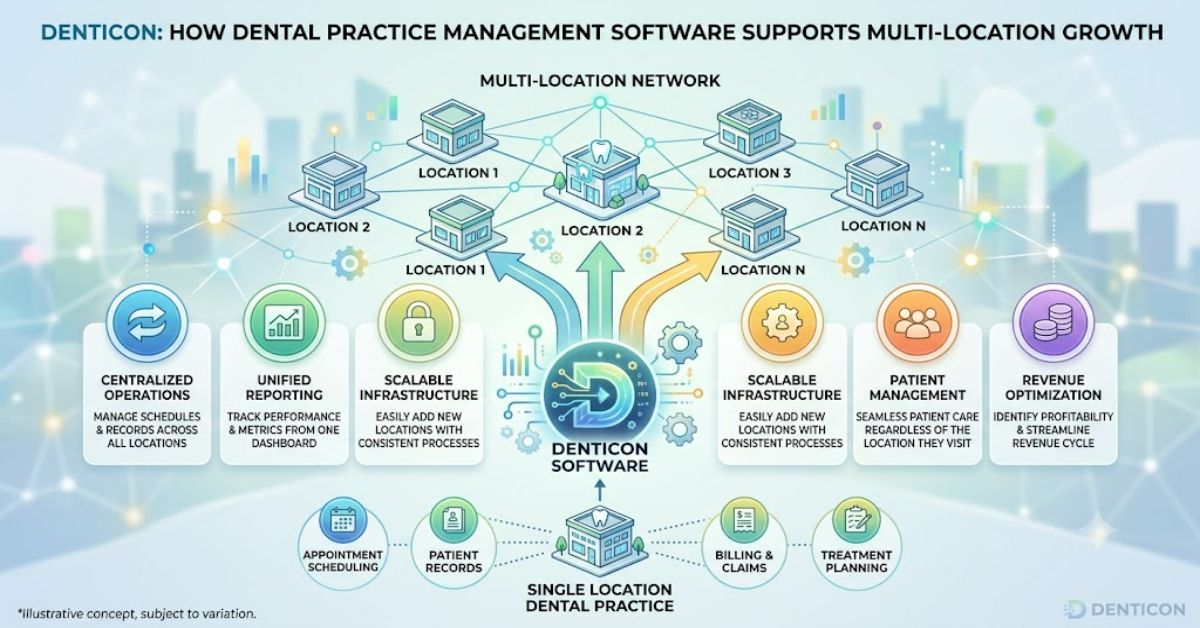
Denticon is a dental practice management software platform developed by Planet DDS to help dental organisations manage clinical operations, administrative workflows, and multi-location networks. Unlike systems originally designed for single dental offices, Denticon was built with group practices in mind, where consistency, reporting, and data accessibility become more complex.
Dental organisations operating across multiple locations face challenges that go beyond appointment scheduling. They must coordinate patient records, billing processes, staff performance, compliance requirements, financial reporting, and clinical workflows across different sites.
Modern dental software addresses these challenges by creating a connected operational environment. A centralised platform allows authorised teams to access information securely while reducing dependence on disconnected systems.
The demand for advanced dental technology has increased as practices expand and patients expect smoother digital experiences. According to industry trends, healthcare providers are increasingly adopting cloud-based systems to improve efficiency, accessibility, and data management.
This article examines how Denticon works, its role in multi-location dentistry, practical advantages, potential limitations, and the future direction of dental practice technology.
Understanding Denticon and Its Role in Dental Management
Traditional dental practices often relied on local software installations that stored information within individual offices. While effective for smaller practices, these systems can create challenges when organisations expand.
A multi-location dental group requires:
- Centralised patient information
- Consistent administrative procedures
- Practice-level reporting
- Financial visibility
- Secure access controls
Denticon addresses these requirements through a cloud-based architecture that allows dental groups to manage operations from a connected platform.
The main value of this approach is standardisation. Instead of every location operating independently, leadership teams can analyse performance and maintain consistent processes across the organisation.
Key Features of Dental Practice Management Platforms
A dental management system typically combines several operational functions.
| Feature | Purpose |
| Patient management | Stores clinical and administrative records |
| Scheduling | Manages appointments and provider availability |
| Billing integration | Supports financial workflows |
| Reporting dashboards | Provides operational insights |
| User permissions | Controls access to sensitive information |
For growing dental organisations, these features reduce administrative complexity.
A practice manager overseeing several clinics, for example, needs visibility into appointment utilisation, revenue performance, and staffing requirements. Without centralised reporting, identifying operational issues becomes more difficult.
Why Multi-Location Dental Groups Need Specialised Software
Single-location practices and dental groups have different technology requirements.
A small clinic may only need basic scheduling and record management. A larger organisation needs systems that support scalability.
| Requirement | Single Practice | Multi-Location Group |
| Patient records | Local management | Organisation-wide access |
| Reporting | Basic performance tracking | Advanced analytics |
| Administration | Small team workflows | Centralised operations |
| Growth planning | Limited complexity | Strategic oversight |
This difference explains why software designed specifically for larger dental networks has become increasingly important.
Operational Benefits of Denticon for Dental Organisations
One of the strongest advantages of Denticon is improving visibility across multiple locations.
Centralised Data Management
Dental groups often struggle when information is spread across separate systems. A unified database can help leadership teams access consistent information.
This supports:
- Better decision-making
- Easier reporting
- Improved coordination between locations
- Reduced administrative duplication
Workflow Standardisation
Different clinics may develop different procedures over time. A shared software environment helps organisations establish consistent workflows.
This can improve:
- Staff training
- Patient experience
- Compliance processes
- Operational measurement
Business Intelligence and Reporting
Data analytics has become increasingly important in healthcare management.
Dental organisations can use reporting tools to examine:
- Appointment trends
- Revenue patterns
- Production metrics
- Provider performance
These insights help leadership identify opportunities for improvement.
Risks and Considerations When Choosing Dental Software
Although advanced software provides advantages, organisations must evaluate several factors before implementation.
Migration Complexity
Moving from an existing system can involve transferring patient records, financial information, and historical data.
Poor planning can create:
- Workflow disruption
- Staff confusion
- Temporary productivity decreases
Training Requirements
Technology adoption depends heavily on user acceptance. Dental teams need appropriate training to use new systems effectively.
A feature-rich platform delivers limited value if employees do not understand how to integrate it into daily workflows.
Data Security Responsibilities
Dental software handles sensitive patient information. Organisations must consider cybersecurity, access controls, and regulatory requirements.
Healthcare data protection remains a major priority because breaches can affect both patient trust and organisational reputation.
Denticon Compared With Traditional Practice Software
| Category | Traditional Dental Software | Cloud-Based Group Solutions |
| Data storage | Often local | Cloud infrastructure |
| Access | Location dependent | Secure remote access |
| Expansion | More complex | Designed for scalability |
| Reporting | Limited visibility | Organisation-wide insights |
| Updates | Manual processes | Provider-managed updates |
The shift towards cloud systems reflects broader healthcare technology trends.
The Impact of Dental Technology on Patient Experience
Software choices influence more than internal administration. They also affect how patients interact with dental organisations.
Improved systems can support:
- Faster appointment management
- More accurate records
- Better communication
- More coordinated care
Patients increasingly expect healthcare providers to offer convenient digital experiences similar to other industries.
Dental groups that invest in connected technology may be better positioned to meet these expectations.
The Future of Denticon and Dental Software in 2027
By 2027, dental practice management systems are expected to become more data-driven and automated.
Artificial intelligence, predictive analytics, and improved integration between healthcare platforms will likely influence how dental organisations operate.
Future developments may include:
- Smarter appointment optimisation
- Automated administrative workflows
- Enhanced patient communication tools
- More advanced business intelligence
However, technology adoption will continue to depend on practical factors such as cost, staff training, cybersecurity, and integration with existing systems.
The most successful dental organisations will likely be those that combine technology investment with effective operational planning.
Key Insights
- Multi-location dental groups require different technology solutions from independent practices.
- Centralised data improves operational visibility and strategic planning.
- Software implementation requires attention to training and workflow management.
- Cloud systems are becoming increasingly important in healthcare operations.
- Patient expectations are influencing how dental organisations approach technology.
- Future dental platforms will likely combine automation with human-led care.
Methodology
This article was prepared using publicly available information about dental practice management technology, healthcare software trends, and general principles of digital transformation.
Product-specific claims were based on the supplied description of Denticon by Planet DDS and broader industry knowledge. Because internal customer performance data and proprietary system testing were not publicly available, the article focuses on operational capabilities and industry-level analysis rather than unverified performance claims.
Frequently Asked Questions
What is Denticon used for?
Denticon is dental practice management software designed to help dental organisations manage clinical, administrative, and operational workflows.
Who typically uses Denticon?
The platform is mainly designed for dental groups and organisations managing multiple locations that require centralised systems.
Is Denticon suitable for small dental practices?
It may be suitable for practices with growth plans, although smaller clinics should evaluate whether enterprise-level features match their needs.
How does dental software improve practice management?
It can improve scheduling, reporting, record management, communication, and operational visibility.
Why do multi-location dental groups need specialised software?
Multiple locations create additional complexity around data access, reporting, compliance, and workflow consistency.
What is the future of dental practice management software?
Future systems are expected to use more automation, analytics, and connected digital healthcare tools.
References
Planet DDS. (2025). Dental practice management technology solutions and software resources. Planet DDS.
American Dental Association. (2024). Digital dentistry and technology adoption in dental practices. ADA.
HealthIT.gov. (2024). Health information technology and healthcare interoperability resources. Office of the National Coordinator for Health Information Technology.